

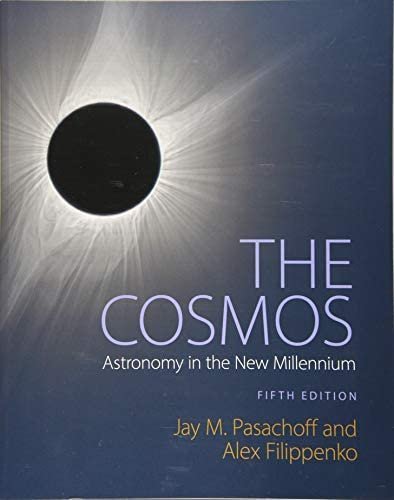
The Cosmos: Astronomy in the New Millennium 5th Edition by Jay M. Pasachoff, ISBN-13: 978-1108431385
Original price was: $50.00.$19.99Current price is: $19.99.
Safe & secure checkout
Description
Description
The Cosmos: Astronomy in the New Millennium 5th Edition by Jay M. Pasachoff, ISBN-13: 978-1108431385
[PDF eBook eTextbook]
- Publisher: Cambridge University Press; 5th edition (July 11, 2019)
- Language: English
- 732 pages
- ISBN-10: 1108431380
- ISBN-13: 978-1108431385
Explains the fundamentals of astronomy together with the hottest current topics in this field, such as exoplanets and gravitational waves.
The fifth edition of The Cosmos: Astronomy in the New Millennium provides you with the fundamentals of astronomical knowledge that have been built up over decades, with an expanded discussion of the incredible advances that are now taking place in this fast-paced field, such as New Horizons’ flyby of Pluto, exoplanets, ‘dark matter’, and the direct detection of gravitational waves by the Laser Interferometer Gravitational-Wave Observatory (LIGO). Written in a clear and easily understandable style, this textbook has been thoroughly revised to include updated data and figures, new images from recent space missions and telescopes, the latest discoveries on supernovae, and new observations of the region around the four-million-solar-mass black hole at the center of our Milky Way Galaxy. A rich array of teaching and learning resources is available at http://thecosmos5.com. The website is regularly updated to include the latest discoveries and photographs in the field.
Table of Contents:
Preface
1. A Grand Tour of the Heavens
2. Light, Matter, and Energy: Powering the Universe
3. Light and Telescopes: Extending Our Senses
4. Observing the Stars and Planets: Clockwork of the
Universe
5. Gravitation and Motion: The Early History of Astronomy
6. The Terrestrial Planets: Earth, Moon, and Their Relatives
7. The Jovian Planets: Windswept Giants
8. Pluto, Comets, Asteroids, and Beyond
9. Our Solar System and Others
10. Our Star: The Sun
11. Stars: Distant Suns
12. How the Stars Shine: Cosmic Furnaces
13. The Death of Stars: Recycling
14. Black Holes: The End of Space and Time
15. The Milky Way: Our Home in the Universe
16. A Universe of Galaxies
17. Quasars and Active Galaxies
18. Cosmology: The Birth and Life of the Cosmos
19. In the Beginning
20. Life in the Universe
Epilogue
Appendix 1/2. Measurement Systems/Basic Constants
Appendix 3. Planets and Dwarf Planets
Appendix 4. The Brightest Stars
Appendix 5. The Nearest Stars
Appendix 6. The Messier Catalogue
Appendix 7. The Constellations
Appendix 8. Star Names
Selected reading
Glossary
Index
Jay M. Pasachoff, Field Memorial Professor of Astronomy at Williams College, teaches the astronomy survey course. He is also Director of the Hopkins Observatory there. He received his undergraduate and graduate degrees from Harvard and was then at Caltech, where he has also had recent sabbatical leaves. He has observed 69 solar eclipses. He also studies occultations of stars by Pluto and other objects in the outer Solar System. Pasachoff is Chair of the Working Group on Eclipses of the International Astronomical Union and was Chair of the American Astronomical Society’s Historical Astronomy Division. He is also co-editor of Teaching and Learning Astronomy (Cambridge, 2005) and Innovation in Astronomy Education (Cambridge, 2008). He received the American Astronomical Society’s Education Prize (2003); the Janssen Prize from the Société Astronomique de France (2012), and the Richtmyer Memorial Lecture Award, American Association of Physics Teachers (2017). In 2019, he was awarded the Klumpke-Roberts Award for his outstanding contribution to the public understanding and appreciation of astronomy. Asteroid (5100) Pasachoff is named after him.
Alex Filippenko is a Professor of Astronomy, and the Richard and Rhoda Goldman Distinguished Professor in the Physical Sciences, at the University of California, Berkeley. He received his undergraduate degree from the University of California, Santa Barbara (1979) and his doctorate from the California Institute of Technology (1984). His primary areas of research are exploding stars, gamma-ray bursts, active galaxies, black holes, and observational cosmology. Filippenko was the only person to have been a member of both teams that revealed the Nobel-worthy accelerating expansion of the Universe. He is one of the world’s most highly cited astronomers and was elected to the National Academy of Sciences (2009). Filippenko has won many prestigious teaching awards, including the Carnegie/CASE National Professor of the Year among doctoral institutions (2006). He has appeared frequently on science newscasts and television documentaries, especially The Universe series. He received the Carl Sagan Prize for Science Popularization (2004).
What makes us different?
• Instant Download
• Always Competitive Pricing
• 100% Privacy
• FREE Sample Available
• 24-7 LIVE Customer Support


Reviews
There are no reviews yet.