

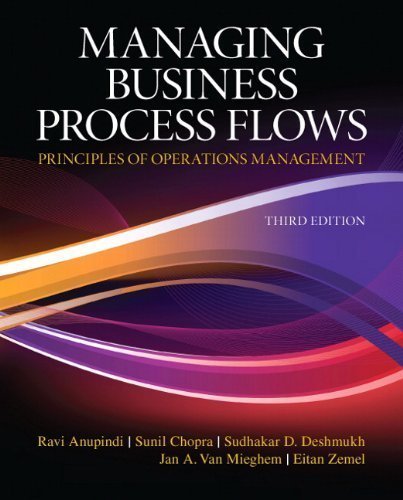
Managing Business Process Flows 3rd Edition by Ravi Anupindi, ISBN-13: 978-0136036371
Original price was: $50.00.$14.99Current price is: $14.99.
Safe & secure checkout
Description
Description
Managing Business Process Flows 3rd Edition by Ravi Anupindi, ISBN-13: 978-0136036371
[PDF eBook eTextbook]
- Publisher: Pearson; 3rd edition (July 21, 2011)
- Language: English
- 352 pages
- ISBN-10: 0136036376
- ISBN-13: 978-0136036371
A structured, data-driven approach to understanding core operations management concepts.
Anupindi shows how managers can design and manage process structure and process drivers to improve the performance of any business process.
The third edition retains the general process view paradigm while providing a sharper, more streamlined presentation of the development of ideas in each chapter–all of which are illustrated with contemporary examples from practice.
Table of Contents:
Preface xv
PART I Process Management and Strategy 1
Chapter 1 Products, Processes, and Performance 2
Introduction 2
1.1 The Process View of Organizations 3
1.2 Performance Measures 7
1.2.1 The Importance of Measurement: Management by Fact 7
1.2.2 Types of Measures: Financial, External, and Internal 7
1.3 Products and Product Attributes 10
1.4 Processes and Process Competencies 13
1.5 Enabling Process Success 14
1.6 Some Basic Process Architectures 15
1.7 The Plan of the Book 17
Summary 18
Key Terms 18
Discussion Questions 18
Selected Bibliography 19
Chapter 2 Operations Strategy and Management 20
Introduction 20
2.1 Strategic Positioning and Operational Effectiveness 21
2.2 The Strategy Hierarchy 23
2.3 Strategic Fit 25
2.4 Focused Operations 27
2.5 Matching Products and Processes 30
2.6 The Operations Frontier and Trade-Offs 31
2.7 The Evolution of Strategy and Operations Management 37
2.8 The Opportunity Today in Service Operations 40
Summary 41
Key Terms 42
Discussion Questions 42
Selected Bibliography 43
PART II Process Flow Metrics 45
Chapter 3 Process Flow Measures 46
Introduction 46
3.1 The Essence of Process Flow 47
3.2 Three Key Process Measures 48
3.3 Flow Time, Flow Rate, and Inventory Dynamics 50
3.4 Throughput in a Stable Process 55
3.5 Little’s Law: Relating Average Flow Time, Throughput, and
Average Inventory 55
3.5.1 Material Flow 57
3.5.2 Customer Flow 57
3.5.3 Job Flow 58
3.5.4 Cash Flow 58
3.5.5 Cash Flow (Accounts Receivable) 58
3.5.6 Service Flow (Financing Applications at Auto-Moto) 59
3.6 Analyzing Financial Flows through Financial Statements 63
3.6.1 Assessing Financial Flow Performance 63
3.6.2 Cash-to-Cash Cycle Performance 67
3.6.3 Targeting Improvement with Detailed Financial
Flow Analysis 67
3.7 Two Related Process Measures: Takt Time and Inventory Turns
(Turnover Ratio) 70
3.7.1 Takt Time 70
3.7.2 Inventory Turns 70
3.8 Linking Operational to Financial Metrics: Valuing
an Improvement 71
3.8.1 Linking Operational Improvements to NPV 71
3.8.2 Linking Operational Improvements to Financial Ratios 73
Summary 75
Key Equations and Symbols 75
Key Terms 76
Discussion Questions 76
Exercises 76
Selected Bibliography 79
Chapter 4 Flow-Time Analysis 80
Introduction 80
4.1 Flow-Time Measurement 81
4.2 The Process Flowchart 83
4.3 Flow Time and Critical Paths 84
4.4 Theoretical Flow Time and the Role of Waiting 86
4.4.1 Flow-Time Efficiency 87
4.5 Levers for Managing Theoretical Flow Time 90
4.5.1 Moving Work Off the Critical Path 91
4.5.2 Reduce Non-Value-Adding Activities 91
4.5.3 Reduce the Amount of Rework 92
4.5.4 Modifying the Product Mix 92
4.4.5 Increase the Speed of Operations 92
4.4.6 Zhang & Associates Revisited 93
Summary 94
Key Equations and Symbols 95
Key Terms 95
Discussion Questions 95
Exercises 96
Selected Bibliography 97
Appendix 4.1 Subprocesses and Cascading 98
Appendix 4.2 The Critical Path Method 99
Appendix 4.3 Rework and Visits 101
Chapter 5 Flow Rate and Capacity Analysis 102
Introduction 102
5.1 Flow Rate Measurements 103
5.2 Resources and Effective Capacity 103
5.2.1 Resources and Resource Pools 103
5.2.2 Effective Capacity 104
5.2.3 Capacity Utilization 105
5.2.4 Extensions: Other Factors Affecting Effective Capacity 106
5.3 Effect of Product Mix on Effective Capacity and Profitability
of a Process 106
5.3.1 Effective Capacity for Product Mix 107
5.3.2 Optimizing Profitability 108
5.4 Capacity Waste and Theoretical Capacity 109
5.4.1 Theoretical Capacity 109
5.4.2 Theoretical Capacity Utilization 110
5.5 Levers for Managing Throughput 110
5.5.1 Throughput Improvement Mapping 111
5.5.2 Increasing Resource Levels 112
5.5.3 Reducing Resource Capacity Waste 112
5.5.4 Shifting Bottlenecks and the Improvement Spiral 113
Summary 114
Key Equations and Symbols 114
Key Terms 114
Discussion Questions 115
Exercises 115
Selected Bibliography 116
Appendix 5.1 Other Factors Affecting Effective Capacity: Load
Batches, Scheduled Availability, and Setups 117
Appendix 5.2 Optimizing Product Mix with Linear
Programming 119
Chapter 6 Inventory Analysis 121
Introduction 121
6.1 Inventory Classification 122
6.2 Inventory Benefits 125
6.2.1 Economies of Scale 125
6.2.2 Production and Capacity Smoothing 126
6.2.3 Stockout Protection 126
6.2.4 Price Speculation 127
6.3 Inventory Costs 128
6.4 Inventory Dynamics of Batch Purchasing 129
6.5 Economies of Scale and Optimal Cycle Inventory 131
6.6 Effect of Lead Times on Ordering Decisions 138
6.7 Periodic Ordering 140
6.8 Levers for Managing Inventories 142
Summary 143
Key Equations and Symbols 144
Key Terms 144
Discussion Questions 144
Exercises 145
Selected Bibliography 146
Appendix 6.1 Derivation of EOQ Formula 147
Appendix 6.2 Price Discounts 148
PART III Process Flow Variability 151
Chapter 7 Managing Flow Variability: Safety Inventory 152
Introduction 152
7.1 Demand Forecasts and Forecast Errors 154
7.2 Safety Inventory and Service Level 155
7.2.1 Service Level Measures 156
7.2.2 Continuous Review, Reorder Point System 157
7.2.3 Service Level Given Safety Inventory 159
7.2.4 Safety Inventory Given Service Level 161
7.3 Optimal Service Level: The Newsvendor Problem 163
7.4 Leadtime Demand Variability 170
7.4.1 Fixed Replenishment Lead Time 170
7.4.2 Variability in Replenishment Lead Time 172
7.5 Pooling Efficiency through Aggregation 173
7.5.1 Physical Centralization 174
7.5.2 Principle of Aggregation and Pooling Inventory 177
7.6 Shortening the Forecast Horizon through
Postponement 179
7.7 Periodic Review Policy 180
7.8 Levers for Reducing Safety Inventory 182
Summary 183
Key Equations and Symbols 183
Key Terms 184
Discussion Questions 184
Exercises 184
Selected Bibliography 186
Appendix Calculating Service Level for a Given Safety
Inventory 187
Chapter 8 Managing Flow Variability: Safety Capacity 188
Introduction 188
8.1 Service Process and Its Performance 190
8.1.1 Service Processes 190
8.1.2 Service Process Attributes 192
8.1.3 Service Process Performance 192
8.1.4 Relationships between Performance Measures 196
8.2 Effect of Variability on Process Performance 197
8.3 Drivers of Process Performance 200
8.3.1 The Queue Length Formula 200
8.3.2 The Exponential Model 202
8.4 Process Capacity Decisions 205
8.5 Buffer Capacity, Blocking, and Abandonment 206
8.5.1 Effect of Buffer Capacity on Process Performance 207
8.5.2 The Buffer Capacity Decision 208
8.5.3 Joint Processing Capacity and Buffer Capacity
Decisions 210
8.6 Performance Variability and Promise 211
8.7 Customer Pooling and Segregation 213
8.7.1 Pooling Arrivals with Flexible Resources 213
8.7.2 Segregating Arrivals with Specialized Resources 215
8.8 Performance Improvement Levers 216
8.8.1 Capacity Utilization Levers 217
8.8.2 Variability Reduction Levers 218
8.8.3 Capacity Synchronization Levers 219
8.8.4 Buffer Capacity Levers 220
8.8.5 Pooling and Segregation Levers 220
8.9 Managing Customer Perceptions and
Expectations 221
Summary 222
Key Equations and Symbols 223
Key Terms 223
Discussion Questions 224
Exercises 224
Selected Bibliography 227
Appendix The Exponential Model with Finite Buffer
Capacity 228
Chapter 9 Managing Flow Variability: Process Control and Capability 229
Introduction 229
9.1 Performance Variability 231
9.2 Analysis of Variability 233
9.2.1 Check Sheets 233
9.2.2 Pareto Charts 234
9.2.3 Histograms 235
9.2.4 Run Charts 237
9.2.5 Multi-Vari Charts 238
9.3 Process Control 240
9.3.1 The Feedback Control Principle 240
9.3.2 Types and Causes of Variability 241
9.3.3 Control Limit Policy 243
9.3.4 Control Charts 244
9.3.5 Cause–Effect Diagrams 252
9.3.6 Scatter Plots 253
9.4 Process Capability 254
9.4.1 Fraction of Output within Specifications 255
9.4.2 Process Capability Ratios (Cpk and Cp) 256
9.4.3 Six-Sigma Quality 257
9.4.4 Capability and Control 260
9.5 Process Capability Improvement 260
9.5.1 Mean Shift 260
9.5.2 Variability Reduction 261
9.5.3 Effect of Process Improvement on Process Control 262
9.6 Product and Process Design 263
9.6.1 Design for Producibility 263
9.6.2 Robust Design 265
9.6.3 Integrated Design 265
Summary 226
Key Equations and Symbols 267
Key Terms 267
Discussion Questions 268
Exercises 268
Selected Bibliography 270
PART IV Process Integration 271
Chapter 10 Lean Operations: Process Synchronization and Improvement 272
Introduction 272
10.1 Processing Networks 273
10.2 The Process Ideal: Synchronization and Efficiency 274
10.3 Waste and Its Sources 275
10.4 Improving Flows in a Plant: Basic Principles of Lean
Operations 278
10.4.1 Improving Process Architecture: Cellular Layouts 280
10.4.2 Improving Information and Material Flow:
Demand Pull 281
10.4.3 Improving Process Flexibility: Batch-Size Reduction 284
10.4.4 Quality at Source: Defect Prevention and Early Detection 285
10.4.5 Reducing Processing Variability: Standardization of Work,
Maintenance, and Safety Capacity 286
10.4.6 Visibility of Performance 287
10.4.7 Managing Human Resources: Employee Involvement 287
10.4.8 Supplier Management: Partnerships 288
10.5 Improving Flows in a Supply Chain 289
10.5.1 Lack of Synchronization: The Bullwhip Effect 290
10.5.2 Causes of the Bullwhip Effect 291
10.5.3 Levers to Counteract the Bullwhip Effect 293
10.6 The Improvement Process 295
10.6.1 Process Stabilization: Standardizing and Controlling
the Process 295
10.6.2 Continuous Improvement: Management by Sight
and Stress 296
10.6.3 Business Process Reengineering: Process Innovation 297
10.6.4 Benchmarking: Heeding the Voices of the Best 298
10.6.5 Managing Change 298
Summary 299
Key Terms 300
Discussion Questions 300
Selected Bibliography 300
Appendix I MBPF Checklist 303
Appendix II Probability Background 306
Solutions to Selected Problems 311
Glossary 317
Index 324
What makes us different?
• Instant Download
• Always Competitive Pricing
• 100% Privacy
• FREE Sample Available
• 24-7 LIVE Customer Support


Reviews
There are no reviews yet.