

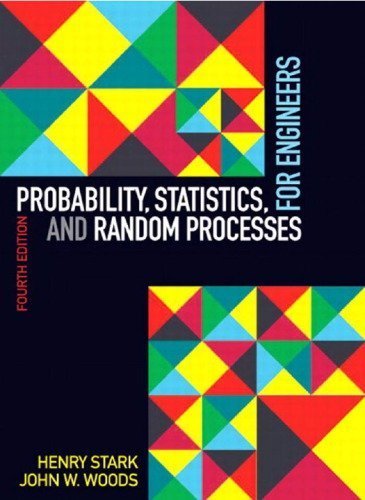
Probability, Statistics, and Random Processes for Engineers 4th Edition by Henry Stark, ISBN-13: 978-0132311236
Original price was: $50.00.$19.99Current price is: $19.99.
Safe & secure checkout
Description
Description
Probability, Statistics, and Random Processes for Engineers 4th Edition by Henry Stark, ISBN-13: 978-0132311236
[PDF eBook eTextbook]
- Publisher: Pearson; 4th edition (August 10, 2011)
- Language: English
- 704 pages
- ISBN-10: 0132311232
- ISBN-13: 978-0132311236
For courses in Probability and Random Processes.
Probability, Statistics, and Random Processes for Engineers, 4e is a useful text for electrical and computer engineers. This book is a comprehensive treatment of probability and random processes that, more than any other available source, combines rigor with accessibility. Beginning with the fundamentals of probability theory and requiring only college-level calculus, the book develops all the tools needed to understand more advanced topics such as random sequences, continuous-time random processes, and statistical signal processing. The book progresses at a leisurely pace, never assuming more knowledge than contained in the material already covered. Rigor is established by developing all results from the basic axioms and carefully defining and discussing such advanced notions as stochastic convergence, stochastic integrals and resolution of stochastic processes.
Table of Contents:
Title Page
Copyright Page
Contents
Preface
1 Introduction to Probability
1.1 Introduction: Why Study Probability?
1.2 The Different Kinds of Probability
Probability as Intuition
Probability as the Ratio of Favorable to Total Outcomes (Classical Theory)
Probability as a Measure of Frequency of Occurrence
Probability Based on an Axiomatic Theory
1.3 Misuses, Miscalculations, and Paradoxes in Probability
1.4 Sets, Fields, and Events
Examples of Sample Spaces
1.5 Axiomatic Definition of Probability
1.6 Joint, Conditional, and Total Probabilities; Independence
Compound Experiments
1.7 Bayes’ Theorem and Applications
1.8 Combinatorics
Occupancy Problems
Extensions and Applications
1.9 Bernoulli Trials—Binomial and Multinomial Probability Laws
Multinomial Probability Law
1.10 Asymptotic Behavior of the Binomial Law: The Poisson Law
1.11 Normal Approximation to the Binomial Law
Summary
Problems
References
2 Random Variables
2.1 Introduction
2.2 Definition of a Random Variable
2.3 Cumulative Distribution Function
Properties of F[Sub(X)](x)
Computation of F[Sub(X)](x)
2.4 Probability Density Function (pdf)
Four Other Common Density Functions
More Advanced Density Functions
2.5 Continuous, Discrete, and Mixed Random Variables
Some Common Discrete Random Variables
2.6 Conditional and Joint Distributions and Densities
Properties of Joint CDF F[Sub(XY)](x, y)
2.7 Failure Rates
Summary
Problems
References
Additional Reading
3 Functions of Random Variables
3.1 Introduction
Functions of a Random Variable (FRV): Several Views
3.2 Solving Problems of the Type Y = g(X)
General Formula of Determining the pdf of Y = g(X)
3.3 Solving Problems of the Type Z = g(X, Y)
3.4 Solving Problems of the Type V = g(X, Y), W = h(X, Y)
Fundamental Problem
Obtaining fVW Directly from fXY
3.5 Additional Examples
Summary
Problems
References
Additional Reading
4 Expectation and Moments
4.1 Expected Value of a Random Variable
On the Validity of Equation 4.1-8
4.2 Conditional Expectations
Conditional Expectation as a Random Variable
4.3 Moments of Random Variables
Joint Moments
Properties of Uncorrelated Random Variables
Jointly Gaussian Random Variables
4.4 Chebyshev and Schwarz Inequalities
Markov Inequality
The Schwarz Inequality
4.5 Moment-Generating Functions
4.6 Chernoff Bound
4.7 Characteristic Functions
Joint Characteristic Functions
The Central Limit Theorem
4.8 Additional Examples
Summary
Problems
References
Additional Reading
5 Random Vectors
5.1 Joint Distribution and Densities
5.2 Multiple Transformation of Random Variables
5.3 Ordered Random Variables
Distribution of area random variables
5.4 Expectation Vectors and Covariance Matrices
5.5 Properties of Covariance Matrices
Whitening Transformation
5.6 The Multidimensional Gaussian (Normal) Law
5.7 Characteristic Functions of Random Vectors
Properties of CF of Random Vectors
The Characteristic Function of the Gaussian (Normal) Law
Summary
Problems
References
Additional Reading
6 Statistics: Part 1 Parameter Estimation
6.1 Introduction
Independent, Identically Distributed (i.i.d.) Observations
Estimation of Probabilities
6.2 Estimators
6.3 Estimation of the Mean
Properties of the Mean-Estimator Function (MEF)
Procedure for Getting a δ-confidence Interval on the Mean of a Normal Random Variable When `
Confidence Interval for the Mean of a Normal Distribution When σ[sub(X)] Is Not Known
Procedure for Getting a δ-Confidence Interval Based on n Observations on the Mean of a Normal R
Interpretation of the Confidence Interval
6.4 Estimation of the Variance and Covariance
Confidence Interval for the Variance of a Normal Random variable
Estimating the Standard Deviation Directly
Estimating the covariance
6.5 Simultaneous Estimation of Mean and Variance
6.6 Estimation of Non-Gaussian Parameters from Large Samples
6.7 Maximum Likelihood Estimators
6.8 Ordering, more on Percentiles, Parametric Versus Nonparametric Statistics
The Median of a Population Versus Its Mean
Parametric versus Nonparametric Statistics
Confidence Interval on the Percentile
Confidence Interval for the Median When n Is Large
6.9 Estimation of Vector Means and Covariance Matrices
Estimation of μ
Estimation of the covariance K
6.10 Linear Estimation of Vector Parameters
Summary
Problems
References
Additional Reading
7 Statistics: Part 2 Hypothesis Testing
7.1 Bayesian Decision Theory
7.2 Likelihood Ratio Test
7.3 Composite Hypotheses
Generalized Likelihood Ratio Test (GLRT)
How Do We Test for the Equality of Means of Two Populations?
Testing for the Equality of Variances for Normal Populations: The F-test
Testing Whether the Variance of a Normal Population Has a Predetermined Value:
7.4 Goodness of Fit
7.5 Ordering, Percentiles, and Rank
How Ordering is Useful in Estimating Percentiles and the Median
Confidence Interval for the Median When n Is Large
Distribution-free Hypothesis Testing: Testing If Two Population are the Same Using Runs
Ranking Test for Sameness of Two Populations
Summary
Problems
References
8 Random Sequences
8.1 Basic Concepts
Infinite-length Bernoulli Trials
Continuity of Probability Measure
Statistical Specification of a Random Sequence
8.2 Basic Principles of Discrete-Time Linear Systems
8.3 Random Sequences and Linear Systems
8.4 WSS Random Sequences
Power Spectral Density
Interpretation of the psd
Synthesis of Random Sequences and Discrete-Time Simulation
Decimation
Interpolation
8.5 Markov Random Sequences
ARMA Models
Markov Chains
8.6 Vector Random Sequences and State Equations
8.7 Convergence of Random Sequences
8.8 Laws of Large Numbers
Summary
Problems
References
9 Random Processes
9.1 Basic Definitions
9.2 Some Important Random Processes
Asynchronous Binary Signaling
Poisson Counting Process
Alternative Derivation of Poisson Process
Random Telegraph Signal
Digital Modulation Using Phase-Shift Keying
Wiener Process or Brownian Motion
Markov Random Processes
Birth–Death Markov Chains
Chapman–Kolmogorov Equations
Random Process Generated from Random Sequences
9.3 Continuous-Time Linear Systems with Random Inputs
White Noise
9.4 Some Useful Classifications of Random Processes
Stationarity
9.5 Wide-Sense Stationary Processes and LSI Systems
Wide-Sense Stationary Case
Power Spectral Density
An Interpretation of the psd
More on White Noise
Stationary Processes and Difierential Equations
9.6 Periodic and Cyclostationary Processes
9.7 Vector Processes and State Equations
State Equations
Summary
Problems
References
10 Advanced Topics in Random Processes
10.1 Mean-Square (m.s.) Calculus
Stochastic Continuity and Derivatives [10-1]
Further Results on m.s. Convergence [10-1]
10.2 Mean-Square Stochastic Integrals
10.3 Mean-Square Stochastic Di.erential Equations
10.4 Ergodicity [10-3]
10.5 Karhunen–Loève Expansion [10-5]
10.6 Representation of Bandlimited and Periodic Processes
Bandlimited Processes
Bandpass Random Processes
WSS Periodic Processes
Fourier Series for WSS Processes
Summary
Appendix: Integral Equations
Existence Theorem
Problems
References
11 Applications to Statistical Signal Processing
11.1 Estimation of Random Variables and Vectors
More on the Conditional Mean
Orthogonality and Linear Estimation
Some Properties of the Operator Ê
11.2 Innovation Sequences and Kalman Filtering
Predicting Gaussian Random Sequences
Kalman Predictor and Filter
Error-Covariance Equations
11.3 Wiener Filters for Random Sequences
Unrealizable Case (Smoothing)
Causal Wiener Filter
11.4 Expectation-Maximization Algorithm
Log-likelihood for the Linear Transformation
Summary of the E-M algorithm
E-M Algorithm for Exponential Probability Functions
Application to Emission Tomography
Log-likelihood Function of Complete Data
E-step
M-step
11.5 Hidden Markov Models (HMM)
Speci.cation of an HMM
Application to Speech Processing
E.cient Computation of P[E|M] with a Recursive Algorithm
Viterbi Algorithm and the Most Likely State Sequence for the Observations
11.6 Spectral Estimation
The Periodogram
Bartlett’s Procedure–Averaging Periodograms
Parametric Spectral Estimate
Maximum Entropy Spectral Density
11.7 Simulated Annealing
Gibbs Sampler
Noncausal Gauss–Markov Models
Compound Markov Models
Gibbs Line Sequence
Summary
Problems
References
Appendix A: Review of Relevant Mathematics
A.1 Basic Mathematics
Sequences
Convergence
Summations
Z-Transform
A.2 Continuous Mathematics
Definite and Indefinite Integrals
Difierentiation of Integrals
Integration by Parts
Completing the Square
Double Integration
Functions
A.3 Residue Method for Inverse Fourier Transformation
Fact
Inverse Fourier Transform for psd of Random Sequence
A.4 Mathematical Induction
References
Appendix B: Gamma and Delta Functions
B.1 Gamma Function
B.2 Incomplete Gamma Function
B.3 Dirac Delta Function
References
Appendix C: Functional Transformations and Jacobians
C.1 Introduction
C.2 Jacobians for n = 2
C.3 Jacobian for General n
Appendix D: Measure and Probability
D.1 Introduction and Basic Ideas
Measurable Mappings and Functions
D.2 Application of Measure Theory to Probability
Distribution Measure
Appendix E: Sampled Analog Waveforms and Discrete-time Signals
Appendix F: Independence of Sample Mean and Variance for Normal Random Variables
Appendix G: Tables of Cumulative Distribution Functions: the Normal, Student t, Chi-square, and F
Index
A
B
C
D
E
F
G
H
I
J
K
L
M
N
O
P
Q
R
S
T
U
V
W
Y
Z
What makes us different?
• Instant Download
• Always Competitive Pricing
• 100% Privacy
• FREE Sample Available
• 24-7 LIVE Customer Support


Reviews
There are no reviews yet.