

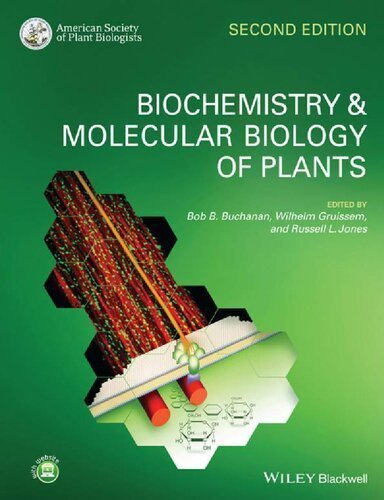
Biochemistry and Molecular Biology of Plants 2nd Edition by Bob B. Buchanan, ISBN-13: 978-0470714218
Original price was: $100.00.$24.99Current price is: $24.99.
Safe & secure checkout
Description
Description
Biochemistry and Molecular Biology of Plants 2nd Edition by Bob B. Buchanan, ISBN-13: 978-0470714218
[PDF eBook eTextbook]
- Publisher: Wiley; 2nd edition (August 31, 2015)
- Language: English
- 1280 pages (Large Size: 112 MB)
- ISBN-10: 9780470714218
- ISBN-13: 978-0470714218
Biochemistry and Molecular Biology of Plants, 2nd Edition has been hailed as a major contribution to the plant sciences literature and critical acclaim has been matched by global sales success. Maintaining the scope and focus of the first edition, the second will provide a major update, include much new material and reorganise some chapters to further improve the presentation.
This book is meticulously organised and richly illustrated, having over 1,000 full-colour illustrations and 500 photographs. It is divided into five parts covering: Compartments, Cell Reproduction, Energy Flow, Metabolic and Developmental Integration, and Plant Environment and Agriculture. Specific changes to this edition include:
- Completely revised with over half of the chapters having a major rewrite.
- Includes two new chapters on signal transduction and responses to pathogens.
- Restructuring of section on cell reproduction for improved presentation.
- Dedicated website to include all illustrative material.
Biochemistry and Molecular Biology of Plants holds a unique place in the plant sciences literature as it provides the only comprehensive, authoritative, integrated single volume book in this essential field of study.
Table of Contents:
COVER
TITLE PAGE
THE EDITORS
LIST OF CONTRIBUTORS
PREFACE
ABOUT THE COMPANION WEBSITE
I: COMPARTMENTS
1 Membrane Structure and Membranous Organelles
Introduction
1.1 Common properties and inheritance of cell membranes
1.2 The fluid-mosaic membrane model
1.3 Plasma membrane
1.4 Endoplasmic reticulum
1.5 Golgi apparatus
1.6 Exocytosis and endocytosis
1.7 Vacuoles
1.8 The nucleus
1.9 Peroxisomes
1.10 Plastids
1.11 Mitochondria
Summary
2 The Cell Wall
Introduction
2.1 Sugars are building blocks of the cell wall
2.2 Macromolecules of the cell wall
2.3 Cell wall architecture
2.4 Cell wall biosynthesis and assembly
2.5 Growth and cell walls
2.6 Cell differentiation
2.7 Cell walls as sources of food, feed, fiber, and fuel, and their genetic improvement
Summary
3 Membrane Transport
Introduction
3.1 Overview of plant membrane transport systems
3.2 Pumps
3.3 Ion channels
3.4 Cotransporters
3.5 Water transport through aquaporins
Summary
4 Protein Sorting and Vesicle Traffic
Introduction
4.1 The cellular machinery of protein sorting
4.2 Targeting proteins to the plastids
4.3 Targeting proteins to mitochondria
4.4 Targeting proteins to peroxisomes
4.5 Transport in and out of the nucleus
4.6 ER is the secretory pathway port of entry and a protein nursery
4.7 Protein traffic and sorting in the secretory pathway: the ER
4.8 Protein traffic and sorting in the secretory pathway: the Golgi apparatus and beyond
4.9 Endocytosis and endosomal compartments
Summary
5 The Cytoskeleton
Introduction
5.1 Introduction to the cytoskeleton
5.2 Actin and tubulin gene families
5.3 Characteristics of actin filaments and microtubules
5.4 Cytoskeletal accessory proteins
5.5 Observing the cytoskeleton: Statics and dynamics
5.6 Role of actin filaments in directed intracellular movement
5.7 Cortical microtubules and expansion
5.8 The cytoskeleton and signal transduction
5.9 Mitosis and cytokinesis
II: CELL REPRODUCTION
6 Nucleic Acids
Introduction
6.1 Composition of nucleic acids and synthesis of nucleotides
6.2 Replication of nuclear DNA
6.3 DNA repair
6.4 DNA recombination
6.5 Organellar DNA
6.6 DNA transcription
6.7 Characteristics and functions of RNA
6.8 RNA processing
Summary
7 Amino Acids
Introduction
7.1 Amino acid biosynthesis in plants: research and prospects
7.2 Assimilation of inorganic nitrogen into N-transport amino acids
7.3 Aromatic amino acids
7.4 Aspartate-derived amino acids
7.5 Branched-chain amino acids
7.6 Glutamate-derived amino acids
7.7 Histidine
Summary
8 Lipids
Introduction
8.1 Structure and function of lipids
8.2 Fatty acid biosynthesis
8.3 Acetyl-CoA carboxylase
8.4 Fatty acid synthase
8.5 Desaturation and elongation of C16 and C18 fatty acids
8.6 Synthesis of unusual fatty acids
8.7 Synthesis of membrane lipids
8.8 Function of membrane lipids
8.9 Synthesis and function of extracellular lipids
8.10 Synthesis and catabolism of storage lipids
8.11 Genetic engineering of lipids
Summary
9 Genome Structure and Organization
Introduction
9.1 Genome structure: a 21st-century perspective
9.2 Genome organization
9.3 Transposable elements
9.4 Gene expression
9.5 Chromatin and the epigenetic regulation of gene expression
Summary
10 Protein Synthesis, Folding, and Degradation
Introduction
10.1 Organellar compartmentalization of protein synthesis
10.2 From RNA to protein
10.3 Mechanisms of plant viral translation
10.4 Protein synthesis in plastids
10.5 Post-translational modification of proteins
10.6 Protein degradation
Summary
11 Cell Division
Introduction
11.1 Animal and plant cell cycles
11.2 Historical perspective on cell cycle research
11.3 Mechanisms of cell cycle control
11.4 The cell cycle in action
11.5 Cell cycle control during development
Summary
III: ENERGY FLOW
12 Photosynthesis
Introduction
12.1 Overview of photosynthesis
12.2 Light absorption and energy conversion
12.3 Photosystem structure and function
12.4 Electron transport pathways in chloroplast membranes
12.5 ATP synthesis in chloroplasts
12.6 Organization and regulation of photosynthetic complexes
12.7 Carbon reactions: the Calvin–Benson cycle
12.8 Rubisco
12.9 Regulation of the Calvin–Benson cycle by light
12.10 Variations in mechanisms of CO2 fixation
Summary
13 Carbohydrate Metabolism
Introduction
13.1 The concept of metabolite pools
13.2 The hexose phosphate pool: a major crossroads in plant metabolism
13.3 Sucrose biosynthesis
13.4 Sucrose metabolism
13.5 Starch biosynthesis
13.6 Partitioning of photoassimilates between sucrose and starch
13.7 Starch degradation
13.8 The pentose phosphate/triose phosphate pool
13.9 Energy and reducing power for biosynthesis
13.10 Sugar-regulated gene expression
Summary
14 Respiration and Photorespiration
Introduction
14.1 Overview of respiration
14.2 Citric acid cycle
14.3 Plant mitochondrial electron transport
14.4 Plant mitochondrial ATP synthesis
14.5 Regulation of the citric acid cycle and the cytochrome pathway
14.6 Integration of the cytochrome pathway and nonphosphorylating pathways
14.7 Interactions between mitochondria and other cellular compartments
14.8 Biochemical basis of photorespiration
14.9 The photorespiratory pathway
14.10 Role of photorespiration in plants
Summary
IV: METABOLIC AND DEVELOPMENTAL INTEGRATION
15 Long-Distance Transport
Introduction
15.1 Selection pressures and long-distance transport systems
15.2 Cell biology of transport modules
15.3 Short-distance transport events between xylem and nonvascular cells
15.4 Short-distance transport events between phloem and nonvascular cells
15.5 Whole-plant organization of xylem transport
15.6 Whole-plant organization of phloem transport
15.7 Communication and regulation controlling phloem transport events
Summary
16 Nitrogen and Sulfur
Introduction
16.1 Overview of nitrogen in the biosphere and in plants
16.2 Overview of biological nitrogen fixation
16.3 Enzymology of nitrogen fixation
16.4 Symbiotic nitrogen fixation
16.5 Ammonia uptake and transport
16.6 Nitrate uptake and transport
16.7 Nitrate reduction
16.8 Nitrite reduction
16.9 Nitrate signaling
16.10 Interaction between nitrate assimilation and carbon metabolism
16.11 Overview of sulfur in the biosphere and plants
16.12 Sulfur chemistry and function
16.13 Sulfate uptake and transport
16.14 The reductive sulfate assimilation pathway
16.15 Cysteine synthesis
16.16 Synthesis and function of glutathione and its derivatives
16.17 Sulfated compounds
16.18 Regulation of sulfate assimilation and interaction with nitrogen and carbon metabolism
16.18.3 Sulfate assimilation is closely linked with carbon and nitrogen metabolism
Summary
17 Biosynthesis of Hormones
Introduction
17.1 Gibberellins
17.2 Abscisic acid
17.3 Cytokinins
17.4 Auxins
17.5 Ethylene
17.6 Brassinosteroids
17.7 Polyamines
17.8 Jasmonic acid
17.9 Salicylic acid
17.10 Strigolactones
Summary
18 Signal Transduction
Introduction
18.1 Characteristics of signal perception, transduction, and integration in plants
18.2 Overview of signal perception at the plasma membrane
18.3 Intracellular signal transduction, amplification, and integration via second messengers and MAPK cascades
18.4 Ethylene signal transduction
18.5 Cytokinin signal transduction
18.6 Integration of auxin signaling and transport
18.7 Signal transduction from phytochromes
18.8 Gibberellin signal transduction and its integration with phytochrome signaling during seedling development
18.9 Integration of light, ABA, and CO2 signals in the regulation of stomatal aperture
18.10 Prospects
Summary
19 Molecular Regulation of Reproductive Development
Introduction
19.1 The transition from vegetative to reproductive development
19.2 The molecular basis of flower development
19.3 The formation of male gametes
19.4 The formation of female gametes
19.5 Pollination and fertilization
19.6 The molecular basis of self-incompatibility
19.7 Seed development
Summary
20 Senescence and Cell Death
Introduction
20.1 Types of cell death
20.2 PCD during seed development and germination
20.3 Cell death during the development of secretory bodies, defensive structures and organ shapes
20.4 PCD during reproductive development
20.5 Senescence and PCD in the terminal development of leaves and other lateral organs
20.6 Pigment metabolism in senescence
20.7 Macromolecule breakdown and salvage of nutrients in senescence
20.8 Energy and oxidative metabolism during senescence
20.9 Environmental influences on senescence and cell death I: Abiotic interactions
20.10 Environmental influences on senescence and cell death II: PCD responses to pathogen attack
20.11 Plant hormones in senescence and defense-related PCD
Summary
V: PLANT ENVIRONMENT AND AGRICULTURE
21 Responses to Plant Pathogens
Introduction
21.1 Pathogens, pests, and disease
21.2 An overview of immunity and defense
21.3 How pathogens and pests cause disease
21.4 Preformed defenses
21.5 Induced defense
21.6 Effector-triggered immunity, a second level of induced defense
21.7 Other sources of genetic variation for resistance
21.8 Local and systemic defense signaling
21.9 Plant gene silencing confers virus resistance, tolerance, and attenuation
21.10 Control of plant pathogens by genetic engineering
Summary
22 Responses to Abiotic Stress
Introduction
22.1 Plant responses to abiotic stress
22.2 Physiological and cellular responses to water deficit
22.3 Gene expression and signal transduction in response to dehydration
22.4 Freezing and chilling stress
22.5 Flooding and oxygen deficit
22.6 Oxidative stress
22.7 Heat stress
22.8 Crosstalk in stress responses
Summary
23 Mineral Nutrient Acquisition, Transport, and Utilization
Introduction
23.1 Overview of essential mineral elements
23.2 Mechanisms and regulation of plant K+ transport
23.3 Phosphorus nutrition and transport
23.4 The molecular physiology of micronutrient acquisition
23.5 Plant responses to mineral toxicity
Summary
24 Natural Products
Introduction
24.1 Terpenoids
24.2 Biosynthesis of the basic five-carbon unit
24.3 Repetitive additions of C5 units
24.4 Formation of parent carbon skeletons
24.5 Modification of terpenoid skeletons
24.6 Metabolic engineering of terpenoid production
24.7 Cyanogenic glycosides
24.8 Cyanogenic glycoside biosynthesis
24.9 Functions of cyanogenic glycosides
24.10 Glucosinolates
24.11 Alkaloids
24.12 Alkaloid biosynthesis
24.13 Biotechnological application of alkaloid biosynthesis research
24.14 Phenolic compounds
24.15 Phenolic biosynthesis
24.16 The phenylpropanoid-acetate pathway
24.17 The phenylpropanoid pathway
24.18 Universal features of phenolic biosynthesis
24.19 Evolution of secondary pathways
Summary
INDEX
FURTHER READING
END USER LICENSE AGREEMENT
Bob B. Buchanan, University of California, Berkeley, USA
Wilhelm Gruissem, ETH Zurich, Switzerland
Russell L. Jones, University of California, Berkeley, USA
What makes us different?
• Instant Download
• Always Competitive Pricing
• 100% Privacy
• FREE Sample Available
• 24-7 LIVE Customer Support



Reviews
There are no reviews yet.