

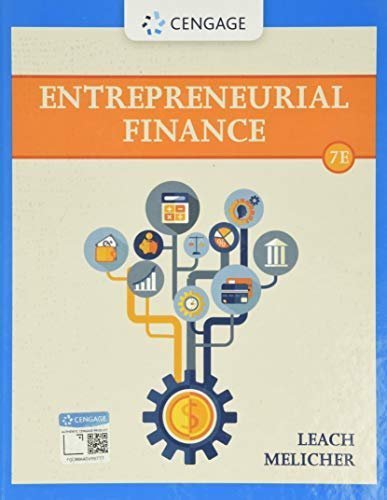
Entrepreneurial Finance 7th Edition by J. Chris Leach, ISBN-13: 978-0357442043
Original price was: $50.00.$19.99Current price is: $19.99.
Safe & secure checkout
Description
Description
Entrepreneurial Finance 7th Edition by J. Chris Leach, ISBN-13: 978-0357442043
[PDF eBook eTextbook]
- Publisher: Cengage Learning; 7th edition (March 9, 2020)
- Language: English
- ISBN-10: 0357442040
- ISBN-13: 978-0357442043
Master each step of the complete “life cycle” of a firm with Leach/Melicher’s ENTREPRENEURIAL FINANCE, 7E. This edition vividly explains the theories, corporate finance tools and techniques you need to start, build and eventually harvest a successful entrepreneurial venture today. Using an inviting presentation, this book emphasizes sound financial management practices as you learn how to secure financing, use business cash flow models and strategically position your early-stage company. You also learn to interact effectively with financial institutions and regulatory agencies that can impact venture growth and ensure liquidity for investors. Updates throughout this edition feature real examples as well as in-depth capstone cases and mini-cases drawn from actual entrepreneurial ventures and common financial scenarios. Strengthen your entrepreneurial skills as you study key concepts, such as venture capital funds, clean tech, sustainable sales growth, strategic alliances, licensing agreements and exit strategies.
Table of Contents:
Brief Contents
Contents
Preface
About the Authors
PART 1: The Entrepreneurial Environment
CHAPTER 1: Introduction to Finance for Entrepreneurs
1.1 The Entrepreneurial Process
1.2 Entrepreneurship Fundamentals
1.3 Sources of Entrepreneurial Opportunities
1.4 Principles of Entrepreneurial Finance
1.5 Role of Entrepreneurial Finance
1.6 The Successful Venture Life Cycle
1.7 Financing Through the Venture Life Cycle
1.8 Life Cycle Approach for Teaching Entrepreneurial Finance
CHAPTER 2: Developing the Business Idea
2.1 Process for Identifying Business Opportunities
2.2 To be Successful, You Must Have a Sound Business Model
2.3 Learn from the Best Practices of Successful Entrepreneurial Ventures
2.4 Time-to-Market and Other Timing Implications
2.5 Initial “Litmus Test” for Evaluating the Business Feasibility of an Idea
2.6 Screening Venture Opportunities
2.7 Key Elements of a Business Plan
Appendix A Applying the VOS Indicator™: An Example
PART 2: Organizing and Operating the Venture
CHAPTER 3: Organizing and Financing a New Venture
3.1 Progressing Through the Venture Life Cycle
3.2 Forms of Business Organization
3.3 Choosing the Form of Organization: Tax and Other Considerations
3.4 Intellectual Property
3.5 Seed, Startup, and First-Round Financing Sources
CHAPTER 4: Preparing and Using Financial Statements
4.1 Obtaining and Recording the Resources Necessary to Start and Build a New Venture
4.2 Business Assets, Liabilities, and Owners’ Equity
4.3 Sales, Expenses, and Profits
4.4 Internal Operating Schedules
4.5 Statement of Cash Flows
4.6 Operating Breakeven Analyses
Appendix A NOPAT Breakeven: Revenues Needed to Cover Total Operating Costs
CHAPTER 5: Evaluating Operating and Financial Performance
5.1 Users of Operating and Financial Performance Measures by Life Cycle Stage
5.2 Using Financial Ratios
5.3 Cash Burn Rates and Liquidity Ratios
5.4 Leverage Ratios
5.5 Profitability and Efficiency Ratios
5.6 Industry Comparable Ratio Analysis
5.7 A Hitchhiker’s Guide to Financial Analysis
PART 3: Planning for the Future
CHAPTER 6: Managing Cash Flow
6.1 Financial Planning throughout the Venture’s Life Cycle
6.2 Surviving in the Short Run
6.3 Short-Term Cash-Planning Tools
6.4 Projected Monthly Financial Statements
6.5 Cash Planning from a Projected Monthly Balance Sheet
6.6 Conversion Period Ratios
CHAPTER 7: Types and Costs of Financial Capital
7.1 Implicit and Explicit Financial Capital Costs
7.2 Financial Markets
7.3 Determining the Cost of Debt Capital
7.4 What is Investment Risk
7.5 Estimating the Cost of Equity Capital
7.6 Weighted Average Cost of Capital
Appendix A Using WACC to Complete the Calibration of EVA
CHAPTER 8: Securities Law Considerations When Obtaining Venture Financing
8.1 Review of Sources of External Venture Financing
8.2 Overview of Federal and State Securities Laws
8.3 Process for Determining Whether Securities Must be Registered
8.4 Registration of Securities Under the Securities Act of 1933
8.5 Security Exemptions from Registration Under the 1933 Act
8.6 Transaction Exemptions from Registration Under the 1933 Act
8.7 SEC’s Regulation D: Safe-Harbor Exemptions
8.8 Regulation a Security Exemption
8.9 JOBS Act Innovations
Appendix A Schedule A (Securities Act of 1933, as Amended)
Appendix B Selected SEC Regulation D Materials
Appendix C Other Forms of Registration Exemptions and Breaks
PART 4: Creating and Recognizing Venture Value
CHAPTER 9: Projecting Financial Statements
9.1 Long-Term Financial Planning Throughout the Venture’s Life Cycle
9.2 Beyond Survival: Systematic Forecasting
9.3 Estimating Sustainable Sales Growth Rates
9.4 Estimating Additional Financing Needed to Support Growth
9.5 Percent-of-Sales Projected Financial Statements
CHAPTER 10: Valuing Early-Stage Ventures
10.1 What is a Venture Worth?
10.2 Basic Mechanics of Valuation: Mixing Vision and Reality
10.3 Required versus Surplus Cash
10.4 Developing the Projected Financial Statements for a DCF Valuation
10.5 Just-In-Time Equity Valuation: Pseudo Dividends
10.6 Accounting versus Equity Valuation Cash Flow
CHAPTER 11: Venture Capital Valuation Methods
11.1 Brief Review of Basic Cash Flow-Based Equity Valuations
11.2 Basic Venture Capital Valuation Method
11.3 Earnings Multipliers and Discounted Dividends
11.4 Adjusting VCSCs for Multiple Rounds
11.5 Adjusting VCSCs for Incentive Ownership
11.6 Adjusting VCSCs for Payments to Senior Security Holders
11.7 Introducing Scenarios to VCSCs
PART 5: Structuring Financing for the Growing Venture
CHAPTER 12: Professional Venture Capital
12.1 Historical Characterization of Professional Venture Capital
12.2 Professional Venture Investing Cycle: Overview
12.3 Determining (Next) Fund Objectives and Policies
12.4 Organizing the New Fund
12.5 Soliciting Investments in the New Fund
12.6 Obtaining Commitments for a Series of Capital Calls
12.7 Conducting Due Diligence and Actively Investing
12.8 Arranging Harvest or Liquidation
12.9 Distributing Cash and Securities Proceeds
CHAPTER 13: Other Financing Alternatives
13.1 Business Incubators, Seed Accelerators, and Intermediaries
13.2 Business Crowdsourcing and Crowdfunding
13.3 Commercial and Venture Bank Lending
13.4 Understanding Why You May not Get Debt Financing
13.5 Credit Cards
13.6 Foreign Investor Funding Sources
13.7 Small Business Administration Programs
13.8 Other Government Financing Programs
13.9 Factoring, Receivables Lending, and Customer Funding
13.10 Debt, Debt Substitutes, and Direct Offerings
Appendix A Summary of Colorado Business Financial Assistance Options
CHAPTER 14: Security Structures and Determining Enterprise Values
14.1 Common Stock or Common Equity
14.2 Preferred Stock or Preferred Equity
14.3 Convertible Debt
14.4 Warrants and Options
14.5 Other Concerns About Security Design
14.6 Valuing Ventures with Complex Capital Structures: The Enterprise Method
PART 6: Exit and Turnaround Strategies
CHAPTER 15: Harvesting the Business Venture Investment
15.1 Venture Operating and Financial Decisions Revisited
15.2 Planning an Exit Strategy
15.3 Valuing the Equity or Valuing the Enterprise
15.4 Systematic Liquidation
15.5 Outright Sale
15.6 Going Public
CHAPTER 16: Financially Troubled Ventures: Turnaround Opportunities
16.1 Venture Operating and Financing Overview
16.2 The Troubled Venture and Financial Distress
16.3 Resolving Financial Distress Situations
16.4 Private Workouts and Liquidations
16.5 Federal Bankruptcy Law
PART 7: Capstone Cases
CASE 1: Eco-Products, Inc
CASE 2: Spatial Technology, Inc
Glossary
Index
J. Chris Leach is the W.W. Reynolds Capital Markets Chair and the former Robert H. and Beverly A. Deming Professor in Entrepreneurship at the Leeds School of Business within University of Colorado at Boulder. Dr. Leach received his Ph.D. in finance from Cornell University and began his teaching career at the Wharton School. He has served as a visiting professor at Carnegie Mellon, the Indian School of Business and the Stockholm Institute for Financial Research (at the Stockholm School of Economics). His teaching experience includes courses for undergraduates, M.B.A. and Ph.D. students, and executives. A former Graduate Professor of the Year, Dr. Leach has received multiple awards for M.B.A. teaching excellence. Dr. Leach’s research on a variety of topics has been published in The Review of Financial Studies; Journal of Financial and Quantitative Analysis; Journal of Business; Journal of Accounting; Auditing and Finance; Review of Economic Dynamics and Journal of Money, Credit and Banking. His business background includes various startups dating back to the 1970s. He has also consulted in areas of business and strategic planning advising, valuation and deal structure for early-stage and small businesses. He is a faculty sponsor for M.B.A. teams that have qualified for twelve international championships for the Venture Capital Investment Competition, and he is a faculty advisor for the Deming Center Venture Fund.
Ronald W. Melicher is Professor Emeritus of Finance in the Leeds School of Business at the University of Colorado at Boulder. He earned his undergraduate, M.B.A. and Ph.D. from Washington University in St. Louis, Missouri. While at the University of Colorado, he received several distinguished teaching awards and was designated as a university-wide President’s Teaching Scholar. A former president of the Financial Management Association, Dr. Melicher has taught entrepreneurial finance at M.B.A. and undergraduate levels, corporate finance and financial strategy in M.B.A. and Executive M.B.A. programs and investment banking to undergraduate students. While on sabbatical leave from the University of Colorado, he taught at the INSEAD Graduate School of Business in Fontainebleau, France, and at the University of Zurich in Switzerland. He has delivered numerous university-offered executive education non-credit courses and has taught in-house finance education materials for IBM and other firms. Dr. Melicher has given expert witness testimony on cost of capital in regulatory proceedings and provided consulting expertise in the areas of financial management and firm valuation. Focusing on mergers and acquisitions, corporate restructurings and the financing and valuation of early-stage firms, his research has been published in such major journals as the Journal of Finance, Journal of Financial and Quantitative Analysis and Financial Management. In addition, he is the co-author of INTRODUCTION TO FINANCE: MARKETS, INVESTMENTS, AND FINANCIAL MANAGEMENT.
What makes us different?
• Instant Download
• Always Competitive Pricing
• 100% Privacy
• FREE Sample Available
• 24-7 LIVE Customer Support

Reviews
There are no reviews yet.