

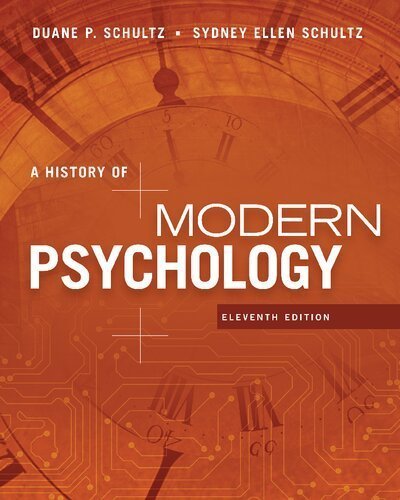
A History of Modern Psychology 11th Edition by Duane P. Schultz, ISBN-13: 978-1305630048
Original price was: $50.00.$19.99Current price is: $19.99.
Safe & secure checkout
Description
Description
A History of Modern Psychology 11th Edition by Duane P. Schultz, ISBN-13: 978-1305630048
[PDF eBook eTextbook]
- Publisher: Cengage Learning; 11th edition (July 13, 2015)
- Language: English
- 448 pages
- ISBN-10: 1305630041
- ISBN-13: 978-1305630048
History doesn’t have to be dull, and this book is living proof with coverage of interesting topics ranging from the controversial use of IQ tests at Ellis Island to the psychodynamics of gum chewing. A market leader for over 30 years, A HISTORY OF MODERN PSYCHOLOGY has been praised for its comprehensive coverage and biographical approach. Focusing on modern psychology, the book’s coverage begins with the late 19th century. The authors present an appealing narrative, personalizing the history of psychology by using biographical information on influential theorists, and by showing you how major events in the theorists’ lives affected their ideas, approaches, and methods. Updates in the eleventh edition include discussions of the latest developments in positive psychology, the interpretation of dreams by computers, the use of Coca Cola as a “nerve tonic,” and many other intriguing topics. The result is a book that is as timely and relevant today as it was when it was first introduced.
Table of Contents:
Title
Statement
Copyright
Brief Contents
Contents
In Their Own Words
Preface
Ch 1: The Study of the History of Psychology
Did You See the Clown? What about the Gorilla?
Why Study the History of Psychology?
The Beginning of Modern Psychology
The Data of History: Reconstructing Psychology’s Past: How Do We Know What Really Happened?
In Context: Forces That Shaped Psychology
A Final Note
Conceptions of Scientific History
Schools of Thought in the Evolution of Modern Psychology
Plan of the Book
Ch 1: Review Questions
Ch 1: Recommended Resources
Ch 2: Philosophical Influences on Psychology
The Defecating Duck
The Spirit of Mechanism
The Clockwork Universe
The Beginnings of Modern Science
The Contributions of Descartes: Mechanism and the Mind-Body Problem
Philosophical Foundations of the New Psychology: Positivism, Materialism, and Empiricism
Contributions of Empiricism to Psychology
Ch 2: Review Questions
Ch 2: Recommended Resources
Ch 3: Physiological Influences on Psychology
David K. Loses His Job: It Was about Time
The Importance of the Human Observer
Developments in Early Physiology
The Beginnings of Experimental Psychology
Hermann von Helmholtz (1821–1894)
Ernst Weber (1795–1878)
Gustav Theodor Fechner (1801–1887)
The Formal Founding of Psychology
Ch 3: Review Questions
Ch 3: Recommended Resources
Ch 4: The New Psychology
No Multitasking Allowed
The Founding Father of Modern Psychology
Wilhelm Wundt (1832–1920)
Other Developments in German Psychology
Hermann Ebbinghaus (1850–1909)
Franz Brentano (1838–1917)
Carl Stumpf (1848–1936)
Oswald Külpe (1862–1915)
Comment
Ch 4: Review Questions
Ch 4: Recommended Resources
Ch 5: Structuralism
Would You Swallow a Rubber Tube?
Edward Bradford Titchener (1867–1927)
Criticisms of Structuralism
Contributions of Structuralism
Ch 5: Review Questions
Ch 5: Recommended Resources
Ch 6: Functionalism: Antecedent Influences
The Man Who Came to See Jenny
The Functionalist Protest in Psychology
Evolution before Darwin
The Inevitability of Evolution
The Life of Darwin (1809–1882)
Forced to Go Public by a Man in a Jungle
Individual Differences: Francis Galton (1822–1911)
Animal Psychology and the Development of Functionalism
Ch 6: Review Questions
Ch 6: Recommended Resources
Ch 7: Functionalism: Development and Founding
The Philosopher Who Wore Earmuffs
Evolution Comes to America: Herbert Spencer (1820–1903)
The Continuing Evolution of Machines
William James (1842–1910): Anticipator of Functional Psychology
The Functional Inequality of Women
Granville Stanley Hall (1844–1924)
The Founding of Functionalism
The Chicago School
John Dewey (1859–1952)
James Rowland Angell (1869–1949)
The Province of Functional Psychology
Functionalism at Columbia University
Robert Sessions Woodworth (1869–1962)
Criticisms of Functionalism
Contributions of Functionalism
Ch 7: Review Questions
Ch 7: Recommended Resources
Ch 8: Applied Psychology: The Legacy of Functionalism
Drug Bust: Psychology to the Rescue
Toward a Practical Psychology
Mental Testing
James McKeen Cattell (1860–1944)
The Psychological Testing Movement
The Clinical Psychology Movement
Lightner Witmer (1867–1956)
The Growth of Clinical Psychology
The Industrial-Organizational Psychology Movement
Walter Dill Scott (1869–1955)
The Impact of the World Wars
The Hawthorne Studies and Organizational Issues
Lillian Gilbreth
Hugo Münsterberg (1863–1916)
Applied Psychology in the United States: A National Mania
Ch 8: Review Questions
Ch 8: Recommended Resources
Ch 9: Behaviorism: Antecedent Influences
Clever Hans, the Clever Horse
Toward a Science of Behavior
Then Came the Revolution
The Role of Positivism
The Influence of Animal Psychology on Behaviorism
Edward Lee Thorndike (1874–1949)
Ivan Petrovich Pavlov (1849–1936)
Vladimir M. Bekhterev (1857–1927)
The Influence of Functional Psychology on Behaviorism
Changing the Direction of Psychology
Ch 9: Review Questions
Ch 9: Recommended Resources
Ch 10: Behaviorism: The Beginnings
The Psychologist, the Baby, and the Hammer: Don’t Try This at Home
What Became of Little Albert?
John B. Watson (1878–1958)
The Reaction to Watson’s Program
The Methods of Behaviorism
Continuing the Mechanistic Tradition
The Subject Matter of Behaviorism
Behaviorism’s Popular Appeal
A Brave New World
An Outbreak of Psychology
Criticisms of Watson’s Behaviorism
Contributions of Watson’s Behaviorism
Ch 10: Review Questions
Ch 10: Recommended Resources
Ch 11: Behaviorism: After the Founding
The IQ Zoo
Three Stages of Behaviorism
Operationism
Edward Chace Tolman (1886–1959)
Clark Leonard Hull (1884–1952)
B. F. Skinner (1904–1990)
Sociobehaviorism: The Cognitive Challenge
Albert Bandura (1925– )
Julian Rotter (1916–2014)
The Fate of Behaviorism
Ch 11: Review Questions
Ch 11: Recommended Resources
Ch 12: Gestalt Psychology
A Sudden Insight
The Gestalt Revolt
Antecedent Influences on Gestalt Psychology
The Changing Zeitgeist in Physics
The Phi Phenomenon: A Challenge to Wundtian Psychology
Max Wertheimer (1880–1943)
Kurt Koffka (1886–1941)
Wolfgang Köhler (1887–1967)
The Nature of the Gestalt Revolt
Gestalt Principles of Perceptual Organization
Gestalt Studies of Learning: Insight and the Mentality of Apes
Productive Thinking in Humans
Isomorphism
The Spread of Gestalt Psychology
Field Theory: Kurt Lewin (1890–1947)
Criticisms of Gestalt Psychology
Contributions of Gestalt Psychology
Ch 12: Review Questions
Ch 12: Recommended Resources
Ch 13: Psychoanalysis: The Beginnings
Was It Only a Dream?
The Development of Psychoanalysis
A New School of Thought
Antecedent Influences on Psychoanalysis
Sigmund Freud (1856–1939)
Freud’s Methods of Treatment
Freud as a Therapist
Freud and Traditional Psychology
Psychoanalysis as a System of Personality
Mechanism and Determinism in Freud’s System
Psychoanalysis versus Academic Psychology
The Scientific Validation of Psychoanalytic Concepts
Criticisms of Psychoanalysis
Contributions of Psychoanalysis
American Popular Culture and Psychoanalysis
Ch 13: Review Questions
Ch 13: Recommended Resources
Ch 14: Psychoanalysis: After the Founding
A Lost, Lonely Little Boy
Competing Factions in Psychoanalysis
The Neo-Freudians and Ego Psychology
Anna Freud (1895–1982)
Carl Jung (1875–1961)
Social Psychological Theories: The Zeitgeist Strikes Again
Alfred Adler (1870–1937)
Karen Horney (1885–1952)
The Evolution of Personality Theory: Humanistic Psychology
Abraham Maslow (1908–1970)
Carl Rogers (1902–1987)
Contributions of Humanistic Psychology
Positive Psychology: The Science of Happiness
Martin Seligman (1942–)
The Psychoanalytic Tradition: A Final Comment
Ch 14: Review Questions
Ch 14: Recommended Resources
Ch 15: Continuing Developments in Psychology
Try It—You Might Like It
Chess Champion Capitulates to Cunning Computer
Schools of Thought: Looking Back
The Cognitive Movement in Psychology
George Miller (1920–2012)
Ulric Neisser (1928–2012)
From Clocks to Computers
Artificial Intelligence
The Life of Alan Turing (1912–1954)
The Nature of Cognitive Psychology
Cognitive Neuroscience
The Return of Introspection
Unconscious Cognition
Animal Cognition: The Return of Animals Who Think
Animal Personality
Current Status of Cognitive Psychology
Evolutionary Psychology
Is There Unity in Psychology at Last?
History in the Making: There Is No End to It
Ch 15: Review Questions
Ch 15: Recommended Resources
Glossary
References
Name Index
Subject Index
Duane P. Schultz is a former professor of psychology at the University of South Florida. He has also held faculty appointments at the University of North Carolina at Charlotte, Mary Washington College of the University of Virginia (now the University of Mary Washington), American University in Washington, D.C., and the University of Groningen in the Netherlands. Dr. Schultz and his wife, Sydney Ellen Schultz, are a well-regarded textbook author team.
Sydney Ellen Schultz is a writer, editor, and researcher who has developed print and digital publications and teaching materials for publishers, government agencies, schools, and professional associations. She and her husband, Duane Schultz, are well regarded as textbook authors.
What makes us different?
• Instant Download
• Always Competitive Pricing
• 100% Privacy
• FREE Sample Available
• 24-7 LIVE Customer Support




Reviews
There are no reviews yet.