

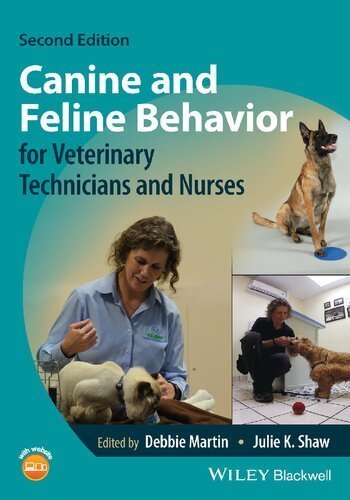
Canine and Feline Behavior for Veterinary Technicians and Nurses 2nd Edition by Debbie Martin, ISBN-13: 978-1119765400
Original price was: $50.00.$14.99Current price is: $14.99.
Safe & secure checkout
Description
Description
Canine and Feline Behavior for Veterinary Technicians and Nurses 2nd Edition by Debbie Martin, ISBN-13: 978-1119765400
[PDF eBook eTextbook]
- Publisher: Wiley-Blackwell; 2nd edition (June 14, 2023)
- Language: English
- 512 pages
- ISBN-10: 1119765404
- ISBN-13: 978-1119765400
A complete and modern guide to the veterinary technician’s role in behavioral preventive services.
This fully revised second edition of Canine and Feline Behavior for Veterinary Technicians and Nurses presents a comprehensive, up-to-date guide for veterinary technicians and nurses seeking to understand their patients on a deeper level, implement preventive behavior medicine, and assist veterinarians with behavioral interventions. The book provides a grounding in the behavioral, mental, and emotional needs of dogs and cats, and offers an invaluable daily reference for daily interactions with patients and clients.
Along with brand-new coverage of Fear Free® veterinary visits, the authors have included discussions of animal behavior and development, communication, behavior modification, problem prevention, and behavior solutions. A companion website offers more than 50 video tutorials, multiple choice questions, PowerPoint slides, and appendices. This Second Edition also provides:
- A thorough introduction to the role of veterinary technicians in animal behavior
- Comprehensive explorations of canine and feline behavior and development
- Discussion of the complexities and richness of the human-animal bond
- Details on implementing emotionally protective practices into the veterinary and husbandry care
- Practical strategies for learning and behavior modification, problem prevention, behavior solutions, and communication and connection amongst the animal behavior team
Canine and Feline Behavior for Veterinary Technicians and Nurses is an essential reference for veterinary technicians and nurses, and will also benefit veterinary technology and nursing students seeking comprehensive information about an increasingly relevant topic.
Table of Contents:
Cover
Title Page
Copyright Page
Dedication Page
Contributors
Preface
Acknowledgments
About the companion website
1 The role of the veterinarytechnician in animal behavior
Veterinarian’s roles and responsibilities
Medical differentials to behavior disorders
Behavior disorder versus training problem
Qualified professionals to treat animal behavior disorders
Trainer’s and consultant’s roles and responsibilities
The role of the veterinary technician in the veterinary behavior consultation
Prior to the consultation
During the consultation
After the consultation: follow‐up care
Summary of the roles of the veterinarian, veterinary technician, and animal trainer in veterinary behavior
Home versus clinic behavior consultations
Veterinary‐technician‐driven behavior services
Financial benefits
Conclusion
References
2 Canine behaviorand development
Canine sensory capacities
Canine communication
Canine social structure
Exploratory behavior
Ingestive behavior
Eliminative behavior
Sexual behavior
Maternal behavior
Play behavior
Canine behavioral development
Conclusion
References
Further reading
3 Feline behavior and development
Feline sensory capacities
Feline communication
Feline domestication, social structure, and behavior
Feline behavioral development
Conclusion
References
4 The human–animal bond – a brief look at its richness and complexities
The HAB past, present, and future
Conclusion
References
5 Communication and connecting the animal behavior team
A comparison between marriage and family therapist and the role of the animal behavior technician
Communication
Connective communication techniques
Teaching
The communication cycle
Grief counseling
Conclusion
References
6 Learning and behavior modification
Genetics and learning
Effect of domestication on learning
Effects of nutrition on learning
Early environment and learning
Habituation and sensitization
Operant conditioning
Classical conditioning
Social learning
Conclusion
Additional resources
References
7 Problem prevention
Introduction
Ideal characteristics for pet owners
Canine management and prevention techniques
Canine environmental enrichment
Canine prevention: effects of neutering
Canine prevention: socialization
Canine prevention: crate training
Canine prevention: elimination training
Canine prevention: independence training
Canine prevention: handling and restraint
Canine prevention: safety around the food bowl and relinquishing objects
Feline management and prevention techniques
Feline prevention: effects of neutering
Feline prevention: socialization
Feline prevention: litter‐box training
Feline prevention: crate training
Feline prevention: handling and restraint
Prevention (canine and feline): introducing a new pet
Prevention (canine and feline): children and pets
Behavior solutions for normal species‐specific behavior
Behavior solutions for typical feline behaviors
Prevention services
Puppy socialization classes
Integrating behavior wellness into the veterinary hospital
Conclusion
Additional resources
Acknowledgement
References
8 Husbandry and veterinary care
Introduction
General core concepts
Creating pleasant experiences throughout the veterinary visit
Creating a plan for veterinary care
Prioritizing veterinary procedures
The medical treatment of FAS
Conclusion
Additional resources
References
9 Specific behavior modification techniques and practical applications for behavior disorders
Common veterinary behavior disorder diagnosis and descriptions
Common veterinarian‐prescribed behavioral treatments
Training techniques
Training tools
Waist leashes, tethers, draglines, long lines
Interactive toys or puzzles
Marker training techniques and skills
Foundation trainer skills
Behavior modification
Drug desensitization
Other
The practical applications of behavior modification
Staying safe
Conclusion
Acknowledgement
References
10 Introductory neurophysiology and psychopharmacology
Introduction
Basic neurophysiology
Blood–brain barrier
Neurotransmitters
Pharmacokinetics
Drug categories
Nutraceuticals and supplements
Mainstay, adjunct, situational event medication and/or nutraceutical
Conclusion
Acknowledgement
References
Further reading
Appendix Section 1: Forms and Questionnaires
Appendix 1: Canine behavior history form part 1
Appendix 2: Canine behavior history form part 2
Appendix 3: Feline behavior history form part 1
Appendix 4: Feline behavior history form part 2
Appendix 5: Links for examples of online behavioral history forms
Appendix 6: Trainer assessment form
Appendix 7: Determining pet owner strain
Appendix 8: Canine behavior plan of care
Appendix 9: Behavior problem list
Appendix 10: Technician observation
Appendix 11: Follow‐up communication form
Appendix 12: Behavior diary
Appendix 13: New kitten (less than 3 months) questionnaire
Appendix 14: New puppy (less than 4 months) questionnaire
Appendix 15: Juvenile, adolescent, or adult cat (3 months to ~12 years) questionnaire
Appendix 16: Juvenile, adolescent, or adult dog (4 months to ~7 years) questionnaire
Appendix 17: Senior or geriatric cat (11+years) questionnaire
Appendix 18: Senior or geriatric dog (~7+years) questionnaire
Appendix 19: Pet selection counseling
Appendix 20: Canine breeder interview questions
Appendix 21: Veterinary hospital scavenger hunt CANINE
Appendix 22: Veterinary hospital scavenger hunt FELINE
Appendix Section 2: Training Exercises
Appendix 23: Acclimatizing a pet to a crate
Appendix 24: Elimination training log
Appendix 25: Shaping plan for teaching a dog to ring a bell to go outside to eliminate
Appendix 26: Preventive handling and restraint exercises
Appendix 27: Preventive food bowl exercises
Appendix 28: Teaching tug
Appendix Section 3: Samples and Letters
Appendix 29: Canine behavior plan of care sample
Appendix 30: Sample field assessment
Owner concerns
Signalment and history: Roo (patient)
History: Misty (housemate)
History: Cocoa (housemate)
Medical information
Assessment – Meeting observations
Assessment of responses to another dog when on leash
***Specific concerns
Appendix 31: Sample of a pet selection report
Appendix 32: Dr. Andrew Luescher’s letter regarding puppy socialization
Appendix 33: Dr. R.K. Anderson’s letter regarding puppy socialization
Appendix 34: Sample puppy socialization class curriculum
Appendix 35: Sample kitten class curriculum
Index
Debbie Martin, LVT, CPDT-KA, KPA CTP, VTS (Behavior), is the Animal Behavior Technician for Veterinary Behavior Consultations, LLC, and an owner of TEAM Education in Animal Behavior, LLC, in Spicewood, Texas, USA.
Julie K. Shaw, RVT, KPA CTP, VTS (Behavior), is the owner of Julie Shaw Consulting in Lafayette, Indiana, USA.
What makes us different?
• Instant Download
• Always Competitive Pricing
• 100% Privacy
• FREE Sample Available
• 24-7 LIVE Customer Support




Reviews
There are no reviews yet.