

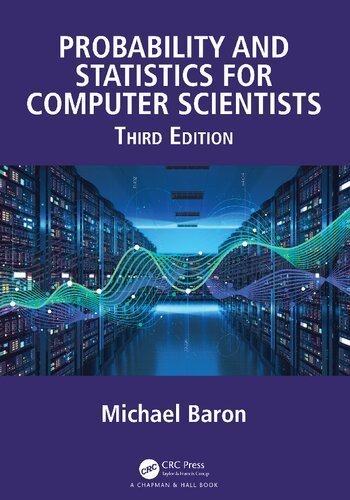
Probability and Statistics for Computer Scientists 3rd Edition by Michael Baron, ISBN-13: 978-1138044487
Original price was: $50.00.$14.99Current price is: $14.99.
Safe & secure checkout
Description
Description
Trustpilot
Probability and Statistics for Computer Scientists 3rd Edition by Michael Baron, ISBN-13: 978-1138044487
[PDF eBook eTextbook] – Available Instantly
- Publisher: Chapman and Hall/CRC; 3rd edition (July 2, 2019)
- Language: English
- 486 pages
- ISBN-10: 1138044482
- ISBN-13: 978-1138044487
Probability and Statistics for Computer Scientists, Third Edition helps students understand fundamental concepts of Probability and Statistics, general methods of stochastic modeling, simulation, queuing, and statistical data analysis; make optimal decisions under uncertainty; model and evaluate computer systems; and prepare for advanced probability-based courses. Written in a lively style with simple language and now including R as well as MATLAB, this classroom-tested book can be used for one- or two-semester courses.
Features:
- Axiomatic introduction of probability
- Expanded coverage of statistical inference and data analysis, including estimation and testing, Bayesian approach, multivariate regression, chi-square tests for independence and goodness of fit, nonparametric statistics, and bootstrap
- Numerous motivating examples and exercises including computer projects
- Fully annotated R codes in parallel to MATLAB
- Applications in computer science, software engineering, telecommunications, and related areas
Starting with the fundamentals of probability, the text takes students through topics heavily featured in modern computer science, computer engineering, software engineering, and associated fields, such as computer simulations, Monte Carlo methods, stochastic processes, Markov chains, queuing theory, statistical inference, and regression. It also meets the requirements of the Accreditation Board for Engineering and Technology (ABET).
Table of Contents:
Cover
Half Title
Title Page
Copyright Page
Dedication
Contents
Preface
1. Introduction and Overview
1.1 Making decisions under uncertainty
1.2 Overview of this book
Summary and conclusions
Exercises
Part I: Probability and Random Variables
2. Probability
2.1 Events and their probabilities
2.1.1 Outcomes, events, and the sample space
2.1.2 Set operations
2.2 Rules of Probability
2.2.1 Axioms of Probability
2.2.2 Computing probabilities of events
2.2.3 Applications in reliability
2.3 Combinatorics
2.3.1 Equally likely outcomes
2.3.2 Permutations and combinations
2.4 Conditional probability and independence
Summary and conclusions
Exercises
3. Discrete Random Variables and Their Distributions
3.1 Distribution of a random variable
3.1.1 Main concepts
3.1.2 Types of random variables
3.2 Distribution of a random vector
3.2.1 Joint distribution and marginal distributions
3.2.2 Independence of random variables
3.3 Expectation and variance
3.3.1 Expectation
3.3.2 Expectation of a function
3.3.3 Properties
3.3.4 Variance and standard deviation
3.3.5 Covariance and correlation
3.3.6 Properties
3.3.7 Chebyshev’s inequality
3.3.8 Application to finance
3.4 Families of discrete distributions
3.4.1 Bernoulli distribution
3.4.2 Binomial distribution
3.4.3 Geometric distribution
3.4.4 Negative Binomial distribution
3.4.5 Poisson distribution
3.4.6 Poisson approximation of Binomial distribution
Summary and conclusions
Exercises
4. Continuous Distributions
4.1 Probability density
4.2 Families of continuous distributions
4.2.1 Uniform distribution
4.2.2 Exponential distribution
4.2.3 Gamma distribution
4.2.4 Normal distribution
4.3 Central Limit Theorem
Summary and conclusions
Exercises
5. Computer Simulations and Monte Carlo Methods
5.1 Introduction
5.1.1 Applications and examples
5.2 Simulation of random variables
5.2.1 Random number generators
5.2.2 Discrete methods
5.2.3 Inverse transform method
5.2.4 Rejection method
5.2.5 Generation of random vectors
5.2.6 Special methods
5.3 Solving problems by Monte Carlo methods
5.3.1 Estimating probabilities
5.3.2 Estimating means and standard deviations
5.3.3 Forecasting
5.3.4 Estimating lengths, areas, and volumes
5.3.5 Monte Carlo integration
Summary and conclusions
Exercises
Part II: Stochastic Processes
6. Stochastic Processes
6.1 Definitions and classifications
6.2 Markov processes and Markov chains
6.2.1 Markov chains
6.2.2 Matrix approach
6.2.3 Steady-state distribution
6.3 Counting processes
6.3.1 Binomial process
6.3.2 Poisson process
6.4 Simulation of stochastic processes
Summary and conclusions
Exercises
7. Queuing Systems
7.1 Main components of a queuing system
7.2 The Little’s Law
7.3 Bernoulli single-server queuing process
7.3.1 Systems with limited capacity
7.4 M/M/1 system
7.4.1 Evaluating the system’s performance
7.5 Multiserver queuing systems
7.5.1 Bernoulli k-server queuing process
7.5.2 M/M/k systems
7.5.3 Unlimited number of servers and M/M/∞
7.6 Simulation of queuing systems
Summary and conclusions
Exercises
Part III: Statistics
8. Introduction to Statistics
8.1 Population and sample, parameters and statistics
8.2 Descriptive statistics
8.2.1 Mean
8.2.2 Median
8.2.3 Quantiles, percentiles, and quartiles
8.2.4 Variance and standard deviation
8.2.5 Standard errors of estimates
8.2.6 Interquartile range
8.3 Graphical statistics
8.3.1 Histogram
8.3.2 Stem-and-leaf plot
8.3.3 Boxplot
8.3.4 Scatter plots and time plots
Summary and conclusions
Exercises
9. Statistical Inference I
9.1 Parameter estimation
9.1.1 Method of moments
9.1.2 Method of maximum likelihood
9.1.3 Estimation of standard errors
9.2 Confidence intervals
9.2.1 Construction of confidence intervals: a general method
9.2.2 Confidence interval for the population mean
9.2.3 Confidence interval for the difference between two means
9.2.4 Selection of a sample size
9.2.5 Estimating means with a given precision
9.3 Unknown standard deviation
9.3.1 Large samples
9.3.2 Confidence intervals for proportions
9.3.3 Estimating proportions with a given precision
9.3.4 Small samples: Student’s t distribution
9.3.5 Comparison of two populations with unknown variances
9.4 Hypothesis testing
9.4.1 Hypothesis and alternative
9.4.2 Type I and Type II errors: level of significance
9.4.3 Level α tests: general approach
9.4.4 Rejection regions and power
9.4.5 Standard Normal null distribution (Z-test)
9.4.6 Z-tests for means and proportions
9.4.7 Pooled sample proportion
9.4.8 Unknown σ: T-tests
9.4.9 Duality: two-sided tests and two-sided confidence intervals
9.4.10 P-value
9.5 Inference about variances
9.5.1 Variance estimator and Chi-square distribution
9.5.2 Confidence interval for the population variance
9.5.3 Testing variance
9.5.4 Comparison of two variances. F-distribution
9.5.5 Confidence interval for the ratio of population variances
9.5.6 F-tests comparing two variances
Summary and conclusions
Exercises
10. Statistical Inference II
10.1 Chi-square tests
10.1.1 Testing a distribution
10.1.2 Testing a family of distributions
10.1.3 Testing independence
10.2 Nonparametric statistics
10.2.1 Sign test
10.2.2 Wilcoxon signed rank test
10.2.3 Mann–Whitney–Wilcoxon rank sum test
10.3 Bootstrap
10.3.1 Bootstrap distribution and all bootstrap samples
10.3.2 Computer generated bootstrap samples
10.3.3 Bootstrap confidence intervals
10.4 Bayesian inference
10.4.1 Prior and posterior
10.4.2 Bayesian estimation
10.4.3 Bayesian credible sets
10.4.4 Bayesian hypothesis testing
Summary and conclusions
Exercises
11. Regression
11.1 Least squares estimation
11.1.1 Examples
11.1.2 Method of least squares
11.1.3 Linear regression
11.1.4 Regression and correlation
11.1.5 Overfitting a model
11.2 Analysis of variance, prediction, and further inference
11.2.1 ANOVA and R-square
11.2.2 Tests and confidence intervals
11.2.3 Prediction
11.3 Multivariate regression
11.3.1 Introduction and examples
11.3.2 Matrix approach and least squares estimation
11.3.3 Analysis of variance, tests, and prediction
11.4 Model building
11.4.1 Adjusted R-square
11.4.2 Extra sum of squares, partial F-tests, and variable selection
11.4.3 Categorical predictors and dummy variables
Summary and conclusions
Exercises
Appendix
A.1 Data sets
A.2 Inventory of distributions
A.2.1 Discrete families
A.2.2 Continuous families
A.3 Distribution tables
A.4 Calculus review
A.4.1 Inverse function
A.4.2 Limits and continuity
A.4.3 Sequences and series
A.4.4 Derivatives, minimum, and maximum
A.4.5 Integrals
A.5 Matrices and linear systems
A.6 Answers to selected Exercises
Index
Michael Baron is a professor of statistics at the American University in Washington, DC. He has published two books and numerous research articles and book chapters. Dr. Baron is a fellow of the American Statistical Association, a member of the International Society for Bayesian Analysis, and an associate editor of the Journal of Sequential Analysis. In 2007, he was awarded the Abraham Wald Prize in Sequential Analysis. His research focuses on the use of sequential analysis, change-point detection, and Bayesian inference in epidemiology, clinical trials, cyber security, energy, finance, and semiconductor manufacturing. He received a Ph.D. in statistics from the University of Maryland.
What makes us different?
• Instant Download
• Always Competitive Pricing
• 100% Privacy
• FREE Sample Available
• 24-7 LIVE Customer Support



Reviews
There are no reviews yet.