
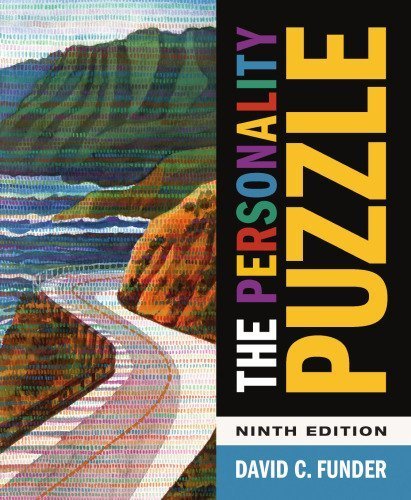
The Personality Puzzle 9th Edition by David C. Funder, ISBN-13: 978-1324060543
Original price was: $50.00.$19.99Current price is: $19.99.
Safe & secure checkout
Description
Description
The Personality Puzzle 9th Edition by David C. Funder, ISBN-13: 978-1324060543
[PDF eBook eTextbook] – Available Instantly
- Publisher: W. W. Norton & Company; Ninth edition (July 1, 2024)
- Language: English
- 712 pages
- ISBN-10: 1324060549
- ISBN-13: 978-1324060543
The ultimate reading and active learning experience for personality science.
Cover
Publisher’s Notice
Half-title Page
Title Page
Copyright
Dedication
About the Author
Quotes
Contents in Brief
Preface
Contents
Chapter 1: The Study of the Person
The Goals of Personality Psychology
Appreciating Individual Differences
Wrapping It Up
Part I: The Science of Personality: Methods and Assessment
Chapter 2: Personality Data and Assessment
Psychology’s Emphasis on Method
Personality Data: Four Kinds of Clues
Personality Assessment
Conclusion
Wrapping It Up
Chapter 3: Evaluating Research and Assessment
Quality of Data: Psychometrics
Research Design
Evaluating the Strength of a Finding
Ethical Issues
Conclusion
Wrapping It Up
Part II: People Are Different: The Trait Approach
Chapter 4: Persons, Situations, and Personality Judgment
The Trait Approach
People Are Inconsistent
The Person-Situation Debate
The Accuracy of Personality Judgment
Accurate Self-Knowledge
Accuracy Matters
Wrapping It Up
Chapter 5: Traits and Types: The Big Five and Beyond
The Single-Trait Approach
The Many-Trait Approach
The Essential-Trait Approach
Typological Approaches to Personality
From Assessment to Understanding
Wrapping It Up
Chapter 6: Personality Stability, Development, and Change
Personality Stability
Personality Development
Personality Change
Principles of Personality Continuity and Change
Is Personality Change Good or Bad?
Wrapping It Up
Part III: The Mind and the Body: Biological Approaches to Personality
Chapter 7: The Anatomy and Physiology of Personality
Hippocrates’ Problem and Ours
Basic Structure and Physiology of the Brain
Methods for Studying the Brain
Brain Physiology
The Big Five and the Brain
Biology and Psychology
Wrapping It Up
Chapter 8: Evolution and Genetics: The Inheritance of Personality
Evolutionary Personality Psychology
Behavioral Genetics
Inheritance is the Beginning, Not the End
Wrapping It Up
Part IV: The Hidden World of the Mind: The Psychoanalytic Approach
Chapter 9: Basics of Psychoanalysis
Freud Himself
Key Ideas of Psychoanalysis
Controversy
Psychoanalysis, Life, and Death
Psychosexual Development: “Follow the Money”
Thinking and Consciousness
Anxiety and Defense
Psychoanalysis as a Therapy and as a Route Toward Understanding
Psychoanalytic Theory: A Critique
Why Study Freud?
Wrapping It Up
Chapter 10: Psychoanalysis After Freud: Neo-Freudians, Object Relations, and Current Research
Interpreting Freud
Latter-Day Issues and Theorists
Empirical Psychoanalytic Research
Psychoanalysis in Perspective
Wrapping It Up
Part V: Experience and Awareness: Humanistic and Cross-Cultural Psychology
Chapter 11: Humanistic and Positive Psychology
Phenomenology: Awareness Is Everything
Existentialism
Optimistic Humanism: Rogers and Maslow
Personal Constructs: Kelly
Positive Psychology
Humanistic and Positive Psychology in the 21st Century
Wrapping It Up
Chapter 12: Cultural Variation in Experience, Behavior, and Personality
What Is Culture?
Culture and Personality
The Importance of Cross-Cultural Differences
Characteristics of Cultures
Cultural Assessment and Personality Assessment
The Origins of Cultural Differences
Challenges and New Directions for Cross-Cultural Research
The Universal Human Condition
Wrapping It Up
Part VI: What Personality Does: Motivation, Emotion, and the Self
Chapter 13: Personality Processes: Learning, Cognition, Motivation, and Emotion
Learning
Cognitive Theories of Personality
Motivation
Emotion
Happiness
Personality as a Verb
Wrapping It Up
Chapter 14: The Self: What You Know About You
The I and the Me
The Contents and Purposes of the Self
The Declarative Self
The Procedural Self
The Narrative Self
How Many Selves?
The Really Real Self
Wrapping It Up
Part VII: Applications of Personality Psychology
Chapter 15: Relationships and Business
Love and Relationships
Work and Business
Personality and Life
Wrapping It Up
Chapter 16: Mental and Physical Health
Personality Disorders
The Diagnostic and Statistical Manual (DSM)
Defining Personality Disorders
The Major Personality Disorders
Organizing and Diagnosing Disorders with the DSM-5 and Beyond
Personality and Disorder
Physical Health
The Healthy Personality
Wrapping It Up
Chapter 17: What Have We Learned?
Which Approach Is Right?
What Have We Learned?
The Quest for Understanding
Wrapping It Up
Credits
References
Glossary
Name Index
Subject Index
What makes us different?
• Instant Download
• Always Competitive Pricing
• 100% Privacy
• FREE Sample Available
• 24-7 LIVE Customer Support