
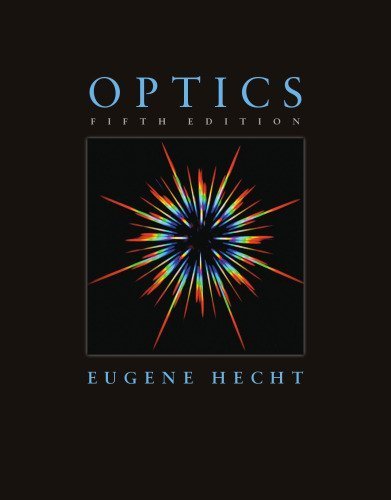
Optics 5th Edition by Eugene Hecht, ISBN-13: 978-0133977226
Original price was: $50.00.$14.99Current price is: $14.99.
Safe & secure checkout
Description
Description
Optics 5th Edition by Eugene Hecht, ISBN-13: 978-0133977226
[PDF eBook eTextbook] – Available Instantly
- Publisher: Pearson; 5th edition (December 23, 2015)
- Language: English
- 720 pages
- ISBN-10: 0133977226
- ISBN-13: 978-0133977226
A Contemporary Approach to Optics with Practical Applications and New Focused Pedagogy.
Table of Contents:
Preface
Contents
1 A Brief History
1.1 Prolegomenon
1.2 In the Beginning
1.3 From the Seventeenth Century
1.4 The Nineteenth Century
1.5 Twentieth-Century Optics
2 Wave Motion
2.1 One-Dimensional Waves
2.1.1 The Differential Wave Equation
Solution
Solution
2.2 Harmonic Waves
Solution
Solution
2.3 Phase and Phase Velocity
Solution
2.4 The Superposition Principle
2.5 The Complex Representation
2.6 Phasors and the Addition of Waves
2.7 Plane Waves
Solution
Solution
2.8 The Three-Dimensional Differential Wave Equation
2.9 Spherical Waves
2.10 Cylindrical Waves
2.11 Twisted Light
Problems
3 Electromagnetic Theory, Photons, and Light
3.1 Basic Laws of Electromagnetic Theory
3.1.1 Faraday’s Induction Law
3.1.2 Gauss’s Law—Electric
Electric Permittivity
3.1.3 Gauss’s Law—Magnetic
3.1.4 Ampère’s Circuital Law
3.1.5 Maxwell’s Equations
3.2 Electromagnetic Waves
3.2.1 Transverse Waves
Solution
3.3 Energy and Momentum
3.3.1 The Poynting Vector
Averaging Harmonic Functions
3.3.2 Irradiance
Solution
Solution
The Inverse Square Law
3.3.3 Photons
The Failure of Classical Theory
A Barrage of Photons
Photon Counting
Squeezed Light
3.3.4 Radiation Pressure and Momentum
Solution
3.4 Radiation
3.4.1 Linearly Accelerating Charges
3.4.2 Synchrotron Radiation
3.4.3 Electric Dipole Radiation
3.4.4 The Emission of Light from Atoms
Optical Cooling
3.5 Light in Bulk Matter
Solution
3.5.1 Dispersion
Negative Refraction
3.6 The Electromagnetic-Photon Spectrum
3.6.1 Radiofrequency Waves
3.6.2 Microwaves
3.6.3 Infrared
3.6.4 Light
3.6.5 Ultraviolet
3.6.6 X-rays
3.6.7 Gamma Rays
3.7 Quantum Field Theory
Problems
4 The Propagation of Light
4.1 Introduction
4.2 Rayleigh Scattering
4.2.1 Scattering and Interference
Forward Propagation
4.2.2 The Transmission of Light Through Dense Media
4.2.3 Transmission and the Index of Refraction
4.3 Reflection
4.3.1 The Law of Reflection
Rays
4.4 Refraction
4.4.1 The Law of Refraction
Solution
Solution
Refraction of Light from a Point Source
Solution
Negative Refraction
4.4.2 Huygens’s Principle
Huygens’s Ray Construction
4.4.3 Light Rays and Normal Congruence
4.5 Fermat’s Principle
4.6 The Electromagnetic Approach
4.6.1 Waves at an Interface
4.6.2 The Fresnel Equations
Solution
4.6.3 Interpretation of the Fresnel Equations
Amplitude Coefficients
Phase Shifts
Reflectance and Transmittance
Solution
Solution
4.7 Total Internal Reflection
4.7.1 The Evanescent Wave
The Goos–Hänchen Shift
Frustrated Total Internal Reflection
4.8 Optical Properties of Metals
4.9 Familiar Aspects of the Interaction of Light and Matter
4.10 The Stokes Treatment of Reflection and Refraction
4.11 Photons, Waves, and Probability
4.11.1 QED
4.11.2 Photons and the Laws of Reflection and Refraction
Problems
5 Geometrical Optics
5.1 Introductory Remarks
5.2 Lenses
5.2.1 Aspherical Surfaces
Solution
5.2.2 Refraction at Spherical Surfaces
Solution
5.2.3 Thin Lenses
Thin-Lens Equations
Focal Points and Planes
Finite Imagery
Solution
Solution
Longitudinal Magnification
Virtual Objects
Focal-Plane Ray Tracing
Thin-Lens Combinations
Solution
Back and Front Focal Lengths
QED and the Lens
5.3 Stops
5.3.1 Aperture and Field Stops
5.3.2 Entrance and Exit Pupils
Solution
Solution
5.3.3 Relative Aperture and f-Number
Solution
5.4 Mirrors
5.4.1 Planar Mirrors
Solution
Moving Mirrors
5.4.2 Aspherical Mirrors
5.4.3 Spherical Mirrors
The Paraxial Region
The Mirror Formula
Finite Imagery
Solution
5.5 Prisms
5.5.1 Dispersing Prisms
5.5.2 Reflecting Prisms
5.6 Fiberoptics
Solution
5.6.1 Fiberoptic Communications Technology
Solution
Solution
Holey / Microstructured Fibers
The Optical Switch
Capillary Optics
5.7 Optical Systems
5.7.1 Eyes
Structure of the Human Eye
Accommodation
5.7.2 Eyeglasses
Nearsightedness—Negative Lenses
Solution
Solution
Farsightedness—Positive Lenses
Solution
Astigmatism—Anamorphic Lenses
5.7.3 The Magnifying Glass
5.7.4 Eyepieces
5.7.5 The Compound Microscope
5.7.6 The Camera
5.7.7 The Telescope
Refracting Telescopes
Solution
Reflecting Telescopes
Aplanatic Reflectors
Catadioptric Telescopes
5.8 Wavefront Shaping
5.8.1 Adaptive Optics
5.8.2 Phase Conjugation
5.9 Gravitational Lensing
Problems
6 More on Geometrical Optics
6.1 Thick Lenses and Lens Systems
Solution
Solution
6.2 Analytical Ray Tracing
6.2.1 Matrix Methods
Matrix Analysis of Lenses
Solution
Solution
Solution
Solution
Solution
Solution
Thin Lenses
Matrix Analysis of Mirrors
Flat Mirrors and the Planar Optical Cavity
6.3 Aberrations
6.3.1 Monochromatic Aberrations
Spherical Aberration
Coma
Astigmatism
Field Curvature
Distortion
6.3.2 Chromatic Aberrations
Thin Achromatic Doublets
Separated Achromatic Doublets
6.4 Grin Systems
6.5 Concluding Remarks
Problems
7 The Superposition of Waves
7.1 The Addition of Waves of the Same Frequency
7.1.1 The Algebraic Method
The Superposition of Many Waves
7.1.2 The Complex Method
7.1.3 Phasor Addition
7.1.4 Standing Waves
Solution
7.2 The Addition of Waves of Different Frequency
7.2.1 Beats
7.2.2 Group Velocity
Solution
Solution
Solution
7.3 Anharmonic Periodic Waves
7.3.1 Fourier series
Solution
7.4 Nonperiodic Waves
7.4.1 Fourier Integrals
7.4.2 Pulses and Wave Packets
The Cosine Wavetrain
Frequency Bandwidth
7.4.3 Coherence Length
Solution
7.4.4 The Discrete Fourier Transform
Fourier Analysis and Diffraction
Superluminal Light
Subluminal Light
Negative Phase Velocity
Problems
8 Polarization
8.1 The Nature of Polarized Light
8.1.1 Linear Polarization
Solution
Solution
8.1.2 Circular Polarization
8.1.3 Elliptical Polarization
8.1.4 Natural Light
8.1.5 Angular Momentum and the Photon Picture
8.2 Polarizers
8.2.1 Malus’s Law
Solution
8.3 Dichroism
8.3.1 The Wire-Grid Polarizer
8.3.2 Dichroic Crystals
8.3.3 Polaroid
Solution
8.4 Birefringence
8.4.1 Calcite
8.4.2 Birefringent Crystals
Wavefronts and Rays in Uniaxial Crystals
Solution
8.4.3 Birefringent Polarizers
8.5 Scattering and Polarization
8.5.1 Polarization by Scattering
8.6 Polarization by Reflection
8.6.1 An Application of the Fresnel Equations
Solution
8.7 Retarders
8.7.1 Wave Plates and Rhombs
Solution
The Full-Wave Plate
The Half-Wave Plate
The Quarter-Wave Plate
Solution
Retarders (Wave Plates)—Some General Considerations
Solution
The Fresnel Rhomb
8.7.2 Compensators and Variable Retarders
8.8 Circular Polarizers
8.9 Polarization of Polychromatic Light
8.9.1 Bandwidth and Coherence Time of a Polychromatic Wave
8.9.2 Interference Colors
8.10 Optical Activity
8.10.1 A Useful Model
8.10.2 Optically Active Biological Substances
8.11 Induced Optical Effects—Optical Modulators
8.11.1 Photoelasticity
8.11.2 The Faraday Effect
8.11.3 The Kerr and Pockels Effects
8.12 Liquid Crystals
8.13 A Mathematical Description of Polarization
8.13.1 The Stokes Parameters
8.13.2 The Jones Vectors
8.13.3 The Jones and Mueller Matrices
Problems
9 Interference
9.1 General Considerations
9.1.1 Near Field / Far Field
9.2 Conditions for Interference
9.2.1 Temporal and Spatial Coherence
9.2.2 The Fresnel–Arago Laws
9.3 Wavefront-Splitting Interferometers
9.3.1 Young’s Experiment
Solution
Electric-Field Amplitude via Phasors
Manifestations of Diffraction
The Effects of Finite Coherence Length
The Fourier Perspective
Particle Interference
Several Other Interferometers
The Fresnel Double Mirror
Solution
The Fresnel Double Prism
Lloyd’s Mirror
Solution
Establishing The Wave Theory of Light
9.4 Amplitude-Splitting Interferometers
9.4.1 Dielectric Films—Double-Beam Interference
Fringes of Equal Inclination
Solution
Solution
Fringes of Equal Thickness
Solution
Solution
A Single-Layer Antireflection Coating
Solution
9.4.2 Mirrored Interferometers
The Michelson Interferometer
Solution
Atomic Interferometers
Measuring Coherence Length
The Mach–Zehnder Interferometer
Sagnac Interferometer
Real Fringes
9.5 Types and Localization of Interference Fringes
9.6 Multiple-Beam Interference
9.6.1 The Fabry–Perot Interferometer
Fabry–Perot Spectroscopy
9.7 Applications of Single and Multilayer Films
9.7.1 Mathematical Treatment
9.7.2 Antireflection Coatings
9.7.3 Multilayer Periodic Systems
9.8 Applications of Interferometry
9.8.1 Scattered-Light Interference
9.8.2 The Twyman–Green Interferometer
9.8.3 The Rotating Sagnac Interferometer
9.8.4 Radar Interferometry
Problems
10 Diffraction
10.1 Preliminary Considerations
10.1.1 Opaque Obstructions
10.1.2 Fraunhofer and Fresnel Diffraction
10.1.3 Several Coherent Oscillators
10.2 Fraunhofer Diffraction
10.2.1 The Single Slit
Phasors and the Electric-Field Amplitude
Single-Slit Irradiance
Solution
10.2.2 The Double Slit
Solution
10.2.3 Diffraction by Many Slits
The Irradiance from Several Slits
Solution
Solution
10.2.4 The Rectangular Aperture
Solution
10.2.5 The Circular Aperture
Solution
10.2.6 Resolution of Imaging Systems
Solution
10.2.7 The Zeroth-Order Bessel Beam
10.2.8 The Diffraction Grating
Solution
Grating Spectroscopy
Solution
Two- and Three-Dimensional Gratings
10.3 Fresnel Diffraction
10.3.1 The Free Propagation of a Spherical Wave
10.3.2 The Vibration Curve
10.3.3 Circular Apertures
Spherical Waves
Plane Waves
Solution
10.3.4 Circular Obstacles
10.3.5 The Fresnel Zone Plate
Solution
10.3.6 Fresnel Integrals and the Rectangular Aperture
Solution
10.3.7 The Cornu Spiral
10.3.8 Fresnel Diffraction by a Slit
Solution
10.3.9 The Semi-Infinite Opaque Screen
10.3.10 Diffraction by a Narrow Obstacle
Solution
10.3.11 Babinet’s Principle
10.4 Kirchhoff’s Scalar Diffraction Theory
10.5 Boundary Diffraction Waves
Problems
11 Fourier Optics
11.1 Introduction
11.2 Fourier Transforms
11.2.1 One-Dimensional Transforms
Solution
Transform of the Gaussian Function
11.2.2 Two-Dimensional Transforms
Transform of the Cylinder Function
The Lens as a Fourier Transformer
11.2.3 The Dirac Delta Function
Displacements and Phase Shifts
Sines and Cosines
11.3 Optical Applications
11.3.1 Two-Dimensional Images
11.3.2 Linear Systems
11.3.3 The Convolution Integral
Solution
The Convolution Theorem
Transform of the Gaussian Wave Packet
11.3.4 Fourier Methods in Diffraction Theory
Fraunhofer Diffraction
The Single Slit
Young’s Experiment: The Double Slit
Three Slits
Apodization
The Array Theorem
11.3.5 Spectra and Correlation
Parseval’s Formula
The Lorentzian Profile
Autocorrelation and Cross-Correlation
Solution
Solution
Solution
11.3.6 Transfer Functions
An Introduction to the Concepts
A More Formal Discussion
Problems
12 Basics of Coherence Theory
12.1 Introduction
12.2 Fringes and Coherence
Solution
12.2.1 Diffraction and the Vanishing Fringes
12.3 Visibility
Solution
12.4 The Mutual Coherence Function and the Degree of Coherence
12.4.1 Temporal and Spatial Coherence
12.5 Coherence and Stellar Interferometry
12.5.1 The Michelson Stellar Interferometer
Modern Astronomical Interferometry
12.5.2 Correlation Interferometry
Problems
13 Modern Optics: Lasers and Other Topics
13.1 Lasers and Laserlight
13.1.1 Radiant Energy and Matter in Equilibrium
Stefan–Boltzmann Law
Wien Displacement Law
Planck Radiation Law
Solution
13.1.2 Stimulated Emission
Population of Energy Levels
The Einstein A and B Coefficients
Solution
Solution
Solution
13.1.3 The Laser
Solution
Solution
A Survey of Laser Developments
Solution
Gas Lasers
Semiconductor Lasers
Liquid Lasers
Chemical Lasers
13.1.4 The Light Fantastic
Femtosecond Optical Pulses
The Speckle Effect
The Spontaneous Raman Effect
The Stimulated Raman Effect
13.2 Imagery—The Spatial Distribution of Optical Information
13.2.1 Spatial Frequencies
13.2.2 Abbe’s Theory of Image Formation
13.2.3 Spatial Filtering
13.2.4 Phase Contrast
13.2.5 The Dark-Ground and Schlieren Methods
13.3 Holography
13.3.1 Methods
13.3.2 Developments and Applications
Volume Holograms
Optoelectronic Image Reconstruction
Holographic Interferometry
Acoustical Holography
Holographic Optical Elements
13.4 Nonlinear Optics
13.4.1 Optical Rectification
13.4.2 Harmonic Generation
13.4.3 Frequency Mixing
13.4.4 Self-Focusing of Light
Problems
Appendix 1 Electromagnetic Theory
Maxwell’s Equations in Differential Form
Electromagnetic Waves
Appendix 2 The Kirchhoff Diffraction Theory
Solutions to Selected Problems
Chapter 2
Chapter 3
Chapter 4
Chapter 5
Chapter 6
Chapter 7
Chapter 8
Chapter 9
Chapter 10
Chapter 11
Chapter 12
Chapter 13
Bibliography
Index
Eugene Hecht is a professor of physics at Adelphi University and author of a number of books including three on American ceramics and seven on physics. His main interests are the history of ideas and the elucidation of the basic concepts of physics. He spends most of his time teaching, studying physics, and training for his fifth degree black belt in Tae Kwan Do.
What makes us different?
• Instant Download
• Always Competitive Pricing
• 100% Privacy
• FREE Sample Available
• 24-7 LIVE Customer Support
Delivery Info
Reviews (0)
Related products
-
-
Original price was: $50.00.$14.99Current price is: $14.99. Buy now
Introduction to Tensor Calculus and Continuum Mechanics by J. H. Heinbockel, ISBN-13: 978-1553691334
-
-