
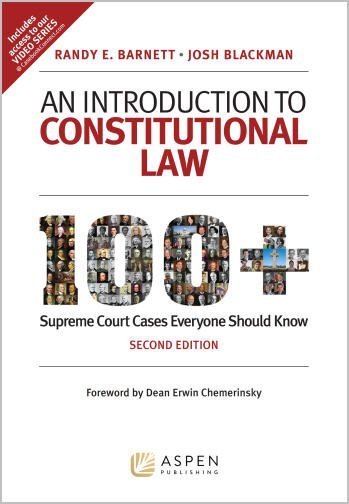
An Introduction to Constitutional Law: 100+ Supreme Court Cases Everyone Should Know 2nd Edition
Original price was: $50.00.$9.99Current price is: $9.99.
Safe & secure checkout
Description
Description
An Introduction to Constitutional Law: 100+ Supreme Court Cases Everyone Should Know 2nd Edition
[PDF eBook eTextbook] – Available Instantly
- Publisher : Aspen Opco Llc
- Publication date : November 8, 2022
- Edition : 2nd
- Language : English
- 421 pages
- ISBN-13 : 979-8886140729
NOTE: This book is a standalone book and will not include any access codes.
An Introduction to Constitutional Law teaches the narrative of constitutional law as it has developed historically and provides the essential background to understand how this foundational body of law has come to be what it is today. This multimedia experience combines a book and video series to engage students more directly in the study of constitutional law. All students—even those unfamiliar with American history—will garner a firm understanding of how constitutional law has evolved. An eleven-hour online video library brings the Supreme Court’s most important decisions to life. Videos are enriched by photographs, maps, and audio from the Supreme Court. The book and videos are accessible for all levels: law school, college, high school, home school, and independent study. Students can read and watch these materials before class to prepare for lectures or study after class to fill in any gaps in their notes. And, come exam time, students can binge-watch the entire canon of constitutional law in about twelve hours.
Table of Contents:
Cover
Front Matter
Editorial Advisors
Praise for Barnett & Blackman’s
Title Page
Copyright
About Aspen Publishing
Table of Contents
Contents
Foreword
Authors’ Note
Part I. Foundational Cases on Constitutional Structure
1. Chisholm v. Georgia (1793)
2. Marbury v. Madison (1803)
3. McCulloch v. Maryland (1819)
4. Gibbons v. Ogden (1824)
5. Barron v. Baltimore (1833)
Part II. Enumerated Powers
6. Prigg v. Pennsylvania (1842)
7. Enumerated Powers on the Chase Court (1869-1871)
United States v. Dewitt (1869)
Hepburn v. Griswold (1870)
Knox v. Lee (1871)
8. Enumerated Powers in the Progressive Era (1895-1918)
United States v. E.C. Knight (1895)
Champion v. Ames (1903)
Hammer v. Dagenhart (1918)
9. Schechter Poultry Corp. v. United States (1935)
10. The Substantial Effects Doctrine (1937-1942)
NLRB v. Jones & Laughlin Steel Corp. (1937)
United States v. Darby (1941)
Wickard v. Filburn (1942)
11. Enumerated Powers on the Warren Court (1964)
Heart of Atlanta Motel v. United States (1964)
Katzenbach v. McClung (1964)
12. South Dakota v. Dole (1987)
13. United States v. Lopez (1995)
14. United States v. Morrison (2000)
15. Gonzales v. Raich (2005)
16. NFIB v. Sebelius (2012)
Part III. Federalism Limits on Congressional Power
17. New York v. United States (1992)
18. Printz v. United States (1997)
19. The Eleventh Amendment
Hans v. Louisiana (1890)
Seminole Tribe of Florida v. Florida (1996)
20. Section 5 of the Fourteenth Amendment
City of Boerne v. Flores (1997)
United States v. Morrison (2000)
Board of Trustees of University of Alabama v. Garrett (2001)
Nevada Department of Human Resources v. Hibbs (2003)
Part IV. The Executive Power
21. Ex parte Merryman (1861)
22. Youngstown Sheet & Tube Company v. Sawyer (1952)
23. Korematsu v. United States (1944)
Part V. The Separation of Powers
24. Morrison v. Olson (1988)
25. NLRB v. Noel Canning (2014)
Part VI. Slavery and the Reconstruction Amendments
26. Dred Scott v. Sandford (1857)
27. The History of the Thirteenth and Fourteenth Amendments
The Article IV Privileges and Immunities Clause
Dred Scott v. Sandford (1857)
The Thirteenth Amendment
The Civil Rights Act of 1866 and the Freedmen’s Bureau Act
The Fourteenth Amendment
The Citizenship Clause
The Privileges or Immunities Clause
The Due Process Clause
The Equal Protection Clause
Section 5
The Supreme Court and Reconstruction Amendments
28. The Privileges or Immunities Clause
The Slaughter-House Cases (1873)
Bradwell v. Illinois (1873)
United States v. Cruikshank (1875)
29. The Enforcement Powers of the Thirteenth and Fourteenth Amendments
Strauder v. West Virginia (1880)
The Civil Rights Cases (1883)
30. The Equal Protection Clause of the Fourteenth Amendment
Yick Wo v. Hopkins (1886)
Plessy v. Ferguson (1896)
Part VII. Expanding the Scope of the Due Process Clause
31. Lochner v. New York (1905)
32. “Economic” Liberty in the Progressive Era
Muller v. Oregon (1908)
Buchanan v. Warley (1917)
Adkins v. Children’s Hospital (1923)
33. “Personal” Liberty in the Progressive Era
Meyer v. Nebraska (1923)
Pierce v. Society of Sisters (1925)
Buck v. Bell (1927)
34. “Economic” Liberty Through the New Deal
O’Gorman & Young, Inc. v. Hartford Fire Insurance Company (1931)
Nebbia v. New York (1934)
West Coast Hotel v. Parrish (1937)
35. “Economic” Liberty After the New Deal
United States v. Carolene Products (1938)
Williamson v. Lee Optical (1955)
Part VIII. Equal Protection of the Law: Discrimination on the Basis of Race
36. The School Desegregation Cases
Brown v. Board of Education (1954)
Bolling v. Sharpe (1954)
37. Cooper v. Aaron (1958)
38. Loving v. Virginia (1967)
39. Affirmative Action on the Burger and Rehnquist Courts
Regents of the University of California v. Bakke (1978)
Gratz v. Bollinger (2003)
Grutter v. Bollinger (2003)
Part IX. Equal Protection of the Law: Sex Discrimination and Other Types
40. Sex Discrimination on the Burger Court
Frontiero v. Richardson (1973)
Craig v. Boren (1976)
41. United States v. Virginia (1996)
42. “Heightened” Rational Basis Scrutiny
City of Cleburne v. Cleburne Living Center, Inc. (1985)
Romer v. Evans (1996)
Part X. Modern Substantive Due Process
43. Griswold v. Connecticut (1965)
44. Roe v. Wade (1973)
45. Planned Parenthood v. Casey (1992)
46. Lawrence v. Texas (2003)
47. Obergefell v. Hodges (2015)
48. Dobbs v. Jackson Women’s Health Organization (2022)
Part XI. Freedom of Speech
49. Sedition and Prior Restraint
50. “Clear and Present Danger”
Schenck v. United States (1919)
Debs v. United States (1919)
Abrams v. United States (1919)
Gitlow v. People of the State of New York (1925)
Stromberg v. California (1931)
51. When Is Conduct Speech?
United States v. O’Brien (1968)
Texas v. Johnson (1989)
R.A.V. v. City of St. Paul (1992)
52. Does Money Equal Speech?
Buckley v. Valeo (1976)
McConnell v. Federal Election Commission (2003)
Citizens United v. Federal Election Commission (2010)
53. Does the First Amendment Protect Tortious Speech?
New York Times Company v. Sullivan (1964)
Snyder v. Phelps (2011)
54. Does the First Amendment Protect “Offensive” Speech?
United States v. Stevens (2010)
Brown v. Entertainment Merchants Association (2011)
55. Tinker v. Des Moines Independent Community School District (1969)
56. New York Times Co. v. United States (1971)
Part XII. The Free Exercise of Religion
57. Generally Applicable Laws Burdening Free Exercise
Sherbert v. Verner (1963)
Wisconsin v. Yoder (1972)
Employment Division v. Smith (1990)
Church of the Lukumi Babalu Aye v. City of Hialeah (1993)
Part XIII. No Law Respecting an Establishment of Religion
58. Engel v. Vitale (1962)
59. Town of Greece v. Galloway (2014)
60. American Legion v. American Humanist Association (2019)
Part XIV. The Right to Keep and Bear Arms
61. District of Columbia v. Heller (2008)
62. McDonald v. City of Chicago (2010)
63. New York State Rifle & Pistol Association, Inc. v. Bruen (2022)
Part XV. Taking Private Property for Public Use
64. What Is a Taking?
Pennsylvania Coal Company v. Mahon (1922)
Penn Central Transportation Company v. New York (1978)
65. Kelo v. City of New London (2005)
Part XVI. The Rights of the Accused
66. Gideon v. Wainwright (1963)
67. Miranda v. Arizona (1966)
Part XVII. Voting Rights
68. Baker v. Carr (1962)
69. Shaw v. Reno (1993)
Appendix A. Annotated Constitution of the United States
Appendix B. Members of the Supreme Court of the United States
Index
Acknowledgments
About the Authors
Randy E. Barnett is the Patrick Hotung Professor of Constitutional Law at the Georgetown University Law Center, where he teaches constitutional law and contracts, and is the Faculty Director of the Georgetown Center for the Constitution. Professor Barnett’s publications include twelve books, more than one hundred and fifty articles and reviews, as well as numerous op- eds.
Josh Blackman holds the Centennial Chair of Constitutional Law at the South Texas College of Law Houston. Josh is the author of three books, one casebook, five dozen law review articles, and his commentary has appeared in national publications. Josh is the President of the Harlan Institute and founder of FantasySCOTUS.
What makes us different?
• Instant Download
• Always Competitive Pricing
• 100% Privacy
• FREE Sample Available
• 24-7 LIVE Customer Support