
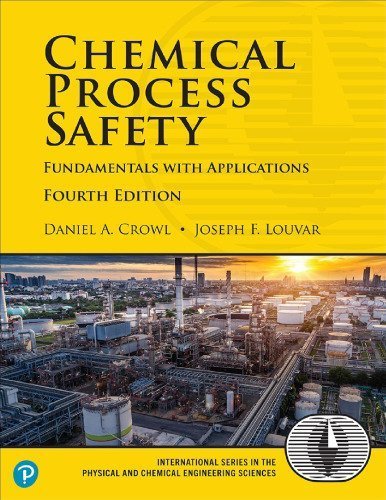
Chemical Process Safety: Fundamentals with Applications 4th Edition by Daniel A. Crowl, ISBN-13: 978-0134857770
Original price was: $100.00.$19.99Current price is: $19.99.
Safe & secure checkout
Description
Description
Chemical Process Safety: Fundamentals with Applications 4th Edition by Daniel A. Crowl, ISBN-13: 978-0134857770
[PDF eBook eTextbook] – Available Instantly
- Publisher: Pearson; 4th edition (June 4, 2019)
- Language: English
- ISBN-10: 0134857771
- ISBN-13: 978-0134857770
The #1 Process Safety Guide, Now Extensively Updated for Current Industrial Processes, Systems, and Practices.
Process safety has seen a dramatic consolidation of concepts in the past few years. Chemical Process Safety, Fourth Edition, provides students and working engineers with the understanding necessary to apply these new concepts to safely design and operate any process.
Long the definitive guide in the field, this edition fully reflects major recent advances in process safety technology and practice. Readers will find extensive new and updated coverage of relief sizing, hazards identification, risk assessment, and many other topics. Several chapters have been completely rewritten, and all are substantially modified. This textbook includes 50 new problems and solutions (mostly in SI units), and 25 new case histories.
- Safety culture
- Preventive and mitigative safeguards
- The CCPS 20 elements of Risk Based Process Safety (RBPS)
- Toxicology, industrial hygiene, and source models
- Hazardous material dispersion
- Fires, explosions, and concepts for preventing them
- Chemical reactivity
- Reliefs and relief sizing
- Hazards identification and evaluation
- Risk analysis and assessment, including Layer of Protection Analysis (LOPA)
- Safety strategies, procedures, designs, case histories, and lessons learned
Crowl and Louvar link key academic concepts to modern industrial practice, making this guide invaluable for all engineering students and for all working engineers.
Table of Contents:
Cover Page
Half-Title Page
Title Page
Copyright Page
Contents
Preface
Acknowledgments
About the Authors
Nomenclature
Chapter 1. Introduction
1-1 Engineering Ethics
1-2 Myths about Process Safety
1-3 Safety Culture
1-4 Individual Risk, Societal Risk, and Risk Populations
1-5 Voluntary and Involuntary Risk
1-6 Safety Metrics
1-7 Accident and Loss Statistics
1-8 Risk Perception
1-9 Risk Tolerance/Acceptance and Risk Matrix
1-10 Codes, Standards, and Regulations
1-11 Safeguards
1-12 The CCPS 20 Elements of Risk-Based Process Safety
1-13 Inherently Safer Design
1-14 The Worst Chemical Plant Tragedy: Bhopal, India, 1984
1-15 Overview of Chemical Process Safety
Suggested Reading
Problems
Chapter 2. Toxicology
2-1 How Toxicants Enter the Body
2-2 How Toxicants Are Eliminated from the Body
2-3 Effects of Toxicants on the Body
2-4 Toxicological Studies
2-5 Dose versus Response
2-6 Dose and Response Using Probit Equation
2-7 Relative Toxicity
2-8 Threshold Limit Values
Online Resources
Suggested Reading
Problems
Chapter 3. Industrial Hygiene
3-1 Anticipating and Identifying Hazardous Workplace Exposures
3-2 Globally Harmonized System
3-3 Evaluate the Magnitude of Exposures and Responses
3-4 Develop and Evaluate Control Techniques to Prevent Exposures
3-5 National Fire Protection Association Diamond
Online Resources
Suggested Reading
Problems
Chapter 4. Source Models
4-1 Introduction to Source Models
4-2 Flow of Liquid through a Hole
4-3 Flow of Liquid through a Hole in a Tank
4-4 Flow of Liquids through Pipes
4-5 Flow of Gases or Vapors through Holes
4-6 Flow of Gases or Vapors through Pipes
4-7 Flashing Liquids
4-8 Liquid Pool Evaporation or Boiling
4-9 Realistic and Worst-Case Releases
4-10 Conservative Analysis
Suggested Reading
Problems
Chapter 5. Hazardous Material Dispersion
5-1 Parameters Affecting Dispersion
5-2 Neutrally Buoyant Dispersion Models
5-3 Pasquill–Gifford Model
5-4 Dense Gas Dispersion
5-5 Toxic Effect Criteria
5-6 Release Prevention and Mitigation
Suggested Reading
Problems
Chapter 6. Fires and Explosions
6-1 The Fire Triangle
6-2 Distinction between Fires and Explosions
6-3 Definitions
6-4 Flammability Characteristics of Liquids and Vapors
6-5 Flammability Characteristics of Dusts
6-6 Sprays and Mists
6-7 Ignition Energy
6-8 Ignition Sources
6-9 Experimental Characterization of Gas/Vapor and Dust Explosions
6-10 Explosions
Suggested Reading
Problems
Chapter 7. Concepts to Prevent Fires and Explosions
7-1 Inerting
7-2 Static Electricity
7-3 Controlling Static Electricity
7-4 Explosion-Proof Equipment and Instruments
7-5 Ventilation
7-6 Sprinkler Systems
7-7 Industry’s Fire and Explosion Protection Strategy
Suggested Reading
Problems
Chapter 8. Chemical Reactivity
8-1 Background Understanding
8-2 Commitment, Awareness, and Identification of Reactive Chemical Hazards
8-3 Characterization of Reactive Chemical Hazards Using Calorimeters
8-4 Controlling Reactive Hazards
Suggested Reading
Problems
Chapter 9. Introduction to Reliefs
9-1 Relief Concepts
9-2 Definitions
9-3 Code Requirements
9-4 Relief System Design
9-5 Relief Types and Characteristics
9-6 Relief Installation Practices
9-7 Relief Effluent Handling
Suggested Reading
Problems
Chapter 10. Relief Sizing
10-1 Set Pressure and Accumulation Limits for Reliefs
10-2 Relief Sizing for Liquid Service
10-3 Relief Sizing for Vapor and Gas Service
10-4 Two-Phase Flow during Runaway Reaction Relief
10-5 Deflagration Venting for Dust and Vapor Explosions
10-6 Venting for Fires External to the Process
10-7 Reliefs for Thermal Expansion of Process Fluids
Suggested Reading
Problems
Chapter 11. Hazards Identification and Evaluation
11-1 Introduction to Hazard Identification/Evaluation and Risk Analysis
11-2 Non-Scenario-Based Hazard Identification/Evaluation Methods
11-3 Scenario-Based Hazard Identification/Evaluation Methods
11-4 Documentation and Actions Required for Hazard Identification and Evaluation
Problems
Chapter 12. Risk Analysis and Assessment
12-1 Review of Probability Theory
12-2 Event Trees
12-3 Fault Trees
12-4 Bow-Tie Diagrams
12-5 Quantitative Risk Analysis
12-6 Layer of Protection Analysis
12-7 Risk Assessment
Suggested Reading
Problems
Chapter 13. Safety Strategies, Procedures, and Designs
13-1 Process Safety Strategies
13-2 Safe Operating Procedures
13-3 Safe Work Practices
13-4 Designs for Process Safety
13-5 Designs for Runaway Reactions
13-6 Designs and Practices for the Safe Handling of Dusts
Suggested Reading
Problems
Chapter 14. Case Histories and Lessons Learned
14-1 Process Safety Culture
14-2 Compliance with Standards
14-3 Process Safety Competency
14-4 Workplace Involvement
14-5 Stakeholder Outreach
14-6 Process Knowledge Management
14-7 Hazard Identification and Risk Analysis
14-8 Operating Procedures
14-9 Safe Work Practices
14-10 Asset Integrity and Reliability
14-11 Contractor Management
14-12 Training and Performance Assurance
14-13 Management of Change
14-14 Operational Readiness
14-15 Conduct of Operations
14-16 Emergency Management
14-17 Incident Investigation
14-18 Measurement and Metrics
14-19 Auditing
14-20 Management Review and Continuous Improvement
14-21 Summary
Suggested Reading
Problems
Appendix A. Unit Conversion Constants
Appendix B. Flammability Data for Selected Hydrocarbons
Appendix C. Saturation Vapor Pressure Data
Appendix D. Special Types of Reactive Chemicals
Appendix E. Hazardous Chemicals Data for a Variety of Chemical Substances
Appendix F. Process Diagrams
Index
Daniel A. Crowl is the Herbert H. Dow Professor for Chemical Process Safety at Michigan Technological University. Professor Crowl received his B.S. in fuel science from Pennsylvania State University and his M.S. and Ph.D. in chemical engineering from the University of Illinois. He is coauthor of the textbook Chemical Process Safety: Fundamentals with Applications, published by Pearson. He is also author/editor of several AIChE books on process safety and editor of the safety section in the eighth edition of Perry’s Chemical Engineer’s Handbook. Professor Crowl has won numerous awards, including the Bill Doyle award from AIChE, the Chemical Health and Safety Award from ACS, the Walton/Miller award from the Safety and Health Division of AIChE, and the Gary Leach Award from the AIChE Board. Professor Crowl is a Fellow of AIChE, ACS Safety and Health Division, and CCPS.
Joseph F. Louvar has a B.S., M.S., and Ph.D. in chemical engineering. He is currently a professor at Wayne State University after having retired from the BASF Corporation. While working at the BASF Corporation, he was a director of BASF’s chemical engineering department; his responsibilities included the production of specialty chemicals, and he managed the implementation and maintenance of five processes that handled highly hazardous chemicals that were covered by Process Safety Management. As a professor at Wayne State University, he teaches chemical process safety, risk assessment, and process design. Professor Louvar is the author of many safety-related publications and the coauthor of two books, Chemical Process Safety: Fundamentals with Applications and Health and Environmental Risk Analysis: Fundamentals with Applications, both published by Pearson. Professor Louvar has been the chair of the Loss Prevention Committee and the Safety and Health Division. He is the CCPS staff consultant for the Undergraduate Education Committee, commonly known as the Safety and Chemical Engineering Education Committee (SAChE), and he is the coeditor of AIChE’s journal for process safety, Process Safety Progress.
What makes us different?
• Instant Download
• Always Competitive Pricing
• 100% Privacy
• FREE Sample Available
• 24-7 LIVE Customer Support