
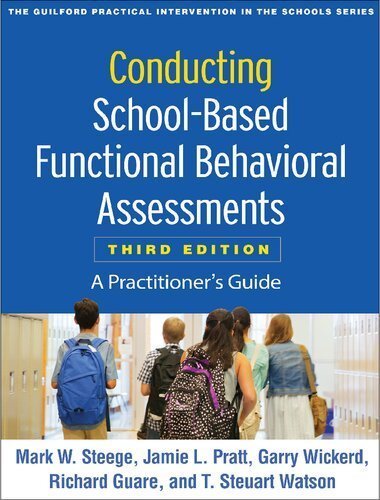
Conducting School-Based Functional Behavioral Assessments: A Practitioner’s Guide 3rd Edition, ISBN-13: 978-1462538737
Original price was: $50.00.$14.99Current price is: $14.99.
Safe & secure checkout
Description
Description
Conducting School-Based Functional Behavioral Assessments: A Practitioner’s Guide 3rd Edition, ISBN-13: 978-1462538737
[PDF eBook eTextbook] – Available Instantly
- Publisher: The Guilford Press; Third edition (February 26, 2019)
- Language: English
- 299 pages
- ISBN-10: 1462538738
- ISBN-13: 978-1462538737
Widely recognized as a gold-standard resource, this authoritative book has been revised and expanded with 50% new material. It provides a complete introduction to functional behavioral assessment (FBA), complete with procedures, forms, and tools that have been piloted and refined in both general and special education settings. Numerous vivid examples illustrate how to use the authors’ behavior-analytic problem-solving model (BAPS) to synthesize assessment results and guide the design of individually tailored interventions. Practitioners and students enjoy the engaging, conversational tone. In a convenient large-size format, the book includes 17 reproducible checklists and forms. Purchasers get access to a companion webpage where they can download and print the reproducible materials.
New to This Edition:
* Revised BAPS model reflects the latest research and offers a more comprehensive approach to FBA.
* Chapters on professional and ethical standards; analyzing how biological/medical conditions, thoughts, and emotions influence behavior; and analyzing how executive skills deficits influence behavior.
* Chapters on testing hypotheses about the functions of problem behavior; testing reinforcer effectiveness; and evaluating function-based interventions.
* Chapter providing applied learning experiences for professionals and students.
* Most of the reproducible tools are new or revised.
Table of Contents:
Half Title Page
Series Page
Title Page
Copyright
Dedication
About the Authors
Foreword
Preface
Acknowledgments
Contents
1. Introduction to Functional Behavioral Assessment
A Functional Perspective
What Is FBA?
FBA Methods
Indirect Assessment
Descriptive Assessment
Experimental Analysis
Treatment Analysis
FBA and Philosophy
Philosophical Doubt
Empiricism
Interactionism
Behavioral Compassion
Behavioral Empathy
FBA and Problem Solving
Phase 1: Identification and Description of Interfering Behavior
Phase 2: Recording Current Levels of Interfering Behaviors
Phase 3: Identifying and Describing Antecedent, Consequence,and Associated Variables
Phase 4: Conceptual Synthesis
Phase 5: Linking Assessment Data to Interventions
Phase 6: Implementation
Phase 7: Progress Monitoring
Summary
2. Professional Standards and Ethical Considerations
National Association of School Psychologists
Behavior Analyst Certification Board
Who Is Qualified to Conduct an FBA?
Behavioral Skills Training to Promote and Maintain FBA Competencies
Resources to Support and Evaluate Competencies in FBA
Functional Behavioral Assessment Competency Scale
Functional Behavioral Assessment Procedural Checklist
Summary
Form 2.1. Functional Behavioral Assessment Competency Scale (FBACS)
Form 2.2. Functional Behavioral Assessment Procedural Checklist (FBAPC)
Form 2.3. Functional Behavioral Assessment Informed Consent Form
3. Conceptual Foundations of Functional Behavioral Assessment
Functional Antecedents and Consequences
Consequence Variables
Positive Reinforcement
Negative Reinforcement
Individually Mediated, Socially Mediated, and Automatic Reinforcement
Antecedent Variables
Discriminative Stimuli
Motivating Operations
SDs and MOs
Antecedents and Consequences: A Summary
Additional Behavior‑Analytic Terms and Concepts
Response Classes (When It Rains . . . It Pours)
Response Class Hierarchies (First the Sky Darkens, Then There Is Thunder and Lightning Followed by a
The Matching Law
Summary
4. Behavior Analysis of Medical Conditions, Emotions, and Thoughts
Biological and Medical Influences on Behavior
How Exactly Do Biological and Medical Variables Affect Interfering Behaviors?
The Influence of Emotions on Behavior
How Exactly Do Emotions Affect Interfering Behaviors?
The Influence of Thoughts on Behavior
How Exactly Do Thoughts (Covert Verbal Behaviors) Affect Interfering Behaviors?
Summary
5. Executive Skills
Executive Skills: A Brief Introduction
Executive Skills Intervention
Intervention Example 1: Response Inhibition
Intervention Example 2: Flexibility
Summary
Form 5.1. Executive Skills Questionnaire for Parents/Teachers
Form 5.2. Executive Skills Questionnaire for Students
Form 5.3. Executive Skills Problem Checklist, Elementary Version—Teacher
Form 5.4. Executive Skills Problem Checklist, Middle/High School Version
Form 5.5. Executive Skills Problem Checklist, Elementary Version—Parents
6. The Behavior-Analytic Problem‑Solving Model
Rationale for the BAPS Model
The Evolution of Conceptual Models
The Three‑Term Conceptual Model
The Four‑Term Conceptual Model
The Five‑Term Conceptual Model
The Eight‑Term Conceptual Model
Components of the BAPS Model
Interfering Behavior
Context
Personal Characteristics
Skill Delays/Deficits
Motivational Triggers (MOs)
Sources of Reinforcement (SDs)
Reinforcing Consequences
Parameters of Reinforcement
Summary
Using the Behavior‑Analytic Problem Solving: Assessment Results Recording Form
Step 1: Interfering Behavior
Step 2: Context
Step 3: Reinforcing Consequences
Step 4: Motivational Triggers (MOs)
Step 5: Sources of Reinforcement (SDs)
Step 6: Personal Characteristics
Step 7: Skill Delays/Deficits
Step 8: Parameters of Reinforcement
Case Examples of the BAPS Model
The Case of the Missing Snack
Additional Case Examples
Communicating FBA Results and Recommendations Using the BAPS Model
BAPS Revelations
Summary
Summary
Form 6.1. Behavior-Analytic Problem Solving: Assessment Results
7. Indirect Functional Behavioral Assessment
Indirect FBA
Considerations for Evaluators Conducting Indirect FBAs
Indirect FBA Procedures
Review of Records
Analysis of Rating Scale Results
Interviews
Behavior‑Analytic Problem‑Solving Interview
Behavioral Stream Interview
Summary
Form 7.1. Behavior-Analytic Problem-Solving Interview (BAPS-I)
8. Descriptive Functional Behavioral Assessment
Defining Behavior
Recording Behavior
Frequency Recording
Duration Recording
Latency Recording
Interval Recording
Performance‑Based Behavior Recordings
Conducting Descriptive FBAs
Functional Behavioral Assessment Observation Form
Incident‑Based Functional Assessment Form
Conditional Probability Record
Interval Recording Procedure
Task Analysis Recording Procedure
Comparing and Contrasting Descriptive FBA Procedures
Summary
Case Example: Indirect and Descriptive FBA
Background Information
Critique of Previous Evaluations
Presenting Referral Concerns
The Functional Behavioral Assessment Process
Recommendations
Case Outcomes
Form 8.1. Functional Behavioral Assessment Observation Form (FBAOF)
Form 8.2. Incident-Based Functional Assessment Form (IBFAF)
Form 8.3. Conditional Probability Record (CPR)
Form 8.4. Interval Recording Procedure (IRP)
9. Experimental Functional Behavioral Assessment
Extended Functional Analysis
Considerations
Case Example of Extended Functional Analysis
Brief Functional Analysis
Case Example of Brief Functional Analysis
Trial‑Based Functional Analysis
Case Example of Trial‑Based Functional Analysis
Synthesized Functional Analysis
Case Example of Synthesized Functional Analysis
Structural Analysis
Case Example of Structural Analysis
Summary
Form 9.1. Task Difficulty Antecedent Analysis Form
10. Preference Assessment and Experimental Analysis of Reinforcer Effectiveness
Preference Assessment
Indirect Assessment of Potential Reinforcers
Descriptive Assessment of Potential Reinforcers
Preference Assessment Considerations
Experimental Analysis of Reinforcer Effectiveness
Case Example
Summary
11. Function-Based Interventions
Antecedent Interventions
Linking FBA Results to Antecedent Interventions
Teaching and Reinforcement‑Based Interventions
Linking FBA Results to Teaching and Reinforcement‑Based Strategies
Consequence‑Based Strategies to Reduce Interfering Behavior
Linking FBA Results to Consequence‑Based Strategies to Reduce Interfering Behavior
Behavior‑Analytic Problem Solving: Function‑Focused Intervention
Using the Behavior‑Analytic Problem Solving: Function‑Focused Intervention Planning Tool
Case Example of Function‑Focused Planning
Summary
Form 11.1. Behavior-Analytic Problem Solving: Function-Focused Intervention
12. Treatment Analysis
Treatment Effectiveness Assessment
Case Example of Treatment Effectiveness Assessment
Treatment Comparison Analysis
Case Examples of Treatment Comparison Analyses
Summary
13. Functional Behavioral Assessment Report Templates and Examples
The FBA Report Template
Identifying Information
Evaluation Dates
Reason for Referral
Purposes of the FBA
Description of Assessment Procedures
Relevant Background Information
Results: Identification and Description of Interfering Behaviors
Results: Documentation of Current Levels of Interfering Behaviors
Results: Graphic Display of Interfering Behaviors
Results: Behavior‑Analytic Interviews
Results: Behavior‑Analytic Observations
Results: Experimental Analyses
Synthesis of Results
Results: Behavior‑Analytic Treatment Assessments
Summary
Interpretive Session with Parent(s)/Guardian(s)
Recommendations for the Team’s Consideration
Summary
Form 13.1. Behavioral Assessment Report
14. Applied Learning Experiences
Applied Learning Experience 1: Identifying, Describing, and Recording Behavior
Identifying Behavior
Describing Behavior
Selecting a Behavior Recording Procedure
Using the Behavior Recording Procedure
Interpreting the Behavior Recording Procedure Data
Applied Learning Experience 2: Behavior Recording Practice
Applied Learning Experience 3: Interobserver Agreement (IOA)
Applied Learning Experience 4: Four‑Term Contingency
Applied Learning Experience 5: Four‑Term Contingency
Applied Learning Experience 6: Four‑Term Contingency
Applied Learning Experience 7: Behavior‑Analytic Interview (Role Play)
Applied Learning Experience 8: Behavior‑Analytic Interview (Actual Case)
Applied Learning Experience 9: Designing the Interval Recording Procedure (IRP)
Applied Learning Experience 10: Implementing the IRP
Applied Learning Experience 11: Behavior‑Analytic Observation
Applied Learning Experience 12: Designing Experimental Analyses
Applied Learning Experience 13: Conducting Experimental Analyses
Applied Learning Experience 14: Behavior‑Analytic Problem Solving (BAPS) and Case Conceptualizatio
Applied Learning Experience 15: Identifying Reinforcers
Applied Learning Experience 16: Behavior‑Analytic Problem Solving (BAPS) and Function‑Focused In
Applied Learning Experience 17: Treatment Analysis (Treatment Effectiveness)
Applied Learning Experience 18: Treatment Analysis (Treatment Comparison)
Applied Learning Experience 19: Explaining Assessment Results and Recommendations
Applied Learning Experience 20: Consultation, Training, and Supervision
Summary
15. It’s the Final Chapter
Case Examples of Pliable and Flexible FBAs
The Suspended Student
Several Target Behaviors
Uninformed Consent and Tardiness
The English Language Learner
It Takes a Village
Low‑Rate, High‑Intensity Behaviors and Variables That Are Unethical to Manipulate
Peer‑Mediated Reinforcement
Parting Shots
Appendix. Functional Behavioral Assessment Rating Scale (FuBARS)
References
Index
Mark W. Steege, PhD, NCSP, BCBA-D, is Professor of Educational and School Psychology at the University of Southern Maine. He has written numerous research articles, book chapters, and books on functional behavioral assessment and response to intervention. His primary research interests are the application of applied behavior analysis in the assessment and treatment of interfering behaviors with persons with developmental disabilities. Dr. Steege has served on the editorial boards of the Journal of Applied Behavior Analysis, School Psychology Review, and Journal of Evidence-Based Practices for Schools.
Jamie L. Pratt, PsyD, BCBA-D, is Assistant Professor and Chair of Educational and School Psychology at the University of Southern Maine. Dr. Pratt has coauthored several articles and book chapters on behavioral assessment and intervention, and has provided assessment, intervention, and consultation services for school-age children with developmental, emotional, and behavioral disorders. Her primary research interests are in extending behavior analytic assessment and intervention methods to improve outcomes for children.
Garry Wickerd, PhD, NCSP, BCBA, is Assistant Professor of Educational and School Psychology at the University of Southern Maine. He has coauthored several behavioral research publications and serves on the editorial board of School Psychology Forum. Dr. Wickerd’s primary research interests are behavioral measurement and assessment validity.
What makes us different?
• Instant Download
• Always Competitive Pricing
• 100% Privacy
• FREE Sample Available
• 24-7 LIVE Customer Support