

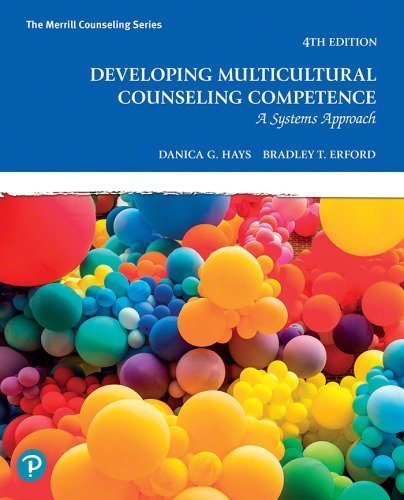
Developing Multicultural Counseling Competence: A Systems Approach 4th Edition, ISBN-13: 978-0137474226
Original price was: $50.00.$19.99Current price is: $19.99.
Safe & secure checkout
Description
Description
Developing Multicultural Counseling Competence: A Systems Approach 4th Edition, ISBN-13: 978-0137474226
[PDF eBook eTextbook] – Available Instantly
- Publisher : Pearson; 4th edition (June 28, 2022)
- Language : English
- 764 pages
- ISBN-10 : 0137474229
- ISBN-13 : 978-0137474226
Developing Multicultural Counseling Competence is infused with self-development opportunities, first-hand perspectives, and real cases to help you on your journey of developing multicultural counseling competence. Emphasis is placed on promoting awareness, knowledge, and skills for understanding cultural makeup and privilege and oppression experiences; understanding others of diverse identities and experiences; and engaging in facilitative counseling relationships.
Table of Contents:
Preface
Organization of Text
New to This Edition
Key Content Updates by Chapter
Pedagogical Features
Learning Management System (LMS)-Compatible Assessment Bank, and Other Instructor Resources
Brief Contents
Contents
About the Editors
About the Contributing Authors
Section 1 The Foundations of Multicultural Counseling
Chapter 1 The Culturally Competent Counselor
Preview
Learning Outcomes
The Culturally Competent Counselor
Key Terminology of Multicultural Counseling
U.S. Demographics
Race and Ethnicity
Nationality
Age
Socioeconomic Status
Rates of Mental Illness
Mental Health Treatment and Multicultural Populations
Counseling versus Cultural Norms of Diverse Populations
Inaccessibility of Services
Stigma and Mistrust
Prejudice and Discrimination
Immigration
Acculturation and Enculturation
Case Study 1.1
Individual and Collective Trauma
The Role of Communication in Multicultural Counseling
Verbal Communication
Nonverbal Communication
Emotional Expression
Communication Patterns of Clients and Counselors
Developing Multicultural Counseling Competence
A Systems Approach to Multicultural Counseling Competence
Case Study 1.2
Level 1: Individual
Levels 2, 3, and 4: Family, Friends, and other Peers
Level 5: Community
Level 6: Historical
Ethical Considerations in Multicultural Counseling
Case Study 1.3
State of the Research: Multicultural Counseling Competency
Summary
Review Questions
Chapter 2 Cultural Identity Development
Preview
Learning Outcomes
Racial and Ethnic Identity Development
Racial Identity Models
Cross’s Nigrescence Model
Case Study 2.1
Helms’s People-of-Color Identity Model
Helms’s White Identity Model
Case Study 2.2
Ponterotto’s Model of Cultural Identity Development
Phinney’s Model of Ethnic Identity
Biracial and Multiracial Identity Development
Biracial Identity Development
Multiracial Identity Development
Multiple Heritage Identity Development
Case Study 2.3
Case Study 2.4
Addressing Racial and Ethnic Identity in Counseling
Gender Identity Development
Gender Identity Models
The Key Model
Downing and Roush’s Model of Feminist Identity
Hoffman’s Model of Feminist Identity
Devor’s Model of Transsexual and Transgender Identity Formation
Lev’s Transgender Emergence Model
De Vries Intersectional Model
Addressing Gender Identity in Counseling
Sexual Identity Development
Sexual Identity Models
Cass’s Homosexual Identity Formation Model
Coleman’s Coming-Out Model
Brady and Busse’s Sexual Identity Model
Troiden’s Model of Sexual Identity
Inclusive Model of Lesbian/Gay (L/G) Identity Formation
Bisexual Identity Development
Addressing Sexual Identity in Counseling
Case Study 2.5
Case Study 2.6
Spiritual and Faith Identity Development
Spiritual Identity Models
Spero’s Development of Religious Transformations
Fowler’s Model of Faith Development
Genia’s Development of Growth
Poll and Smith’s Model of Spiritual Identity
Parks’s Model of Spiritual Identity
Case Study 2.7
Case Study 2.8
Addressing Spiritual Identity in Counseling
State of the Research: Cultural Identity Development
Summary
Review Questions
Section 2 Social Advocacy
Chapter 3 Social Justice Counseling
Preview
Learning Outcomes
Key Constructs for Understanding Social Advocacy
Social Justice and Mental Health
Historical Context
Counselors as Social Advocates
Advocacy in Professional Counseling Standards
Three-Tiered Model of Social Advocacy
Case Study 3.1 Case of the Three-Tiered Model: Supervision
Case Study 3.2 Case of the Three-Tiered Model: Mental Health Counseling
Case Study 3.3 Case of the Three-Tiered Model: School Counseling
Case Study 3.4 Case of the Three-Tiered Model: Rehabilitation Counseling
Case Study 3.5 Case of the Three-Tiered Model: College Campus Hate Crime
Case Study 3.6 Case of the Three-Tiered Model: Counselor Educator
Challenges and Benefits of Social Justice Counseling
State of the Research: Social Justice Counseling
Summary
Review Questions
Chapter 4 Racism and White Supremacy
Preview
Learning Outcomes
Race and Racism
Social Construction of Race
Defining Racism
Costs of Racism for People of Color
Case Study 4.1
Cognitive Costs
Affective Costs
Interpersonal Costs
Physical Costs
Efforts to Combat the Costs of Racism
White Supremacy
White Privilege
White People’s Psychological Responses to Racism and White Privilege
White Fragility
Being American
Racial Microaggressions and Macroaggressions
Color-Blind Racial Attitudes
Myth of Meritocracy
Focus on Exceptions
The Costs of Racism for White People
Cognitive Costs
Affective Costs
Interpersonal Costs
State of the Research: Racism, White Supremacy, and White Privilege
Becoming Antiracist
Counselor Self-Awareness
Client Services
Assessing the Client’s Racial Identity
Addressing Microaggressions
Addressing Client Racial Prejudice
Community Collaboration
Addressing Racism in the Client’s School and Community
Addressing Racism Within Other Systems
Economic Concerns
Public Health Concerns
Legal Concerns
Taking Action
Selected Books
Selected Films (Descriptions extracted from www.imdb.com)
Other Resources
Summary
Review Questions
Chapter 5 Gender and Sexism
Preview
Learning Outcomes
Understanding Gender and Sexism
Gender and Counseling Considerations
Counseling Cisgender and Trans Girls and Women
Case Study 5.1
Counseling Cisgender and Trans Men
Case Study 5.2
Counseling People who are Trans and Nonbinary
Case Study 5.3
Historical Context of Sexism
White Colonization, Enslavement, and Warfare
World War II and Women’s Return “Home”
Historical Resistance to Sexism: Womanist and Feminist Movements
Cultural Intersections of Gender
Gender and Sexism for Individuals of African and African American Descent
Gender and Sexism for People of Native American Descent
Gender and Sexism for Individuals of Asian and Asian American Descent
Gender and Sexism for Individuals of Latin and Latin American Descent
Gender and Sexism for People of Arab and Arab American Descent
Consequences of Sexism
Mental Health Consequences of Sexism
Cisgender and Trans Women and Depression
Disordered Eating
Internalized Oppression
Physical Consequences of Sexism
Social Consequences of Sexism
Addressing Sexism in Counseling
Men as Feminists
Expanding Resilience and Social Justice
State of the Research: Gender and Sexism
Summary
Review Questions
Chapter 6 Sexual and Affectional Orientation and Heterosexism
Preview
Learning Outcomes
Key Constructs
Heterosexism and Homophobia
LGBTQ+ Demography
Intersectional Issues for LGBTQ+ Individuals
Race and Ethnicity
Black Individuals
Individuals of Asian and Asian American Descent
Individuals of Latin and Latin American Descent
Individuals of Native American Descent
Middle Eastern, Arab, and Muslim Individuals
Gender
LGBTQ+ Youth
Age and Disclosure of Sexual and Affectional Orientation
Case Study 6.1
Educational Status
Social Class
Spirituality
LGBTQ+ Relationships
Consequences of Heterosexism
Mental Health Consequences
Suicidality and Depression
Stress and Self-Esteem
LGBTQ+ Youth
Physical Consequences
Substance Abuse
HIV/AIDS
Social Consequences
Social Class
Institutional Heterosexism
Diminished Interpersonal Relationships
State of the Research: Sexual and Affectional Orientation
Socially Just, Nonheterosexist Training and Clinical Practice
Counselor Attitudes and Beliefs
The Counseling Relationship
Counseling LGBTQ+ Youth
Case Study 6.2
Challenging Sexual Orientation Change Efforts
LGBTQ+ Affirmative Counseling
Counselor Training
Additional Systems Level Advocacy
Summary
Review Questions
Chapter 7 Social Class and Classism
Preview
Learning Outcomes
Social Class, Socioeconomic Status, and Classism
What is Social Class?
What is Socioeconomic Status?
Class Across Cultures and Nations
What is Classism?
U.S. Class Structure
Classism, Racism, and Ethnocentrism
Class and Race
Class and Immigration
Poverty and Mental Health
Who is Poor?
Risk Factors and Mental Health Consequences
Sufficient and Nutritious Food
Case Study 7.1
Education
Employment
Safe and Affordable Housing
Health & Health Insurance
Poverty: Perceptions and Identity
State of the Research: Social Class and Classism
Addressing Classism in Counseling
Awareness
Knowledge
Skills
Case Study 7.2
Case Study 7.3
Part I
Part II
Advocacy
Summary
Review Questions
Chapter 8 Disability, Ableism, and Ageism
Preview
Learning Outcomes
Disability Defined
Types of Disability
Disability Statistics
Models of Disability
Variations on the Social Model of Disability
Counseling Individuals with a Disability
Case Study 8.1
Disability, Ableism, and the Counseling Process
Ableism
Awareness
Knowledge
Skills
Disability-Affirmative Counseling and Cultural Intersections
Older Adults
Case Study 8.2
Ageism and Adultism
Age, Ageism, and the Counseling Process
Awareness
Knowledge
Skills
State of the Research: Disability, Ableism, and Ageism
Summary
Review Questions
Section 3 Counseling Multicultural Populations
Chapter 9 Individuals and Families of African and African American Descent
Preview
Learning Outcomes
Individuals and Families of African and African American Descent
Terminology
Demographics
Discrimination Experiences
Black Racial Identity and Acculturation
Black Culture and Values
Black Families
Case Study 9.1
Black Couples
Interracial Couples
Black Children
Black Middle-Class Individuals
Black Elderly Individuals
Gender
Black LGBTQ+ Individuals
General Mental Health Issues and Counseling Approaches
Common Support Systems for Black Individuals
Traditional (Eurocentric) Counseling Approaches with Black Clients
Client-Centered Counseling
Psychodynamic Counseling
Adlerian Counseling
Case Study 9.2
An Afrocentric Psychological Perspective
Black Psychology
State of the Research: Black Individuals and Families
Summary
Review Questions
Chapter 10 Individuals and Families of Arab and Arab American Descent
Preview
Learning Outcomes
Arab American Heterogeneity
Contemporary Social Perceptions and Discrimination Experiences
Arab American Culture and Values
Collectivism
Religion and Faith
Education, Work, and Socioeconomic Status
Communication Styles
Individual Differences and Identities
Acculturation
Ethnicity
Gender Identity
Risks and Resiliencies: Mental Health Issues Among Arab Americans
Oppression and Discrimination
Acculturative Stress
Ethnic and Gender Identity Development
Other Psychosocial Issues
Case Study 10.1 Meet Ahmed: A Saudi Arabian Middle School Student
Case Study 10.2 Meet Laila: A Lebanese Graduate Student
State of the Research: Arab and Arab American Individuals and Families
Considerations in Counseling Arab Americans
Approach
Family and Community Involvement
Stigmas and Help-Seeking Behaviors
Case Studies Revisited
Case Study 10.1 Continued: Ahmed: A School Counseling Case
Case Study 10.2 Continued: Laila: A College Counseling Case
Counseling Considerations Endnote
Summary
Review Questions
Chapter 11 Individuals and Families of Asian and Asian American Descent
Preview
Learning Outcomes
Asian American History
Contemporary Forms of Discrimination
Asian American Heterogeneity
Asian American Culture and Values
Family
Gender Roles
Interpersonal Relationships
Intimacy and Marriage
Education
Religion
Death and Dying
Individual Differences and Identities
Immigration, Enculturation, and Acculturation
Ethnicity and Race
Gender Roles
Sexuality and Sexual Identity
General Mental Health Issues of Individuals of Asian and Asian American Descent
Case Study 11.1
Case Study 11.2
Psychopathology
Racism
Depression
Posttraumatic Stress Disorder (PTSD)
Domestic Violence
Anxiety and Schizophrenia
Help Seeking and Coping
Utilization Rates
Attitudes Toward, and Barriers to, Help Seeking
Sites of Resiliency
State of the Research: Asian and Asian American Individuals and Families
Guidelines for Counseling Clients of Asian and Asian American Descent
Counselor Self-Assessment
Counseling Process
Conceptualization of the Problem
Intervention
Outreach and Nonclinical Visibility
Social Advocacy and Social Justice
Summary
Review Questions
Chapter 12 Individuals and Families of Latin and Latin American Descent
Preview
Learning Outcomes
A Latin American History of Terminology
Latin American and Latino Heterogeneity
Mexicans
Puerto Ricans
Cubans
Caribbean Latinx/as/os and Central and South Americans
Latin American and Latinx/a/o Culture and Values
Case Study 12.1
“Somos Inmigrantes” (“We Are Immigrants”)
Language
Religion and Spirituality
Resiliency
Gender Roles
Families of Latin and Latin American Descent
Interpersonal Relationships
Individual Differences and Identities
Immigration Status
Generational Status
Socioeconomic Status
Mental Health Issues of Individuals of Latin and Latin American Descent
Acculturative Stress
Grief and Loss
Experiences with Discrimination
Additional Concerns
Guidelines for Counseling Clients of Latin and Latin American Descent
Counseling Considerations for Children of Latin and Latin American Descent
Counseling Children
Counseling Considerations for Adolescents of Latin and Latin American Descent
Counseling Adolescents
Case Study 12.2
Counseling Considerations for Adults of Latin and Latin American Descent
Counseling Adults
Case Study 12.3
State of the Research: Latin and Latin American Individuals and Families
Summary
Review Questions
Chapter 13 Counseling Individuals and Families of Native American Descent
Preview
Learning Outcomes
Understanding Native Americans: Reflections Down by the Riverside
Who Are Native Americans?
Tribal Membership and Native American Identity
Case Study 13.1
Native American History
Current Social, Economic, and Political Issues
Native American Sociocultural Characteristics Today
Families
Case Study 13.2
Education – K-12
Case Study 13.3
Education-College
Income, Poverty, and Unemployment
Health, Mental Health, and Premature Mortality
Cultural Preservation
Language Preservation
Gaming
Tribal Resources
Sacred Sites and Repatriation
Stereotypes and Mascot Issues
Native American Culture and Values
Overview of Native American Cultural Values and Cultural Identity
Humility
Sharing
Patience
Time
Communication Style
Harmony
Humor
Being
Elders
Native American Religions and Spirituality
Medicine
Harmony
Relation
Vision
Case Study 13.4
Lessons of the Eagle Feather
State of the Research: Individuals and Families of Native American Descent
Counseling Native American Clients
Examining Bias and Gaps in Knowledge
Identity, Family, and Acculturation
Healing from Historical Trauma and the Impact of Oppression
Drawing on Values
Integrating Spirituality
Intersectionality Considerations
Case Study 13.5
Therapeutic Environment
Culturally Specific Interventions
Working from a Social Justice and Advocacy Counseling Perspective
Summary
Review Questions
Chapter 14 Individuals and Families of European and European American Descent
Preview
Learning Outcomes
European American History
The Early Colonial Period
European Immigration
Terminology
Development of a White American Ethnic Identity
The Melting Pot
The American Dream
The Creation of an American Heritage
Privilege, Oppression, and White Supremacy
Who Gets to be White?
The Process of Becoming White
European American Heterogeneity
Recent European American Immigrants
Immigrants, Undocumented Immigrants, and Refugees
Immigration Stressors
Acculturation and Identity Deconstruction
Oppression and Discrimination
State of the Research: European and European American Individuals and Families
Counseling Considerations for White Individuals
Cultural Influences on Mental Health in White Clients
White Racial Identity Development
Intersectionality
Multicultural and Social Justice Counseling with White Clients
Broaching
Cultural Humility Framework
Consciousness-Raising
Anti-Racist Approach
Narrative Approach in Counseling
Creative Arts
Summary
Review Questions
Chapter 15 Individuals and Families of Multiracial Descent
Preview
Learning Outcomes
Terminology
Historical Perspectives
Interracial Marriages Today
Multiracial Identity Development
Multiracial Individuals and Intersectionality
Contemporary Social Perceptions, Salient Experiences, and Resilience
Individuals
Microaggressions and Resilience
Case Study 15.1
Couples
Families
Considerations for Counseling Individuals of Multiracial Descent and Families
Counselor Self-Awareness
Client Worldview
Counseling Relationship
Counseling and Advocacy Interventions
Counseling and Advocacy Interventions for Counseling Interracial Couples
Case Study 15.2
Counseling and Advocacy Interventions for Counseling Multiracial Families
Case Study 15.3
Counseling and Advocacy Interventions for Counseling Children of Multiracial Descent
Counseling and Advocacy Interventions for Counseling Multiracial Adolescents
Counseling and Advocacy Interventions for Counseling Multiracial College Students
Case Study 15.4
Counseling and Advocacy Interventions for Counseling Adults of Multiracial Descent
State of the Research: Multiracial Individuals and Families
Summary
Review Questions
Chapter 16 Spiritual Diversity
Preview
Learning Outcomes
Religion and Spirituality in America
Spirituality and Religion Defined
Toward Defining Spirituality
Toward Defining Religion
Relationships between Religion and Spirituality
Case Study 16.1 The Case of Devon
Hand in Hand
The Jungian Path of Pretending
“Spiritual but not Religious”
Neither . . . .Nor. . . .
Overview of Major World Religions
Eastern World Religions
Buddhism
Hinduism
Sikhism
Taoism
Confucianism
Western World Religions
Christianity
Islam
Judaism
Experiences of Religious Oppression
All is one: Aspects Common to all Religions
Tenet 1: Spirit, by Whatever Name, Exists
Tenet 2: Spirit is Found “in Here,” within an Open Heart and Mind
Tenet 3: Many/Most Don’t Realize Spirit Within
Tenet 4: There is a Path to Liberation
Tenet 5: If This Path is Followed, the Result is Rebirth or Enlightenment
Tenet 6: Rebirth or Enlightenment Results in the End of Suffering
Tenet 7: The End of Suffering Manifests in Social Actions of Mercy and Compassion
State of the Research: Spiritual Diversity
Special Considerations for Counseling
Approaching Client Spiritual Issues
Case Study 16.2
Ethical Competence
Spiritual Bypass
Case Study 16.3
ASERVIC Competencies
Summary
Review Questions
Section 4 Multicultural Conceptualization
Chapter 17 Using Counseling Theories in Multicultural Contexts
Preview
Learning Outcomes
Social and Cultural Foundations of Counseling Theory
Case Study 17.1
Worldview Shaping Counseling
Transition from Worldview to Theory
Alternative Sources of Theory in Multicultural Counseling
Religion and Spirituality
Government
Family
Applications of Counseling Theory Across Cultures
Case Study 17.2
Traditional Theoretical Frameworks in Counseling
Culturally Responsive Use of Traditional Theories
Culturally Responsive Counseling Theories
Multicultural Counseling and Therapy (MCT)
Empowerment Theory
Relational-Cultural Theory
Counseling Theory and Approaches Based on Non-western Worldviews
State of the Research: Using Counseling Theories in Multicultural Contexts
Summary
Review Questions
Chapter 18 Multicultural Diagnosis and Conceptualization
Preview
Learning Outcomes
The Challenge of Ethical Practice
Cultural Validity in Assessment
Normal Versus Abnormal
Case Study 18.1
Overdiagnosis, Underdiagnosis, and Misdiagnosis
Sampling Bias
Culture and Psychopathology
Case Study 18.2
Feminist Challenges
Prevalence Data of Diagnoses by Gender
Developmental Shifts in Prevalence Rates
Case Study 18.3
Sex Bias in Diagnosis
Case Study 18.4
Socialization and Mental Health
Case Study 18.5
Social Conditions
Women’s Trauma Experiences
Case Study 18.6
Case Study 18.7
Toward Solutions
Comprehensive Assessment
Universal and Culturally Specific Diagnoses
Other Culturally Astute Strategies
Feminist Analysis
Function of Symptoms in Context
Referral
State of the Research: Multicultural Diagnosis and Conceptualization
Summary
Review Questions
Appendix Multicultural and Social Justice Counseling Competencies
Multicultural and Social Justice Counseling Competencies
Multicultural and Social Justice Counseling Competencies
I. Counselor Self-Awareness
II. Client Worldview
III. Counseling Relationship
IV. Counseling and Advocacy Interventions
References
Index
Danica G. Hays, PhD, is a professor and interim dean of the College of Education at the University of Nevada, Las Vegas. She earned a doctorate in Counselor Education and Supervision, with an emphasis in multicultural research, from Georgia State University. She has published about 125 journal articles and book chapters in her areas of research expertise, which include research methodology and program evaluation, leadership development, domestic violence prevention, assessment and diagnosis, and multicultural and social justice issues in community mental health and counselor preparation. In addition to this text, she is co-editor of Qualitative Research in Clinical and Educational Settings (2/e, Cognella), A Counselor’s Guide to Career Assessment Instruments (6/e, National Career Development Association), Corona Chronicles: Necessary Narratives in Uncertain Times (1/e, Dio Press), and Corona Chronicles: On Leadership, Processes, Commitments, and Hope in Uncertain Times (1/e, Dio Press). She is also an associate and content editor of the American Counseling Association Encyclopedia of Counseling (1/e, ACA), co-author of Mastering the NCE and CPCE (3/e, Pearson), and author of Assessment in Counseling: A Guide to Psychological Assessment Procedures (6/e, ACA). She has extensive leadership history in the Association for Assessment and Research in Counseling (AARC) and the Association for Counselor Education and Supervision (ACES), including serving as AARC President, ACES journal editor for Counselor Education and Supervision, founding editor for the Counseling Outcome Research and Evaluation journal, and President of an ACES region. The American Counseling Association has recognized her nationally as an ACA Fellow, as well as presented her awards for her research and advocacy as a counselor educator.
Bradley T. Erford, PhD, is professor and director of the human development counseling and human development studies programs in the Department of Human and Organizational Development at Peabody College of Education and Human Development at Vanderbilt University. He was president of the American Counseling Association from 2012 to 2013. He is an American Counseling Association (ACA) Fellow and the recipient of several ACA awards, including the Research Award, Extended Research Award, Thomas J. Sweeney Award for Visionary Leadership and Advocacy, Arthur A. Hitchcock Distinguished Professional Service Award, Professional Development Award, and the Carl Perkins Government Relations Award. He has received the Association for Assessment and Research in Counseling (AARC) Exemplary Practices Award; Association for Counselor Education and Supervision (ACES) Robert O. Stripling Award for Excellence in Standards; and the Maryland Association for Counseling and Development (MACD) Maryland Counselor of the Year, Professional Development, Counselor Visibility, and Counselor Advocacy Awards. His research specialization falls primarily in development and technical analysis of psychoeducational tests and has resulted in the publication of more than 35 books, 90 journal articles, 100 book chapters, and 20 psychoeducational tests. He is a past chair of the ACA – Southern Region; past president of the AARC, the MACD, the Maryland Association for Counselor Education and Supervision (MACES), the Maryland Association for Mental Health Counselors (MAMHC), and the Maryland Association for Measurement and Evaluation (MAME). Dr. Erford is the past chair of the ACA Task Force on High Stakes Testing, Task Force on Standards for Test Users, Public Awareness and Support Committee, Bylaws Committee, and Interprofessional Committee. Dr. Erford is a Licensed Clinical Professional Counselor, Licensed Professional Counselor, Nationally Certified Counselor, Licensed Psychologist, and Licensed School Psychologist. He teaches courses primarily in the areas of assessment, human development, research and evaluation, and stress management.
What makes us different?
• Instant Download
• Always Competitive Pricing
• 100% Privacy
• FREE Sample Available
• 24-7 LIVE Customer Support