
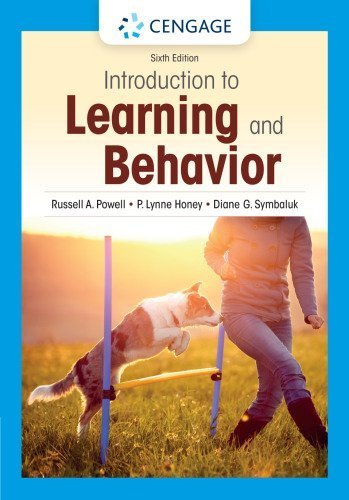
Introduction to Learning and Behavior 6th Edition by Russell Powell, ISBN-13: 978-0357658475
Original price was: $75.00.$19.99Current price is: $19.99.
Safe & secure checkout
Description
Description
Introduction to Learning and Behavior 6th Edition by Russell Powell, ISBN-13: 978-0357658475
[PDF eBook eTextbook] – Available Instantly
- Publisher: Cengage Learning; 6th edition (March 10, 2022)
- Language: English
- 640 pages
- ISBN-10: 0357658477
- ISBN-13: 978-0357658475
Gain a clear understanding of the basic principles of learning and behavior and how you can apply this information to better understand and improve today’s world with Powell/Honey/Symbaluk’s INTRODUCTION TO LEARNING AND BEHAVIOR, 6E. This engaging, student-friendly behavioral approach to psychology uses examples derived from both animals and humans to vividly illustrate the relevance of behavioral principles in comprehending and impacting human behavior. Updated, expanded coverage and a dedicated appendix address self-control and behavior self-management in detail with specific tactics you can immediately apply. “Study Tip” guide you in strategies, from effectively reading texts to using procedures to increase concentration and reduce procrastination. You also see how principles apply to managing relationships and raising children. Numerous innovative and updated review, self-testing, learning and independent study features further your understanding of key concepts.
Table of Contents:
Cover Page
Title Page
Copyright Page
Dedication
Preface
Key Characteristics
Changes to the Sixth Edition
Learning Aids
Acknowledgments
About the Authors
Chapter 1. Introduction
1.1. Historical Background
Aristotle: Empiricism and the Laws of Association
Descartes: Mind–Body Dualism and the Reflex
The British Empiricists
Structuralism: The Experimental Study of Human Consciousness
Functionalism: The Study of the Adaptive Mind
The Theory of Evolution: Humans as Animals
Behaviorism: The Study of Observable Behavior
1.2. Five Schools of Behaviorism
Watson’s Methodological Behaviorism
Hull’s Neobehaviorism
Tolman’s Cognitive Behaviorism
Bandura’s Social Learning Theory
Skinner’s Radical Behaviorism
In Review
For Further Exploration
Study Questions
Concept Review
Chapter Test
Chapter 2. Research Methods
2.1. Basic Terms and Definitions
Independent and Dependent Variables
Functional Relationships
Stimulus and Response
Overt and Covert Behavior
Appetitive and Aversive Stimuli
Motivating Operations
Contiguity and Contingency
2.2. Measurement of Behavior
Behavioral Definitions
Recording Methods
Assessing Reliability
2.3. Research Designs
Descriptive Research
Experimental Research
2.4. Use of Animals in Behavioral Research
In Review
Further Exploration
Study Questions
Concept Review
Chapter Test
Chapter 3. Elicited Behaviors and Classical Conditioning
3.1. Elicited Behaviors
Reflexes
Fixed Action Patterns
3.2. Simple Mechanisms of Learning
Habituation and Sensitization
Opponent-Process Theory of Emotion
3.3. Classical Conditioning
Pavlov’s Discovery of Classical Conditioning
Basic Procedure and Definitions
Appetitive and Aversive Conditioning
Excitatory and Inhibitory Conditioning
Temporal Factors in Conditioning
Pseudoconditioning
In Review
Further Exploration
Study Questions
Concept Review
Chapter Test
Chapter 4. Classical Conditioning: Basic Phenomena and Various Complexities
4-1. Some Basic Conditioning Phenomena
Acquisition
Extinction and Related Phenomena
Stimulus Generalization and Discrimination
Experimental Neurosis
4-2. Three Extensions to Classical Conditioning
Higher-Order Conditioning
Sensory Preconditioning
US Revaluation
4-3. Four Examples of Specificity in Classical Conditioning
Overshadowing
Blocking
Occasion Setting
Latent Inhibition
In Review
For Further Exploration
Study Questions
Concept Review
Chapter Test
Chapter 5. Classical Conditioning: Underlying Processes and Practical Applications
5.1. Underlying Processes in Classical Conditioning
Stimulus-Substitution Theory
Preparatory-Response Theory (and the Compensatory-Response Model)
Rescorla–Wagner Theory
5.2. Practical Applications of Classical Conditioning
Understanding Phobias
Treating Phobias
Aversion Therapy for Problem Behaviors
Medical Applications of Classical Conditioning
In Review
For Further Exploration
Study Questions
Concept Review
Chapter Test
Chapter 6. Operant Conditioning: Introduction
6.1. Historical Background
Thorndike’s Law of Effect
Skinner’s Selection by Consequences
6.2. Operant Conditioning
Operant Behavior
Operant Consequences: Reinforcers and Punishers
Operant Antecedents: Discriminative Stimuli
6.3. Four Types of Contingencies
Positive Reinforcement
Negative Reinforcement
Positive Punishment
Negative Punishment
6.4. Positive Reinforcement: Further Distinctions
Immediate versus Delayed Reinforcement
Primary and Secondary Reinforcers
Intrinsic and Extrinsic Reinforcement
Natural and Contrived Reinforcers
Shaping
In Review
For Further Exploration
Study Questions
Concept Review
Chapter Test
Chapter 7. Schedules and Theories of Reinforcement
7.1. Schedules of Reinforcement
Continuous versus Intermittent Schedules
Four Basic Intermittent Schedules
Other Simple Schedules of Reinforcement
Complex Schedules of Reinforcement
7.2. Theories of Reinforcement
Drive Reduction Theory
The Premack Principle
Response Deprivation Hypothesis
Behavioral Bliss Point Approach
In Review
Further Exploration
Study Questions
Concept Review
Chapter Test
Chapter 8. Extinction and Stimulus Control
8.1. Extinction
Side Effects of Extinction
Resistance to Extinction
Spontaneous Recovery
Differential Reinforcement of Other Behavior
8.2. Stimulus Control
Stimulus Generalization and Discrimination
The Peak Shift Effect
Multiple Schedules and Behavioral Contrast
Fading and Errorless Discrimination Learning
Stimulus Control: Additional Applications
In Review
Further Exploration
Study Questions
Concept Review
Chapter Test
Chapter 9. Escape, Avoidance, and Punishment
9.1. Escape and Avoidance
Two-Process Theory of Avoidance
Avoidance Conditioning and Phobias
Avoidance Conditioning and Obsessive–Compulsive Disorder
9.2. Punishment
Types of Punishment
Problems with the Use of Punishment
Benefits and the Effective Use of Punishment
Theories of Punishment
9.3. Noncontingent Punishment
Learned Helplessness
Masserman’s Experimental Neurosis
In Review
Further Exploration
Study Questions
Concept Review
Chapter Test
Chapter 10. Choice, Matching, and Self-Control
10.1. Choice and Matching
Concurrent Schedules
The Matching Law
Deviations from Matching
Matching and Melioration
10.2. Self-Control
Skinner on Self-Control
Self-Control as a Temporal Issue
Mischel’s Delay of Gratification Paradigm
The Ainslie–Rachlin Model of Self-Control
The Small-But-Cumulative Effects Model
In Review
Further Exploration
Study Questions
Concept Review
Chapter Test
Chapter 11. Observational Learning and Rule-Governed Behavior
11.1. Observational or Social Learning
Contagious Behavior and Stimulus Enhancement
Observational Learning in Classical Conditioning
Observational Learning in Operant Conditioning
Imitation
Social Learning and Aggression
11.2. Rule-Governed Behavior
Definitions and Characteristics
Some Disadvantages of Rule-Governed Behavior
Personal Rules in Self-Regulation
In Review
Further Exploration
Study Questions
Concept Review
Chapter Test
Chapter 12. Biological Dispositions in Learning
12.1. Preparedness and Conditioning
Preparedness in Classical Conditioning
Preparedness in Operant Conditioning
12.2. Operant–Respondent Interactions
Instinctive Drift
Sign Tracking
12.3. Adjunctive Behavior
Basic Procedure and Defining Characteristics
Adjunctive Behavior in Humans
Adjunctive Behavior as Displacement Activity
12.4. Activity Anorexia
Basic Procedure and Defining Characteristics
Comparisons with Anorexia Nervosa
Underlying Mechanisms
Clinical Implications
12.5. Behavior Systems Theory
In Review
Further Exploration
Study Questions
Concept Review
Chapter Test
Chapter 13. Comparative Cognition
13.1. What Is Comparative Cognition?
13.2. Memory in Animals
How to Study Animal Memory
Memory in Food-Storing Birds
13.3. Can Animals Count?
The Case of Clever Hans
Beyond Clever Hans: Evidence for Numerical Ability in Animals
13.4. Category Learning and Relational Decisions
13.5. Concepts of Tools, Self, and Others
Making and Using Tools
Theory of Mind
Self-Awareness and Differentiating Self from Others
Cooperation and Deception
13.6. Language
Can Animals “Talk”?
Sign Language Experiments
Artificial Language Experiments
In Review
Further Exploration
Study Questions
Concept Review
Chapter Test
Appendix. A Brief Guide to Behavior Self-Management
References
Russ Powell earned his Ph.D. in psychology under the mentorship of notable behavior analysts Dr. Frank Epling and Dr. David Pierce at the University of Alberta. As a long-standing faculty member at MacEwan University, Dr. Powell has taught classes in learning and behavior for more than 30 years using a variety of behaviorally inspired formats. He has published and conducted research in a wide range of areas, including operant conditioning, social psychology, sleep and dreams (especially nightmares) and self-regulation. He has also researched the history of psychology and helped identify the individual believed to have been Little Albert, the famous infant in whom Watson and Rayner (1920) attempted to condition a phobia of furry animals (Powell, Digdon, Harris, and Smithson, 2014).
Lynne Honey — a self-described “evolutionary behaviorist” — completed a Ph.D. in experimental psychology in Jeff Galef’s lab at McMaster University, studying the role of social learning on alcohol consumption in rats. She has published a number of papers on this topic and considers social learning to be one of the most powerful adaptations available to our species and others. Dr. Honey joined the department of psychology at MacEwan University in 2003 because of its focus on teaching and student engagement. She currently conducts research on human social behavior in an evolutionary context, focusing on the influence of personality traits on social behaviors. She also studies the effectiveness of various teaching methods, and she has been recognized with several awards for innovation and excellence in teaching.
Diane Symbaluk received her Ph.D. in sociology from the University of Alberta in 1997, with a specialization in criminology and social psychology. She joined MacEwan University in 1996 to pursue her joint passion for teaching and research mentorship. Her publications include textbooks, journal articles and more than 40 pedagogical resources such as study guides, test banks, instructor manuals and online resources. Dr. Symbaluk’s contributions to student success through teaching and educational leadership have been recognized with distinguished teaching awards and a 3M National Teaching Fellowship.
What makes us different?
• Instant Download
• Always Competitive Pricing
• 100% Privacy
• FREE Sample Available
• 24-7 LIVE Customer Support