

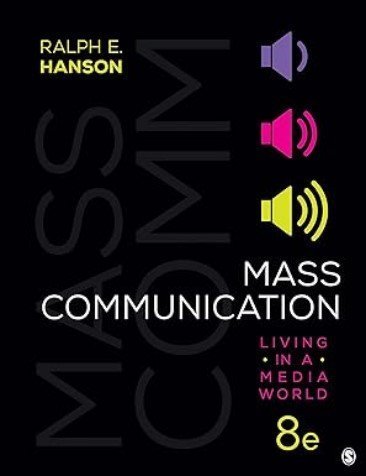
Mass Communication: Living in a Media World 8th Edition by Ralph E. Hanson, ISBN-13: 978-1544382999
Original price was: $50.00.$14.99Current price is: $14.99.
Safe & secure checkout
Description
Description
Mass Communication: Living in a Media World 8th Edition by Ralph E. Hanson, ISBN-13: 978-1544382999
[PDF eBook eTextbook] – Available Instantly
- Publisher: SAGE Publications, Inc; Eighth edition (January 6, 2021)
- Language: English
- 488 pages
- ISBN-10: 1544382995
- ISBN-13: 978-1544382999
The best-selling Mass Communication: Living in a Media World presents a highly accessible introduction to mass communication that equips students with the critical thinking skills to become savvy media consumers. To help students better retain the material, author Ralph E. Hanson uses a storytelling approach that weaves in examples drawn from everyday life. Readers are encouraged to consider the media industry from the inside out and, in doing so, discover the many dimensions of mass communication that operate in our society. The thoroughly revised Eighth Edition highlights how social and digital media, video games, and the COVID-19 pandemic are changing the face of media.
Table of Contents:
Preface
Acknowledgments
About the Author
PART I. INTRODUCTION TO THE MEDIA
Chapter 1. Living in a Media World: An Introduction to Mass Communication
The Four Levels of Communication
Intrapersonal Communication
Interpersonal Communication
Group Communication
Mass Communication
Understanding Our Media World
The Cognitive Dimension
The Emotional Dimension
The Aesthetic Dimension
The Moral Dimension
Models of Mass Communication
Transmission Model
Ritual Model
Publicity Model
Reception Model
Evolution of the Media World
• Test Your Media Literacy: Can Television Take Anything Seriously?
Online and Mobile Media: Interactive Communication
The Seven Secrets About the Media “They” Don’t Want You to Know 2.0
SECRET 1: The Media Are Essential Components of Our Lives
SECRET 2: There Are No Mainstream Media (MSM)
SECRET 3: Everything From the Margin Moves to the Center
SECRET 4: Nothing Is New: Everything That Happened in the Past Will Happen Again
SECRET 5: All Media Are Social
SECRET 6: Online Media Are Mobile Media
SECRET 7: There Is No “They”
Chapter Review
Chapter Summary
Key Terms
Review Questions
Chapter 2. Mass Communication Effects: How Society and Media Interact
The Evolution of Media Effects Research
The Limited Effects Model
Effects of Media in Our Lives
Message Effects
Attitudinal Effects
Behavioral Effects
Psychological Effects
Medium Effects
Ownership Effects
Active Audience Effects
Media and Society
Surveillance of the Environment
Correlation of Different Elements of Society
Socialization and Transmission of Culture
Our Interactions With Media
Uses and Gratifications Theory
Symbolic Interactionism
Cultivation Analysis
The Critical/Cultural Approach
• Test Your Media Literacy: Agenda Setting Versus Critical/Cultural Theory
Media and Body Image
Chapter Review
Chapter Summary
Key Terms
Review Questions
Chapter 3. The Media Business: Consolidation, Globalization, and the Long Tail
The U.S. Media Industry
The Growth of National News
Big Media: The Legacy Conglomerates
Disney: The Mouse That Grew and Grew
News Corporation and Fox: A Worldwide Giant Downsizes
WarnerMedia: Back to Basics
ViacomCBS: Together Again
Bertelsmann: The World’s Largest Publisher
Big Media: The New Players
Comcast/NBCUniversal: Cable Buys Broadcaster
Alphabet: Google and Company
• Test Your Visual Media Literacy: Google Doodles
Apple: Reinventing the Media
Media Economics and the Long Tail
Characteristics of the Long Tail
Consequences of the Long Tail
Big Players in the Long Tail
Chapter Review
Chapter Summary
Key Terms
Review Questions
PART II. LEGACY MEDIA
Chapter 4. Books: The Birth of the Mass Media
Books and Mass Communication
A Demand for Books
Books and Mass Culture
Spreading Ideas Through Publishing
The Development of Large-Scale, Mass-Produced Books
Buying and Selling Books
Publishers
Writers
Booksellers
Books and Culture
The Role of Libraries in Culture
Books and Censorship
• Test Your Visual Media Literacy: Graphic Novels
The Future of Books
From Clay, to Paper, to Electronic
Print on Demand
Chapter Review
Chapter Summary
Key Terms
Review Questions
Chapter 5. The News Business: Reflection of a Democratic Society
Inventing the Modern Press
The Penny Press: Newspapers for the People
A Modern Democratic Society
Pulitzer, Hearst, and the Battle for New York City
Magazines and the News
Broadcast News
News on the Radio
Television News Goes 24/7
The News Business
National and Metropolitan Newspapers
Local and Community News
News Media, Identity, and Political Bias
Gans’s Basic Journalistic Values
From Where Do People Get Their News?
Fake News
Patriotism and the Press
The Ethnic Press
The Future of News
• Test Your Visual Media Literacy: Comic Strip Tells Story of Syrian Refugee Family
Chapter Review
Chapter Summary
Key Terms
Review Questions
Chapter 6. Audio: Music and Talk Across Media
The History of Audio Recording and Transmission
A New Way of Publishing Music
The Birth of Radio: Transmitting Music and Talk
From Radio’s Golden Age to the Television Age
Becoming a Companion Medium
Radio’s New Look: HD and Satellite
Streaming Audio
• Test Your Media Literacy: Smart Speakers
Podcasting
Music, Youth Culture, and Society
Blending Black and White Musical Traditions
The Changing Face of Popular Music
Finding a Niche: Popular Radio Formats
Concerns About Effects of Music on Young People
Changing the Musical Experience: From Social Music to Personal Soundtracks
Music and the Long Tail: The Future of Sound
New Economic Models for the Music Industry
Chapter Review
Chapter Summary
Key Terms
Review Questions
Chapter 7. Movies: Mass Producing Entertainment
The Development of Movies
The Earliest Filmmakers
The Studio System
Talking Pictures
The Blacklist
Television and the Movies
The Blockbuster Movie Era
Movie Viewership in the Digital Era
Digital Production and Projection
What Makes a Movie Profitable?
Where Are Movies Made?
Movies and Society
• Test Your Visual Media Literacy: Does It Look As If Women Have Major Film Roles?
Problematic Depictions of Race
The Production Code: Protecting the Movies From Censorship
The Ratings System
The Long Tail and the Future of Movies
Declining Ticket Sales
Chapter Review
Chapter Summary
Key Terms
Review Questions
Chapter 8. Television and Video: Broadcast and Beyond
Broadcast Television
The Beginning of Broadcasting
Cable and Satellite Television
Ted Turner’s Cable TV Empire
Digital Television: HDTV and DVRs
The Changing Business of Television
Defining Ratings
An Earthquake in Slow Motion
Diversity on Television
Television and Society
How Do Viewers Use Television?
Standards for Television
• Test Your Media Literacy: No Sense of Place
The Problem of Decency
Redefining Television in the Twenty-First Century
The Earthquake in Slow Motion Continues
Chapter Review
Chapter Summary
Key Terms
Review Questions
PART III. DIGITAL AND GLOBAL MEDIA
Chapter 9. Online and Mobile Media
The Development of the Internet
ARPAnet
Connecting Incompatible Networks
Texting and Direct Messaging
Tim Berners-Lee: Inventor of the World Wide Web
Openness and Accessibility on the Internet
Searching on the World Wide Web
Going Mobile
Online Media: Blogs, Podcasts, and Streaming
• Test Your Visual Media Literacy: Humans of New York
Longtail Content
The Internet and Society: Hacker Ethic
Hacking the 2016 Presidential Election
The Notion of Cyberspace
The Internet and Society: Our Online World
Conflicts Over Digital Media
Convergence of Old and New Media
Everything Is Data
Chapter Review
Chapter Summary
Key Terms
Review Questions
Chapter 10. Social Media and Video Games: Becoming Part of the Story
Social Media: Sharing Our Lives Online
YouTube
Snapchat
TikTok
Development of Video Games
• Test Your Media Literacy: Should the President Be Active on Social Media?
Atari Popularizes Video Games
Importance of Arcades
Nintendo Revives Home Console Market
Sony PlayStation and Microsoft Xbox
Conflicts Over Video Games
Pokémon
Video Games as Mass Communication
Video Games as a Spectator Sport
Video Games in Contemporary Culture
Diversity and Representation in Video Games
Chapter Review
Chapter Summary
Key Terms
Review Questions
Chapter 11. Global Media: Communication Around the World
Media Ideals Around the World
Authoritarian Theory
Communist Theory
Libertarian Theory
Social Responsibility Theory
Norms for the Press in the Twenty-First Century
Going Global: Media Standards Around the World
Are We Really Living in a Media World?
Media in Canada, Western Europe, and Great Britain
Charlie Hebdo, the Danish Cartoons, and Terrorism
Privacy Law in Europe
Media in Central and Latin America
Media in Islamic Countries and the Middle East
The Importance of “Small” Media
Old and New Media in the Islamic World
Al Jazeera
Media in Africa
Media in Russia and the Former Soviet Republics
Media in Asia
• Test Your Media Literacy: How Free Are the World’s Media to Report the News?
Chapter Review
Chapter Summary
Key Terms
Review Questions
PART IV. STRATEGIC COMMUNICATION
Chapter 12. Advertising: Selling a Message
Creation of the Advertising Industry
The Growth of Brand Names
Advertising-Supported Media
The Advertising Business
The Client
The Agency
The Media
The Audience
• Test Your Media Literacy: Target’s Targeting
Contemporary Culture in Advertising
Debunking Subliminal Advertising
When Advertisements Are More Important Than the Program
The Long Tail and the Future of Advertising
Social Marketing
Integrated Marketing Communication
From Advertorials to Native Advertising
Is Anyone Watching Television Ads?
Mobile Advertising
Product Placement
Social Chicken Sandwiches
Chapter Review
Chapter Summary
Key Terms
Review Questions
Chapter 13. Public Relations: Interactions, Relationships, and the News
The Growth of Public Relations
World War I: The Federal Government Starts Using Public Relations
• Test Your Media Literacy: False Reports Garner Publicity
Public Relations Becomes a Profession
The Business of Public Relations
The Public Relations Process
The Publics
Crisis Communication
Public Relations Goes Online
Social Media—Interacting Directly With Your Publics
IMC & Coca-Cola Freestyle
Public Relations and Society
Spin Control: A More Personal Form of Public Relations
Public Relations and the Civil Rights Movement
Chapter Review
Chapter Summary
Key Terms
Review Questions
PART V. REGULATION AND CONTROL OF THE MEDIA
Chapter 14. Media Law: Free Speech and Fairness
The Development of a Free Press
The Roots of American Free Speech
Limits on Free Speech
Libel and Protection of Individuals
Truth, Privilege, and Opinion
New York Times Co. v. Sullivan
Libel and Public Figures
Libel and Social Media
Recent Libel Cases
Invasion of Privacy
Social Media and Privacy
Privacy and Your Smartphone
Free Press/Fair Trial
Cameras in the Courtroom
• Test Your Visual Media Literacy: Should Legal Protections Extend to Offensive Speech?
Controlling the Press
Prior Restraint
Journalists and the Police
Free Speech and Students
Obscenity
Copyright and Regulation of the Media Industry
The Rise and Fall of Broadcast Regulation
Chapter Review
Chapter Summary
Key Terms
Review Questions
Chapter 15. Media Ethics: Truthfulness, Fairness, and Standards of Decency
Ethical Principles and Decision Making
Aristotle: Virtue and the Golden Mean
Kant: The Categorical Imperative
• Test Your Visual Media Literacy: “It Was Such a Violent Collision”
John Stuart Mill: The Principle of Utility
John Rawls: The Veil of Ignorance
Hutchins Commission: Social Responsibility Ethics
The Bok Model for Ethical Decision Making
Truthfulness and the News
Catching Fabrications
Disclosing Conflicts of Interest
Recognizing Fake News Is Consumer Responsibility
Photos and the Truth
Mistakes and Consequences in the News
When News Moves Too Fast: Kobe Bryant’s Death
There Is No “They”: Sago Mine Disaster
Ethics Enforcement
Ethics and Persuasive Communication
Ethics in Public Relations
Media and Representation
Attacks on Women Through Online Media
Representation and the Movies
Chapter Review
Chapter Summary
Key Terms
Review Questions
Glossary
Notes
Index
Ralph E. Hanson is a professor in the communication department at the University of Nebraska at Kearney, where he teaches courses in writing, blogging, reporting, and mass communication. Previously, he was on the faculty at West Virginia University and Northern Arizona University. He has been teaching introduction to mass communication for more than twenty-five years, and he has worked extensively on developing online courses and degree programs. Hanson has a bachelor’s degree in journalism and anthropology from Iowa State University, a master’s degree in journalism from Iowa State, and a doctorate in sociology from Arizona State University. He recently completed a book chapter on the long-standing connections between the Martin Luther King Jr. holiday and the NFL’s Super Bowl. When Ralph is not out on his motorcycle riding to places a long way from Nebraska, he is blogging on mass communication issues at http://ralphehanson.com. He tweets as @ralphehanson.
What makes us different?
• Instant Download
• Always Competitive Pricing
• 100% Privacy
• FREE Sample Available
• 24-7 LIVE Customer Support