
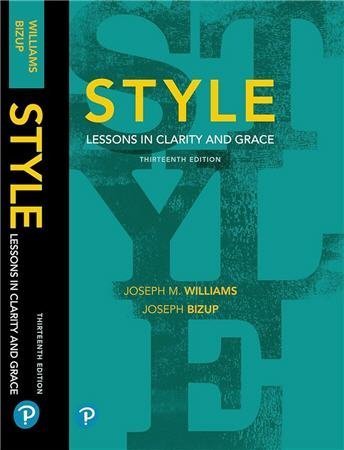
Style: Lessons in Clarity and Grace 13th Edition by Joseph M. Williams, ISBN-13: 978-0135171837
Original price was: $50.00.$14.99Current price is: $14.99.
Safe & secure checkout
Description
Description
Style: Lessons in Clarity and Grace 13th Edition by Joseph M. Williams, ISBN-13: 978-0135171837
[PDF eBook eTextbook] – Available Instantly
- Publisher: Pearson; 13th edition (January 11, 2020)
- Language: English
- 241 pages
- ISBN-10: 0135171830
- ISBN-13: 978-0135171837
For courses in English and writing.
Emphasizes the importance of style in writing for a global audience.
Style: Lessons in Clarity and Grace asserts that good style is a matter of making informed choices in the service of one’s readers. While writers know best what they want to say, readers ultimately decide if they’ve said it well. This long-established and highly respected text builds on that premise, with this 13th Edition providing up-to-date advice on gender-neutral writing and writing for global audiences. The principles offered here help writers understand what readers expect and encourage writers to revise to meet those expectations more effectively. This book is all you need to understand the principles of effective writing.
Table of Contents:
Preface
What’s New in the Thirteenth Edition
What’s The Same
RevelTM
Learn more about Revel
Supplements
In Memoriam
Introduction
The Causes of Unclear Writing
How to Use This Book
Part One Style as Choice
Lesson 1 Correctness and Style
The Authority of Standard English
Three Kinds of Rules
Real Rules
Social Rules
Invented Rules
Invented Rules: Folklore
“Don’t begin sentences with and or but.”
“Use the relative pronoun that—not which—for restrictive clauses.”
“Use fewer with nouns you count, less with nouns you cannot.”
“Use since and while to refer only to time, not to mean because or although.”
Elegant Options
“Don’t split infinitives.”
“Don’t end a sentence with a preposition.”
“Use whom as the object of a verb or preposition.”
“Use the singular with none and any.”
Hobgoblins
“Never use like for as or as if.”
“Don’t use hopefully to mean ‘I hope.’ ”
“Don’t use finalize to mean ‘finish’ or ‘complete.’”
“Don’t use impact as a verb but only as a noun.”
“Don’t modify absolute words such as perfect, unique, final, or complete with very, more, quite, and so on.”
“Never ever use irregardless for regardless or irrespective.”
Some Words that Attract Special Attention
Gender and Style
Gender-Specific Nouns
Pronouns and Gender: The Problem of Agreement
Pronouns and Gender: Inclusive Options
Non-Binary Pronouns
The Future
Summing Up
Part Two Clarity
Lesson 2 Actions
Telling Stories: Characters and Actions
Principle of Clarity 1: Make Main Characters Subjects
Principle of Clarity 2: Make Important Actions Verbs
Fairy Tales and “Serious” Writing
A Simple Test for Clarity
Finding Actions in a Sentence
How to Revise: Characters and Actions
The Problem of Familiarity
A Procedure for Revising Sentences
How to Revise: Nominalizations
Some Benefits of Making Actions Verbs
A Qualification: Useful Nominalizations
Summing Up
Lesson 3 Characters
How to Revise: Characters and Actions (Again)
Reconstructing Absent Characters
Abstractions as Characters
Characters and Passive Verbs
Choosing Between Active and Passive
The “Objective” Passive vs. I/We
Metadiscourse
Noun + Noun + Noun
Short Subjects
Clarity and the Professional Voice
Summing Up
Lesson 4 Cohesion and Coherence
Cohesion
The Sense of Flow
Managing Information: Old Before New
Coherence
A Sense of the Whole
Subjects and Topics
Topics and Coherence
How to Revise: Cohesion and Coherence
Beginning Sentences Well
Two Qualifications
Alleged Monotony
Faked Coherence
Summing Up
Lesson 5 Emphasis
Managing Complexity: Simple Before Complex
Complex Grammar
Complex Meaning
Emphasis and Stress
How To Revise: Stress
Three Tactical Revisions
Six Syntactic Devices to Emphasize the Right Words
Topics, Stress, Themes, and Coherence
A Model for Sentences
Summing Up
Part Three Clarity of Form
Lesson 6 Framing Documents
Framing Introductions to Help Readers
Establishing a Shared Context
Stating the Problem
The Two Parts of a Problem
Two Kinds of Problems: Practical and Conceptual
Practical Problems
Conceptual Problems
Stating the Solution
Another Part: Prelude
How to Revise: Introductions
Framing Conclusions
Summing Up
Practical Problems
Conceptual Problems
Lesson 7 Framing Sections
Forecasting Themes to Create Coherence
Relevance and Organization
On Paragraphs
A General Principle of Clarity and Coherence
The Costs and Benefits of Templated Writing
Summing Up
Part Four Grace
Lesson 8 Concision
How to Revise: Concision
Redundant Metadiscourse
Hedges and Intensifiers
Hedges
Intensifiers
Concise, Not Terse
Summing Up
Lesson 9 Shape
Starting with Your Point
How to Revise: Long Openings
Rule of Thumb 1: Get to the Subject Quickly
Rule of Thumb 2: Get to the Verb and Object Quickly
Avoid long, abstract subjects
Avoid interrupting the subject-verb connection
Avoid interrupting the verb-object connection
How to Revise: Sprawling Endings
Cut
Turn Dependent Clauses into Independent Sentences
Change Clauses to Modifying Phrases
Resumptive Modifiers
Summative Modifiers
Free Modifiers
Coordinate
Short before Long
Troubleshooting Long Sentences
Faulty Grammatical Coordination
Faulty Rhetorical Coordination
Unclear Connections
Ambiguous Modifiers
Dangling Modifiers
Summing Up
Lesson 10 Elegance
Balance
Climactic Emphasis
1. Weighty Words
2. Of + Weighty Word
3. Echoing Salience
4. Chiasmus
5. Suspension
Extravagant Elegance
Nuances of Length and Rhythm
Elegance and Clarity
Summing Up
Part Five Ethics
Lesson 11 The Ethics of Clarity
The Responsibilities of Writers and Readers
Clarity and Other Values
Clarity and Competing Interests
Unintended Obscurity
Intended Misdirection
Who Erred?
Who Pays?
Who Dies?
Rationalizing Opacity
Necessary Complexity
Salutary Complexity/Subversive Clarity
Summing Up
Lesson 12 Beyond Clarity
Lincoln’s Second Inaugural Address
Summing Up
Appendix I Punctuation
Simple, Compound, and Complex Sentences
Punctuated and Grammatical Sentences
Punctuating the Ends of Sentences
Three Common Forms of End Punctuation
Four Less Common Forms of End Punctuation
Three Special Cases: Colon, Dash, Parentheses
Intended Sentence Fragments
Punctuating Beginnings
Five Reliable Rules
Two Reliable Principles
Punctuating Middles
Subject—Verb, Verb—Object
Interruptions
Loose Commentary
Punctuating Coordinate Elements
Punctuating Two Coordinate Elements
Four Exceptions
Punctuating Three or More Coordinate Elements
Apostrophes
Contractions
Plurals
Possessives
Summing Up
Appendix II Using Sources
Using Sources Properly
Avoiding Plagiarism
Taking Good Notes
Punctuating Quotations
Citing Sources Appropriately
Using Sources Effectively
How Much of a Source to Include?
How to Include a Source: Summary, Paraphrase, or Quotation?
Summarize
Paraphrase
Use a block quotation
Drop in a quotation
Weave in a quotation
Use just a few words from a source
How to Attribute a Source: Explicitly or Not?
Summing Up
Glossary
Suggested Answers
Exercise 2.2
Exercise 2.4
Exercise 2.5
Exercise 2.6
Exercise 3.1
Exercise 3.2
Exercise 3.3
Exercise 3.4
Exercise 4.1
Exercise 4.2
Exercise 5.1
Exercise 5.2
Exercise 8.1
Exercise 8.3
Exercise 9.1
Exercise 9.2
Exercise 10.1
Exercise 10.2
Exercise 11.1
Exercise 11.2
Acknowledgments
Front Matter
Introduction
Chapter 1
Chapter 2
Chapter 3
Chapter 5
Chapter 6
Chapter 7
Chapter 8
Chapter 9
Chapter 10
Chapter 11
Chapter 12
Appendix I
Appendix II
Index
What makes us different?
• Instant Download
• Always Competitive Pricing
• 100% Privacy
• FREE Sample Available
• 24-7 LIVE Customer Support