
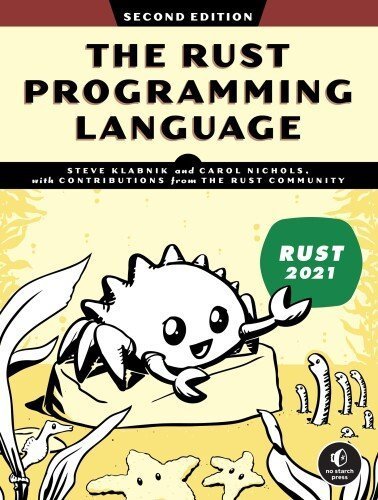
The Rust Programming Language 2nd Edition by Steve Klabnik, ISBN-13: 978-1718503106
Original price was: $50.00.$14.99Current price is: $14.99.
Safe & secure checkout
Description
Description
The Rust Programming Language 2nd Edition by Steve Klabnik, ISBN-13: 978-1718503106
[PDF eBook eTextbook] – Available Instantly
- Publisher: No Starch Press; 2nd edition (February 28, 2023)
- Language: English
- 560 pages
- ISBN-10: 1718503105
- ISBN-13: 978-1718503106
With over 50,000 copies sold, The Rust Programming Language is the quintessential guide to programming in Rust. Thoroughly updated to Rust’s latest version, this edition is considered the language’s official documentation.
The Rust Programming Language “covers everything you could want to know about the language.”—Stack Overflow
Rust has been repeatedly voted “Most Loved Language” on the StackOverflow Developer Survey.
The Rust Programming Language, 2nd Edition is the official guide to Rust 2021: an open source systems programming language that will help you write faster, more reliable software. Rust provides control of low-level details along with high-level ergonomics, allowing you to improve productivity and eliminate the hassle traditionally associated with low-level languages.
Klabnik and Nichols, alumni of the Rust Core Team, share their knowledge to help you get the most out of Rust’s features so that you can create robust and scalable programs. You’ll begin with basics like creating functions, choosing data types, and binding variables, then move on to more advanced concepts, such as:
Table of Contents:
Title Page
Copyright
About the Authors
Foreword
Preface
Acknowledgments
Introduction
Who Rust Is For
Teams of Developers
Students
Companies
Open Source Developers
People Who Value Speed and Stability
Who This Book Is For
How to Use This Book
Resources and How to Contribute to This Book
Chapter 1: Getting Started
Installation
Installing rustup on Linux or macOS
Installing rustup on Windows
Troubleshooting
Updating and Uninstalling
Local Documentation
Hello, World!
Creating a Project Directory
Writing and Running a Rust Program
Anatomy of a Rust Program
Compiling and Running Are Separate Steps
Hello, Cargo!
Creating a Project with Cargo
Building and Running a Cargo Project
Building for Release
Cargo as Convention
Summary
Chapter 2: Programming a Guessing Game
Setting Up a New Project
Processing a Guess
Storing Values with Variables
Receiving User Input
Handling Potential Failure with Result
Printing Values with println! Placeholders
Testing the First Part
Generating a Secret Number
Using a Crate to Get More Functionality
Generating a Random Number
Comparing the Guess to the Secret Number
Allowing Multiple Guesses with Looping
Quitting After a Correct Guess
Handling Invalid Input
Summary
Chapter 3: Common Programming Concepts
Variables and Mutability
Constants
Shadowing
Data Types
Scalar Types
Compound Types
Functions
Parameters
Statements and Expressions
Functions with Return Values
Comments
Control Flow
if Expressions
Repetition with Loops
Summary
Chapter 4: Understanding Ownership
What Is Ownership?
Ownership Rules
Variable Scope
The String Type
Memory and Allocation
Ownership and Functions
Return Values and Scope
References and Borrowing
Mutable References
Dangling References
The Rules of References
The Slice Type
String Slices
Other Slices
Summary
Chapter 5: Using Structs to Structure Related Data
Defining and Instantiating Structs
Using the Field Init Shorthand
Creating Instances from Other Instances with Struct Update Syntax
Using Tuple Structs Without Named Fields to Create Different Types
Unit-Like Structs Without Any Fields
An Example Program Using Structs
Refactoring with Tuples
Refactoring with Structs: Adding More Meaning
Adding Useful Functionality with Derived Traits
Method Syntax
Defining Methods
Methods with More Parameters
Associated Functions
Multiple impl Blocks
Summary
Chapter 6: Enums and Pattern Matching
Defining an Enum
Enum Values
The Option Enum and Its Advantages Over Null Values
The match Control Flow Construct
Patterns That Bind to Values
Matching with Option<T>
Matches Are Exhaustive
Catch-All Patterns and the _ Placeholder
Concise Control Flow with if let
Summary
Chapter 7: Managing Growing Projects with Packages, Crates, and Modules
Packages and Crates
Defining Modules to Control Scope and Privacy
Paths for Referring to an Item in the Module Tree
Exposing Paths with the pub Keyword
Starting Relative Paths with super
Making Structs and Enums Public
Bringing Paths into Scope with the use Keyword
Creating Idiomatic use Paths
Providing New Names with the as Keyword
Re-exporting Names with pub use
Using External Packages
Using Nested Paths to Clean Up Large use Lists
The Glob Operator
Separating Modules into Different Files
Summary
Chapter 8: Common Collections
Storing Lists of Values with Vectors
Creating a New Vector
Updating a Vector
Reading Elements of Vectors
Iterating Over the Values in a Vector
Using an Enum to Store Multiple Types
Dropping a Vector Drops Its Elements
Storing UTF-8 Encoded Text with Strings
What Is a String?
Creating a New String
Updating a String
Indexing into Strings
Slicing Strings
Methods for Iterating Over Strings
Strings Are Not So Simple
Storing Keys with Associated Values in Hash Maps
Creating a New Hash Map
Accessing Values in a Hash Map
Hash Maps and Ownership
Updating a Hash Map
Hashing Functions
Summary
Chapter 9: Error Handling
Unrecoverable Errors with panic!
Recoverable Errors with Result
Matching on Different Errors
Propagating Errors
To panic! or Not to panic!
Examples, Prototype Code, and Tests
Cases in Which You Have More Information Than the Compiler
Guidelines for Error Handling
Creating Custom Types for Validation
Summary
Chapter 10: Generic Types, Traits, and Lifetimes
Removing Duplication by Extracting a Function
Generic Data Types
In Function Definitions
In Struct Definitions
In Enum Definitions
In Method Definitions
Performance of Code Using Generics
Traits: Defining Shared Behavior
Defining a Trait
Implementing a Trait on a Type
Default Implementations
Traits as Parameters
Returning Types That Implement Traits
Using Trait Bounds to Conditionally Implement Methods
Validating References with Lifetimes
Preventing Dangling References with Lifetimes
The Borrow Checker
Generic Lifetimes in Functions
Lifetime Annotation Syntax
Lifetime Annotations in Function Signatures
Thinking in Terms of Lifetimes
Lifetime Annotations in Struct Definitions
Lifetime Elision
Lifetime Annotations in Method Definitions
The Static Lifetime
Generic Type Parameters, Trait Bounds, and Lifetimes Together
Summary
Chapter 11: Writing Automated Tests
How to Write Tests
The Anatomy of a Test Function
Checking Results with the assert! Macro
Testing Equality with the assert_eq! and assert_ne! Macros
Adding Custom Failure Messages
Checking for Panics with should_panic
Using Result<T, E> in Tests
Controlling How Tests Are Run
Running Tests in Parallel or Consecutively
Showing Function Output
Running a Subset of Tests by Name
Ignoring Some Tests Unless Specifically Requested
Test Organization
Unit Tests
Integration Tests
Summary
Chapter 12: An I/O Project: Building a Command Line Program
Accepting Command Line Arguments
Reading the Argument Values
Saving the Argument Values in Variables
Reading a File
Refactoring to Improve Modularity and Error Handling
Separation of Concerns for Binary Projects
Fixing the Error Handling
Extracting Logic from main
Splitting Code into a Library Crate
Developing the Library’s Functionality with Test-Driven Development
Writing a Failing Test
Writing Code to Pass the Test
Working with Environment Variables
Writing a Failing Test for the Case-Insensitive Search Function
Implementing the search_case_insensitive Function
Writing Error Messages to Standard Error Instead of Standard Output
Checking Where Errors Are Written
Printing Errors to Standard Error
Summary
Chapter 13: Functional Language Features: Iterators and Closures
Closures: Anonymous Functions That Capture Their Environment
Capturing the Environment with Closures
Closure Type Inference and Annotation
Capturing References or Moving Ownership
Moving Captured Values Out of Closures and the Fn Traits
Processing a Series of Items with Iterators
The Iterator Trait and the next Method
Methods That Consume the Iterator
Methods That Produce Other Iterators
Using Closures That Capture Their Environment
Improving Our I/O Project
Removing a clone Using an Iterator
Making Code Clearer with Iterator Adapters
Choosing Between Loops and Iterators
Comparing Performance: Loops vs. Iterators
Summary
Chapter 14: More About Cargo and Crates.io
Customizing Builds with Release Profiles
Publishing a Crate to Crates.io
Making Useful Documentation Comments
Exporting a Convenient Public API with pub use
Setting Up a Crates.io Account
Adding Metadata to a New Crate
Publishing to Crates.io
Publishing a New Version of an Existing Crate
Deprecating Versions from Crates.io with cargo yank
Cargo Workspaces
Creating a Workspace
Creating the Second Package in the Workspace
Installing Binaries with cargo install
Extending Cargo with Custom Commands
Summary
Chapter 15: Smart Pointers
Using Box<T> to Point to Data on the Heap
Using Box<T> to Store Data on the Heap
Enabling Recursive Types with Boxes
Treating Smart Pointers Like Regular References with Deref
Following the Pointer to the Value
Using Box<T> Like a Reference
Defining Our Own Smart Pointer
Implementing the Deref Trait
Implicit Deref Coercions with Functions and Methods
How Deref Coercion Interacts with Mutability
Running Code on Cleanup with the Drop Trait
Rc<T>, the Reference Counted Smart Pointer
Using Rc<T> to Share Data
Cloning an Rc<T> Increases the Reference Count
RefCell<T> and the Interior Mutability Pattern
Enforcing Borrowing Rules at Runtime with RefCell<T>
Interior Mutability: A Mutable Borrow to an Immutable Value
Allowing Multiple Owners of Mutable Data with Rc<T> and RefCell<T>
Reference Cycles Can Leak Memory
Creating a Reference Cycle
Preventing Reference Cycles Using Weak<T>
Summary
Chapter 16: Fearless Concurrency
Using Threads to Run Code Simultaneously
Creating a New Thread with spawn
Waiting for All Threads to Finish Using join Handles
Using move Closures with Threads
Using Message Passing to Transfer Data Between Threads
Channels and Ownership Transference
Sending Multiple Values and Seeing the Receiver Waiting
Creating Multiple Producers by Cloning the Transmitter
Shared-State Concurrency
Using Mutexes to Allow Access to Data from One Thread at a Time
Similarities Between RefCell<T>/Rc<T> and Mutex<T>/Arc<T>
Extensible Concurrency with the Send and Sync Traits
Allowing Transference of Ownership Between Threads with Send
Allowing Access from Multiple Threads with Sync
Implementing Send and Sync Manually Is Unsafe
Summary
Chapter 17: Object-Oriented Programming Features
Characteristics of Object-Oriented Languages
Objects Contain Data and Behavior
Encapsulation That Hides Implementation Details
Inheritance as a Type System and as Code Sharing
Using Trait Objects That Allow for Values of Different Types
Defining a Trait for Common Behavior
Implementing the Trait
Trait Objects Perform Dynamic Dispatch
Implementing an Object-Oriented Design Pattern
Defining Post and Creating a New Instance in the Draft State
Storing the Text of the Post Content
Ensuring the Content of a Draft Post Is Empty
Requesting a Review Changes the Post’s State
Adding approve to Change the Behavior of content
Trade-offs of the State Pattern
Summary
Chapter 18: Patterns and Matching
All the Places Patterns Can Be Used
match Arms
Conditional if let Expressions
while let Conditional Loops
for Loops
let Statements
Function Parameters
Refutability: Whether a Pattern Might Fail to Match
Pattern Syntax
Matching Literals
Matching Named Variables
Multiple Patterns
Matching Ranges of Values with ..=
Destructuring to Break Apart Values
Ignoring Values in a Pattern
Extra Conditionals with Match Guards
@ Bindings
Summary
Chapter 19: Advanced Features
Unsafe Rust
Unsafe Superpowers
Dereferencing a Raw Pointer
Calling an Unsafe Function or Method
Accessing or Modifying a Mutable Static Variable
Implementing an Unsafe Trait
Accessing Fields of a Union
When to Use Unsafe Code
Advanced Traits
Associated Types
Default Generic Type Parameters and Operator Overloading
Disambiguating Between Methods with the Same Name
Using Supertraits
Using the Newtype Pattern to Implement External Traits
Advanced Types
Using the Newtype Pattern for Type Safety and Abstraction
Creating Type Synonyms with Type Aliases
The Never Type That Never Returns
Dynamically Sized Types and the Sized Trait
Advanced Functions and Closures
Function Pointers
Returning Closures
Macros
The Difference Between Macros and Functions
Declarative Macros with macro_rules! for General Metaprogramming
Procedural Macros for Generating Code from Attributes
How to Write a Custom derive Macro
Attribute-Like Macros
Function-Like Macros
Summary
Chapter 20: Final Project: Building a Multithreaded Web Server
Building a Single-Threaded Web Server
Listening to the TCP Connection
Reading the Request
A Closer Look at an HTTP Request
Writing a Response
Returning Real HTML
Validating the Request and Selectively Responding
A Touch of Refactoring
Turning Our Single-Threaded Server into a Multithreaded Server
Simulating a Slow Request
Improving Throughput with a Thread Pool
Graceful Shutdown and Cleanup
Implementing the Drop Trait on ThreadPool
Signaling to the Threads to Stop Listening for Jobs
Summary
Appendix A: Keywords
Keywords Currently in Use
Keywords Reserved for Future Use
Raw Identifiers
Appendix B: Operators and Symbols
Operators
Non-operator Symbols
Appendix C: Derivable Traits
Debug for Programmer Output
PartialEq and Eq for Equality Comparisons
PartialOrd and Ord for Ordering Comparisons
Clone and Copy for Duplicating Values
Hash for Mapping a Value to a Value of Fixed Size
Default for Default Values
Appendix D: Useful Development Tools
Automatic Formatting with rustfmt
Fix Your Code with rustfix
More Lints with Clippy
IDE Integration Using rust-analyzer
Appendix E: Editions
Index
Carol Nichols is a member of the Rust Community Team and a former member of the Rust Core Team. Also active in the Ruby community, she was a key organizer of the Steel City Ruby Conference 2012-2014.
Steve Klabnik is the Community Team Leader for the Rust team at Mozilla, in charge of official Rust community documentation, as well as a trusted Rust community advocate. Klabnik is a frequent speaker at conferences and one of the world’s most prolific contributors to Rails projects.
What makes us different?
• Instant Download
• Always Competitive Pricing
• 100% Privacy
• FREE Sample Available
• 24-7 LIVE Customer Support