

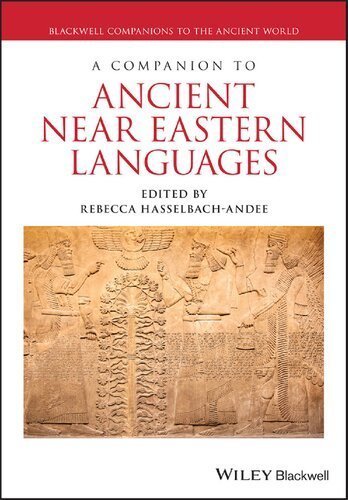
A Companion to Ancient Near Eastern Languages by Rebecca Hasselbach-Andee, ISBN-13: 978-1119193296
Original price was: $50.00.$14.99Current price is: $14.99.
Safe & secure checkout
Description
Description
A Companion to Ancient Near Eastern Languages by Rebecca Hasselbach-Andee, ISBN-13: 978-1119193296
[PDF eBook eTextbook] – Available Instantly
- Publisher: Wiley-Blackwell; 1st edition (March 31, 2020)
- Language: English
- 560 pages
- ISBN-10: 111919329X
- ISBN-13: 978-1119193296
Covers the major languages, language families, and writing systems attested in the Ancient Near East.
Filled with enlightening chapters by noted experts in the field, this book introduces Ancient Near Eastern (ANE) languages and language families used during the time period of roughly 3200 BCE to the second century CE in the areas of Egypt, the Levant, eastern Anatolia, Mesopotamia, and Iran. In addition to providing grammatical sketches of the respective languages, the book focuses on socio-linguistic questions such as language contact, diglossia, the development of literary standard languages, and the development of diplomatic languages or “linguae francae.” It also addresses the interaction of Ancient Near Eastern languages with each other and their roles within the political and cultural systems of ANE societies.
Presented in five parts, The Companion to Ancient Near Eastern Languages provides readers with in-depth chapter coverage of the writing systems of ANE, starting with their decipherment. It looks at the emergence of cuneiform writing; the development of Egyptian writing in the fourth and early third millennium BCI; and the emergence of alphabetic scripts. The book also covers many of the individual languages themselves, including Sumerian, Egyptian, Akkadian, Hittite, Pre- and Post-Exilic Hebrew, Phoenician, Ancient South Arabian, and more.
- Provides an overview of all major language families and writing systems used in the Ancient Near East during the time period from the beginning of writing (approximately 3200 BCE) to the second century CE (end of cuneiform writing)
- Addresses how the individual languages interacted with each other and how they functioned in the societies that used them
- Written by leading experts on the languages and topics
The Companion to Ancient Near Eastern Languages is an ideal book for undergraduate students and scholars interested in Ancient Near Eastern cultures and languages or certain aspects of these languages.
Table of Contents:
Cover
List of Illustrations
List of Tables
Notes on Contributors
Preface
PART I: WRITING SYSTEMS
CHAPTER ONE: The Decipherment of Ancient Near Eastern Languages
Introduction
Types of Decipherment
Processes in Decipherment
Accounts of Decipherment
REFERENCES
CHAPTER TWO: The Emergence of Cuneiform Writing
Introduction
The Context of Proto‐Cuneiform, Its Precursors and Origins
The Archaic Text Corpus and Cuneiform Script Characteristics
Structural Organization and Sign Types
Relationship with Sumerian
REFERENCES
CHAPTER THREE: The Development of Egyptian Writing in the Fourth and Early Third Millennium bce
Introduction
Working Definition of Script and its Relation to Other Graphic Communication Systems
The Rebus Principle and the Phoneticization of Pictures
Radical Phoneticization in Graphophonic Writing: Mono‐Consonantal Signs
Developmental Stages of the Early Script in the Nile Valley – a Historical Sketch of the First 500 Years
The Egyptian Script and its Relation to the Visual Mode of Gestural Communication
The Question of Language Versus Languages: Multilingualism in the Nile Valley in the Fourth Millennium BCE and the Question of the Correlation Between Language – Culture – State(s):
Standardization and Formalization
Abandoned Innovations, Removal of Cultural Residue, Breaks in Traditions
Coda
REFERENCES
CHAPTER FOUR: The Emergence of Alphabetic Scripts
The Earliest Evidence for the Alphabet and its Iconic Models in Egyptian
The Broader Usage of Early Alphabetic in the Second Millennium
The Inventors of the Alphabet: Elite Semites Familiar with the Egyptian Writing System
The Transition from Early Alphabetic to Phoenician: The Center and the Periphery
Failed Attempts to Label Early Alphabetic Inscriptions as Hebrew or South Arabic
REFERENCES
PART II: ANCIENT NEAR EASTERN LANGUAGES
CHAPTER FIVE: Sumerian
Introduction
Sumerian Textual Evidence
Language Contact
Varieties of Sumerian
Sketch of Sumerian Grammar
Typological Features of Sumerian
Sumerian Phonology
Sumerian Morphology
Sumerian Syntax
REFERENCES
CHAPTER SIX: Egyptian
Historical and Cultural Context
Grammatical Sketch
Phonology
Morphology
Syntax
REFERENCES
CHAPTER SEVEN: Akkadian
Introduction
Akkadian Dialects and Textual Evidence
Language Contact
Sketch of Akkadian grammar
Akkadian Phonology
Akkadian Morphology
Syntax
REFERENCES
CHAPTER EIGHT: Eblaite
Introduction
Sketch of Eblaite Grammar
Eblaite Phonology
Eblaite Morphology
Syntax
REFERENCES
CHAPTER NINE: Elamite
Introduction
Textual Evidence
Language Contact
Sketch of Elamite Grammar
Phonology
Morphology
Syntax
REFERENCES
CHAPTER TEN: Amorite
Introduction
Phonology
Morphology
REFERENCES
CHAPTER ELEVEN: Hurrian
Introduction
The Hurrians
Hurrian Dialects and Textual Evidence
Distribution of Hurrian Texts
Sketch of Hurrian Grammar
Ergativity
Hurrian Phonology
Word Class
Relative Clauses
REFERENCES
CHAPTER TWELVE: Hittite
Introduction and Sociolinguistic Information
Grammatical Sketch
REFERENCES
CHAPTER THIRTEEN: Luwian
Textual Evidence
Sociolinguistic Status of Luwian
REFERENCES
FURTHER READING
CHAPTER FOURTEEN: Ugaritic
Introduction
Textual Evidence
Language Contact
Sketch of Ugaritic Grammar
Ugaritic Phonology
Ugaritic Morphology
Syntax
Lexicon
REFERENCES
CHAPTER FIFTEEN: Ancient Hebrew
Introduction
Time of Attestation, Phases and Branches
Language Affiliation (Language Family, Sub‐Group)
Writing System
Textual Evidence: Genres, Approximate Number of Texts
Geographical Setting
Historical Setting and Language Contact
Historical and Cultural Factors: The Ancient Scholarly Shaping of Hebrew
Grammatical Sketch
REFERENCES
CHAPTER SIXTEEN: Phoenician and Punic
Introduction
Textual Evidence
Language Contact
Sketch of Phoenician Grammar
Phoenician Phonology
Phoenician Morphology
Lexicon
Syntax
REFERENCES
CHAPTER SEVENTEEN: Old and Imperial Aramaic
Introduction and Wider Perspective
Historical Setting, Language Stages, Textual Evidence, and Text Types
Language Contact, Social Settings, and Language Use
Grammatical Sketch
Phonology and Orthography
Nominal Morphology and Morphosyntax
Verbal Morphology and Morphosyntax
REFERENCES
CHAPTER EIGHTEEN: Ancient South Arabian
Introduction
Linguistic Differentiation and Affiliation
Textual Evidence and Writing System
Language Contact
Sketch of Sabaic Grammar
Sabaic Orthography
Sabaic Phonology
Sabaic Morphology
Sabaic Syntax
Some Features of the Non‐Sabaic Languages
REFERENCES
PART III: ANCIENT NEAR EASTERN LANGUAGES USED AS ADMINISTRATIVE LANGUAGES OR LINGUAE FRANCAE
CHAPTER NINETEEN: Akkadian as a Lingua Franca
REFERENCES
CHAPTER TWENTY: Aramaic as Lingua Franca
General Introduction
Neo‐Assyrian Empire
Neo‐Babylonian Period (626–539 BCE)
Achaemenid Empire (ca. 550–330 BCE)
Post‐Achaemenid Period and the Decline of Aramaic as a Lingua Franca
ABBREVIATIONS
REFERENCES
PART IV: LANGUAGE CONTACT IN THE ANCIENT NEAR EAST
CHAPTER TWENTY-ONE: Sumerian and Akkadian Language Contact
Introduction
Sources and Methodologies for Sumerian–Akkadian Contact
Language Use
Sociolinguistic History of Sumerian–Semitic Contact
Contact‐Induced Changes
Final Remarks
REFERENCES
CHAPTER TWENTY-TWO: Language Contact of Ancient Egyptian with Semitic and Other Near Eastern Languages
Introduction
Egyptian–Near Eastern Language Contact Until the Middle Bronze Age
Late Bronze Age
The Iron Age
REFERENCES
CHAPTER TWENTY-THREE: Hebrew and Aramaic in Contact
Introduction: Divergence
Contact in Pre‐History
Iron Age Contacts
Persian Period
Hellenistic and Roman Periods
Early Rabbinic Literature
REFERENCES
CHAPTER TWENTY-FOUR: Multilingualism and Diglossia in the Ancient Near East
Introduction
Multilingualism in the Ancient Near East
Conclusion
REFERENCES
PART V: THE DEVELOPMENT OF LITERARY LANGUAGES AND LITERARY CONTACT
CHAPTER TWENTY-FIVE: Standard Babylonian
Introduction
Early Standard Babylonian and the Late Bronze Age
Monumental Inscriptions in Babylonia
Middle Assyrian Developments
The Evolution of Grammatical Style
Stability and Change in the First Millennium
FURTHER READING
REFERENCES
CHAPTER TWENTY-SIX: Standardization in Egyptian
Introduction: Standardization as a Recursive Process
Egypt’s Language History
Establishing the Writing Standard
Standardizing the Language
Epilogue
REFERENCES
CHAPTER TWENTY-SEVEN: The “Influence” of Sumerian on Hittite Literature
Influence and Contact
The status of Sumerian in the Late Bronze Age
The Use of Sumerian Texts at Hattusa
Sumerian Literary Texts at Hattusa
Sumerian Literary Texts and Hittite Translations
Concluding remarks
REFERENCES
CHAPTER TWENTY-EIGHT: Ancient Near Eastern Literary Influences on Hebrew Literature and the Hebrew Bible
Introduction
The Problem of “Literature”
The Scribal Tradition
Mesopotamia
Egypt
Syro‐Anatolia
Conclusion
REFERENCES
Index
End User License Agreement
What makes us different?
• Instant Download
• Always Competitive Pricing
• 100% Privacy
• FREE Sample Available
• 24-7 LIVE Customer Support




Reviews
There are no reviews yet.