

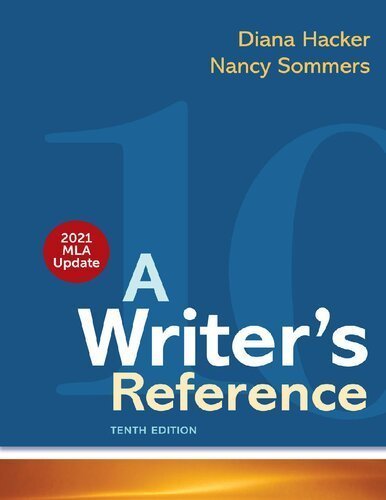
A Writer’s Reference Tenth Edition by Diana Hacker, ISBN-13: 978-1319169404
Original price was: $50.00.$14.99Current price is: $14.99.
Safe & secure checkout
Description
Description
Trustpilot
A Writer’s Reference Tenth Edition by Diana Hacker, ISBN-13: 978-1319169404
[PDF eBook eTextbook] – Available Instantly
- Publisher: Bedford/St. Martin’s; Tenth edition (September 10, 2020)
- Language: English
- 560 pages
- ISBN-10: 1319169406
- ISBN-13: 978-1319169404
Engage more. Achieve more.
A Writer’s Reference helps you engage in and meet the challenges of your writing course. Clear How-to boxes help you complete common writing assignments like argument and analysis. Guidance about paraphrasing and fact-checking sources help you become a more responsible writer and reader. And Notes-to-self help you reflect on your progress and plan your revision. If your instructor has assigned Achieve, you have new ways to engage with course material and with your instructor and peers. Revision planning tools and individualized study plans help you become a better writer, and a built-in e-book puts your problem and your solution side by side.
Table of Contents:
About This Book
Cover Page
Inside Front Cover
Title Page
Copyright Page
Preface for Instructors
C Composing and Revising
C1 Planning
C1-a Assess your writing situation.
Subject
Purpose
Audience
Genre
C1-b Explore your subject.
Asking questions
Talking and listening
Reading and annotating texts
Brainstorming and freewriting
Keeping a journal
Blogging
C1-c Draft and revise a working thesis statement.
Understanding what makes an effective thesis statement
Drafting a working thesis
Revising a working thesis
How To: Solve five common problems with thesis statements
C1-d Draft a plan.
When to use an informal outline
When to use a formal outline
C2 Drafting
C2-a Draft an introduction.
C2-b Draft the body.
Asking questions as you draft
Adding visuals as you draft
C2-c Draft a conclusion.
C3 Writing paragraphs
C3-a Focus on a main point.
Stating the main point in a topic sentence
Sticking to the point
C3-b Develop the main point.
C3-c Make paragraphs coherent.
Linking ideas clearly
Repeating key words
Using parallel structures
Providing transitions
C3-d If necessary, adjust paragraph length.
C3-e Choose a suitable strategy for developing paragraphs.
Illustrations
Narration
Description
Process
Comparison and contrast
Analogy
Cause and effect
Classification
Definition
C4 Reviewing, revising, and editing
C4-a Use peer review: Give constructive comments.
How To: Write helpful peer review comments
C4-b Learn from peer review: Revise with comments.
C4-c Reflect on comments: Develop a revision plan.
C4-d One student’s peer review process
C4-e Approach global revision in cycles.
C4-f Revise globally by making a reverse outline.
C4-g Revise and edit sentences.
How To: Improve your writing with an editing log
C4-h Proofread and format your work.
C4-i Sample student revision: Literacy narrative
Writing Guide: How to write a literacy narrative
C5 Reflecting on your writing; preparing a portfolio
C5-a Reflect on your writing.
C5-b Prepare a portfolio.
C5-c Student writing: Reflective letter for a portfolio
Writing Guide: How to write a reflective letter
A Academic Reading, Writing, and Speaking
A1 Reading and writing critically
A1-a Read actively.
Previewing a text
Annotating a text
Conversing with a text
Asking the “So what?” question
How To: Read like a writer
A1-b Outline a text to identify main ideas.
A1-c Summarize to deepen your understanding.
How To: Write a summary
A1-d Analyze to demonstrate your critical thinking.
Balancing summary with analysis
Drafting an analytical thesis statement
How To: Draft an analytical thesis statement
A1-e Sample student essay: Analysis of an article
Writing Guide: How to write an analytical essay
A2 Reading and writing about multimodal texts
A2-a Read actively.
A2-b Summarize a multimodal text to deepen your understanding.
A2-c Analyze a multimodal text to demonstrate your critical reading.
Balancing summary with analysis
Drafting an analytical thesis statement about a multimodal text
A2-d Sample student writing: Analysis of an advertisement
A3 Reading arguments
A3-a Read with an open mind and a critical eye.
A3-b Evaluate ethical, logical, and emotional appeals as a reader.
A3-c Evaluate the evidence behind an argument.
A3-d Identify underlying assumptions.
A3-e Evaluate how fairly a writer handles opposing views.
A4 Writing arguments
A4-a Identify your purpose and context.
A4-b View your audience as a panel of jurors.
A4-c Build common ground with your audience.
A4-d In your introduction, establish credibility and state your position.
How To: Draft a thesis statement for an argument
Case Study: Responding to an argument
A4-e Back up your thesis with persuasive lines of argument.
A4-f Support your thesis with specific evidence.
Using facts and statistics
Using examples
Using visuals
Citing expert opinion
A4-g Anticipate objections; counter opposing arguments.
A4-h Sample student writing: Argument
Writing Guide: How to write an argument essay
A5 Speaking confidently
A5-a Identify your purpose, audience, and context.
A5-b Prepare a presentation.
Knowing your subject
Developing a clear structure
Using signposts and repetition
Writing for the ear, not the eye
Integrating sources with signal phrases
Using visuals and multimedia purposefully
A5-c Remix a written essay for an oral presentation.
A6 Writing in the disciplines
A6-a Find commonalities across disciplines.
A6-b Recognize the questions writers in a discipline ask.
A6-c Understand the kinds of evidence writers in a discipline use.
A6-d Become familiar with a discipline’s language conventions.
A6-e Use a discipline’s preferred citation style.
R Researched Writing
R1 Thinking like a researcher; gathering sources
R1-a Manage the project.
Managing time
Getting the big picture
Keeping a research log
R1-b Pose questions worth exploring.
Choosing a focused question
Choosing a debatable question
Choosing a question grounded in evidence
Testing your research question
How To: Enter a research conversation
R1-c Map out a search strategy.
R1-d Search efficiently; master a few shortcuts to finding good sources.
Using the library
Using the web
Using bibliographies and citations as shortcuts
Check URLs for clues about sponsorship
R1-e Write a research proposal.
R1-f Conduct field research, if appropriate.
Interviewing
Conducting a survey
How To: Go beyond a Google search
R2 Managing information; taking notes responsibly
R2-a Maintain a working bibliography.
R2-b Keep track of source materials.
How To: Avoid plagiarizing from the web
R2-c As you take notes, avoid unintentional plagiarism.
How To: Take notes responsibly
R3 Evaluating sources
R3-a Evaluate the reliability and usefulness of a source.
How To: Detect false and misleading sources
R3-b Read with an open mind and a critical eye.
R3-c Assess web sources with special care.
R3-d Construct an annotated bibliography.
Writing Guide: How to write an annotated bibliography
MLA MLA Style
List of MLA in-text citation models
List of MLA works cited models
MLA Style
MLA-1 Supporting a thesis
MLA-1a Form a working thesis statement.
MLA-1b Organize ideas with a rough outline.
MLA-1c Consider how sources will contribute to your essay.
Providing context or background information
Explaining terms or concepts
Supporting your claims
Lending authority to your argument
Anticipating and countering objections
MLA-2 Citing sources; avoiding plagiarism
MLA-2a Understand how the MLA system works.
MLA-2b Understand what plagiarism is.
How To: Be a responsible research writer
MLA-2c Use quotation marks around borrowed language.
MLA-2d Put summaries and paraphrases in your own words.
MLA-3 Integrating sources
MLA-3a Summarize and paraphrase effectively.
Summarizing
Paraphrasing
How To: Paraphrase effectively
MLA-3b Use quotations effectively.
Limiting your use of quotations
Using the ellipsis mark
Setting off long quotations
MLA-3c Use signal phrases to integrate sources.
Marking boundaries
Establishing authority
Introducing summaries and paraphrases
Integrating statistics and other facts
Putting source material in context
MLA-3d Synthesize sources.
Considering how sources relate to your argument
Placing sources in conversation
MLA-4 Documenting sources
MLA-4a MLA in-text citations
General guidelines for signal phrases and page numbers
Variations on the general guidelines
Literary works and sacred texts
MLA-4b MLA list of works cited
General guidelines for listing authors
How To: Answer the basic question “Who is the author?”
Articles and other short works
Books and other long works
Websites and parts of websites
Audio, visual, and multimedia sources
How To: Cite a source reposted from another source
Government and legal documents
Personal communication and social media
MLA-4c MLA information notes (optional)
MLA-5 MLA format; sample research paper
MLA-5a MLA format
Formatting the paper: The basics
Formatting the paper: Other concerns
Preparing the list of works cited
MLA-5b Sample MLA research paper
APA CMS APA Style and CMS Style
List of APA in-text citation models
List of APA reference list models
APA Style
APA-1 Supporting a thesis
APA-1a Form a working thesis.
APA-1b Organize your ideas.
APA-1c Consider how sources will contribute to your essay.
Providing background information or context
Explaining terms or concepts
Supporting your claims
Lending authority to your argument
Anticipating and countering alternative perspectives
APA-2 Citing sources; avoiding plagiarism
APA-2a Understand how the APA system works.
APA-2b Understand what plagiarism is.
APA-2c Use quotation marks around borrowed language.
APA-2d Put summaries and paraphrases in your own words.
APA-3 Integrating sources
APA-3a Summarize and paraphrase effectively.
Summarizing
Paraphrasing
APA-3b Use quotations effectively.
Limiting your use of quotations
Using the ellipsis mark
Using brackets
Setting off long quotations
APA-3c Use signal phrases to integrate sources.
Marking boundaries
Using signal phrases with summaries and paraphrases
Integrating statistics and other data
Putting source material in context
APA-3d Synthesize sources.
APA-4 Documenting sources
APA-4a APA in-text citations
APA-4b APA list of references
General guidelines for listing authors
Articles and other short works
Books and other long works
Websites and parts of websites
Audio, visual, and multimedia sources
Social media
APA-5 APA format; sample research paper
APA-5a APA format
Formatting the paper
Preparing the list of references
APA-5b Sample APA research paper
List of CMS-style notes and bibliography entries
CMS (Chicago) Style
CMS-1 Supporting a thesis statement
CMS-1a Form a working thesis statement.
CMS-1b Organize your ideas.
CMS-1c Consider how sources will contribute to your essay.
Providing background information or context
Explaining terms or concepts
Supporting your claims
Lending authority to your argument
Anticipating and countering alternative perspectives
CMS-2 Citing sources; avoiding plagiarism
CMS-2a Use the CMS (Chicago) system for citing sources.
CMS-2b Understand what plagiarism is.
CMS-2c Use quotation marks around borrowed language.
CMS-2d Put summaries and paraphrases in your own words.
CMS-3 Integrating sources
CMS-3a Use quotations effectively.
Limiting your use of quotations
Using the ellipsis mark
Using brackets
Setting off long quotations
CMS-3b Use signal phrases to integrate sources.
Marking boundaries
Using signal phrases with summaries and paraphrases
Integrating statistics and other facts
Putting source material in context
CMS-4 Documenting sources
CMS-4a First and later notes for a source
CMS-4b CMS-style bibliography
CMS-4c Model notes and bibliography entries
General guidelines for listing authors
Books and other long works
Articles and other short works
Web sources
Audio, visual, and multimedia sources
Personal communication and social media
CMS-5 CMS (Chicago) format; sample pages
CMS-5a CMS format
Formatting the paper
Preparing the endnotes
Preparing the bibliography
CMS-5b Sample pages from a CMS-style research paper
S Sentence Style
S1 Parallelism
S1-a Balance parallel ideas in a series.
Headings
Lists
S1-b Balance parallel ideas presented as pairs.
Parallel ideas linked with coordinating conjunctions
Parallel ideas linked with correlative conjunctions
Comparisons linked with than or as
S1-c Repeat function words to clarify parallels.
S2 Needed words
S2-a Add words needed to complete compound structures.
S2-b Add the word that if there is any danger of misreading without it.
S2-c Add words needed to make comparisons logical and complete.
S2-d Add the articles a, an, and the where necessary for grammatical completeness.
S3 Problems with modifiers
S3-a Put limiting modifiers in front of the words they modify.
S3-b Place phrases and clauses so that readers can see at a glance what they modify.
S3-c Move awkwardly placed modifiers.
S3-d Avoid split infinitives when they are awkward.
S3-e Repair dangling modifiers.
Recognizing dangling modifiers
Repairing dangling modifiers
S4 Shifts
S4-a Make the point of view consistent in person and number.
S4-b Maintain consistent verb tenses.
S4-c Make verbs consistent in mood and voice.
Writer’s Choice: Choosing a point of view
S4-d Avoid sudden shifts from indirect to direct questions or quotations.
S5 Mixed constructions
S5-a Untangle the grammatical structure.
S5-b Straighten out the logical connections.
S5-c Avoid is when, is where, and reason . . . is because constructions.
S6 Sentence emphasis
S6-a Coordinate equal ideas; subordinate minor ideas.
Coordination
Subordination
S6-b Combine choppy sentences.
Writer’s Choice: Positioning major and minor ideas
S6-c Avoid ineffective or excessive coordination.
S6-d Do not subordinate major ideas.
S6-e Do not subordinate excessively.
S6-f Experiment with techniques for gaining emphasis.
Using sentence endings for emphasis
Using parallel structure for emphasis
S7 Sentence variety
S7-a Vary your sentence openings.
Writer’s Choice: Strengthening with variety
S7-b Use a variety of sentence structures.
S7-c Try inverting sentences occasionally.
W Word Choice
W1 Glossary of usage
W2 Wordy sentences
W2-a Eliminate redundancies.
W2-b Avoid unnecessary repetition of words.
W2-c Cut empty or inflated phrases.
W2-d Simplify the structure.
W2-e Reduce clauses to phrases, phrases to single words.
W3 Active verbs
W3-a Choose the active voice or the passive voice depending on your writing situation.
W3-b Replace be verbs that result in dull or wordy sentences.
Writer’s Choice: Using the active or the passive voice
W3-c As a rule, choose a subject that names the person or thing doing the action.
W4 Appropriate language
W4-a Avoid jargon, except in specialized writing situations.
Writer’s Choice: Using discipline-specific terms
W4-b Avoid most euphemisms and doublespeak.
W4-c In most contexts, avoid slang.
W4-d Choose an appropriate level of formality.
W4-e Avoid sexist and noninclusive language.
Recognizing sexist and noninclusive language
Revising sexist and noninclusive language
W5 Exact language
W5-a Select words with appropriate connotations.
W5-b Prefer specific, concrete nouns.
W5-c Do not misuse words.
W5-d Use common idioms.
W5-e Do not rely heavily on clichés.
W5-f Use figures of speech with care.
G Grammatical Sentences
G1 Subject-verb agreement
G1-a Learn to recognize standard subject-verb combinations.
G1-b Make the verb agree with its subject, not with a word that comes between.
G1-c Treat most subjects joined with and as plural.
G1-d With subjects joined with or or nor (or with either . . . or or neither . . . nor), make the verb agree with the part of the subject nearer to the verb.
G1-e Treat most indefinite pronouns as singular.
G1-f Treat collective nouns as singular unless the meaning is clearly plural.
G1-g Make the verb agree with its subject even when the subject follows the verb.
G1-h Make the verb agree with its subject, not with a subject complement.
G1-i Who, which, and that take verbs that agree with their antecedents.
One of the
Only one of the
G1-j Words such as athletics, economics, mathematics, physics, politics, statistics, measles, and news are usually singular, despite their plural form.
G1-k Treat titles of works, company names, words mentioned as words, and gerund phrases as singular.
G2 Verb forms, tenses, and moods
G2-a Choose among the forms of irregular verbs.
Common irregular verbs
G2-b Distinguish among the forms of lie and lay.
G2-c Use -s (or -es) endings on present-tense verbs that have third-person singular subjects.
G2-d Do not omit -ed endings on verbs.
Past tense
Past participles
G2-e Do not omit needed verbs.
G2-f Choose the appropriate verb tense.
Survey of tenses
Special uses of the present tense
The past perfect tense
Sequence of tenses with infinitives and participles
G2-g Use the subjunctive mood in the few contexts that require it.
Forms of the subjunctive
Uses of the subjunctive
G3 Pronouns
G3-a Make pronouns and antecedents agree.
Indefinite pronouns
Generic nouns
Collective nouns
Compound antecedents
G3-b Make pronoun references clear.
Ambiguous reference
Implied reference
Broad reference of this, that, which, and it
Indefinite use of they, it, and you
G3-c Distinguish between pronouns such as I and me.
Subjective case (I, you, he, she, it, we, they)
Objective case (me, you, him, her, it, us, them)
Compound word groups
Appositives
Comparisons with than or as
We or us before a noun
Subjects and objects of infinitives
Possessive case to modify a gerund
G3-d Distinguish between who and whom.
In subordinate clauses
In questions
For subjects or objects of infinitives
G4 Adjectives and adverbs
G4-a Use adjectives to modify nouns.
Subject complements
Object complements
G4-b Use adverbs to modify verbs, adjectives, and other adverbs.
G4-c Distinguish between good and well, bad and badly.
G4-d Use comparatives and superlatives with care.
Comparative versus superlative
Forming comparatives and superlatives
Double comparatives or superlatives
Absolute concepts
G4-e Avoid double negatives.
G5 Sentence fragments
Recognizing sentence fragments
Repairing sentence fragments
G5-a Attach fragmented subordinate clauses or turn them into sentences.
G5-b Attach fragmented phrases or turn them into sentences.
G5-c Attach other fragmented word groups or turn them into sentences.
Parts of compound predicates
Lists
Examples introduced by for example, in addition, or similar expressions
G5-d Exception: A fragment may be used for effect.
G6 Run-on sentences
Recognizing run-on sentences
Writer’s Choice: Clustering ideas in meaningful ways
How To: Revise a run-on sentence
G6-a Consider separating the clauses with a comma and a coordinating conjunction.
G6-b Consider separating the clauses with a semicolon, a colon, or a dash.
G6-c Consider making the clauses into separate sentences.
G6-d Consider restructuring the sentence, perhaps by subordinating one of the clauses.
M Multilingual Writers and ESL Topics
M1 Verbs
M1-a Use the appropriate verb form and tense.
Basic verb forms
Verb tenses
M1-b To write a verb in the passive voice, use a form of be with the past participle.
M1-c Use the base form of the verb after a modal.
M1-d To make negative verb forms, add not in the appropriate place.
M1-e In a conditional sentence, choose verb tenses according to the type of condition expressed in the sentence.
Factual
Predictive
Speculative
M1-f Become familiar with verbs that may be followed by gerunds or infinitives.
Verb + gerund or infinitive (no change in meaning)
Verb + gerund or infinitive (change in meaning)
Verb + gerund
Verb + infinitive
Verb + noun or pronoun + infinitive
Verb + noun or pronoun + unmarked infinitive
M2 Articles
M2-a Be familiar with articles and other noun markers.
Using articles and other noun markers
Types of articles and types of nouns
M2-b Use the with most specific common nouns.
M2-c Use a (or an) with common singular count nouns that refer to “one” or “any.”.
M2-d Use a quantifier such as some or more, not a or an, with a noncount noun to express an approximate amount.
M2-e Do not use articles with nouns that refer to all of something or to something in general.
M2-f Do not use articles with most singular proper nouns. Use the with most plural proper nouns.
M3 Sentence structure
M3-a Use a linking verb between a subject and its complement.
M3-b Include a subject in every sentence.
M3-c Do not use both a noun and a pronoun to perform the same grammatical function in a sentence.
M3-d Do not repeat a subject, an object, or an adverb in an adjective clause.
M3-e Avoid mixed constructions beginning with although or because.
M3-f Do not place an adverb between a verb and its direct object.
M4 Using adjectives
M4-a Distinguish between present participles and past participles used as adjectives.
M4-b Place cumulative adjectives in an appropriate order.
M5 Prepositions and idiomatic expressions
M5-a Become familiar with prepositions that show time and place.
M5-b Use nouns (including -ing forms) after prepositions.
M5-c Become familiar with common adjective + preposition combinations.
M5-d Become familiar with common verb + preposition combinations.
M6 Paraphrasing sources effectively
M6-a Avoid replacing a source’s words with synonyms.
M6-b Determine the meaning of the original source.
M6-c Present the author’s meaning in your own words.
P Punctuation and Mechanics
P1 The comma
P1-a Use a comma before a coordinating conjunction joining independent clauses.
P1-b Use a comma after an introductory clause or phrase.
P1-c Use a comma between all items in a series.
P1-d Use a comma between coordinate adjectives not joined with and. Do not use a comma between cumulative adjectives.
P1-e Use commas to set off nonrestrictive (nonessential) elements. Do not use commas to set off restrictive (essential) elements.
Restrictive elements
Nonrestrictive elements
Adjective clauses
Adjective phrases
Appositives
P1-f Use commas to set off transitional and parenthetical expressions, absolute phrases, and word groups expressing contrast.
Transitional expressions
Parenthetical expressions
Absolute phrases
Word groups expressing contrast
P1-g Use commas to set off nouns of direct address, the words yes and no, interrogative tags, and mild interjections.
P1-h Use commas with expressions such as he said to set off direct quotations.
P1-i Use commas with dates, addresses, titles, and numbers.
Dates
Addresses
Titles
Numbers
P2 Unnecessary commas
P2-a Do not use a comma with a coordinating conjunction that joins only two words, phrases, or subordinate clauses.
P2-b Do not use a comma to separate a verb from its subject or object.
P2-c Do not use a comma before the first or after the last item in a series.
P2-d Do not use a comma between cumulative adjectives, between an adjective and a noun, or between an adverb and an adjective.
P2-e Do not use commas to set off restrictive elements.
P2-f Do not use a comma to set off a concluding adverb clause that is essential for meaning.
P2-g Do not use a comma after a phrase that begins an inverted sentence.
P2-h Avoid other common misuses of the comma.
P3 The semicolon and the colon
P3-a Use a semicolon between closely related independent clauses.
Between independent clauses with no coordinating conjunction
Between independent clauses linked with a transitional expression
P3-b Use a semicolon between items in a series containing internal punctuation.
P3-c Avoid common misuses of the semicolon.
P3-d Use a colon after an independent clause to direct attention to a list, an appositive, a quotation, or a summary or an explanation.
P3-e Use a colon according to convention.
P3-f Avoid common misuses of the colon.
P4 The apostrophe
P4-a Use an apostrophe to indicate that a noun is possessive.
When to add -’s
When to add only an apostrophe
Joint possession
Compound nouns
Indefinite pronouns
P4-b Use an apostrophe to mark omissions in contractions and numbers.
P4-c Do not use an apostrophe in certain situations.
Plural of numbers
Plural of letters
Plural of abbreviations
Plural of words mentioned as words
P4-d Avoid common misuses of the apostrophe.
P5 Quotation marks
P5-a Use quotation marks to enclose direct quotations.
Exception: long quotations
Exception: indirect quotations
P5-b Use single quotation marks to enclose a quotation within a quotation.
P5-c Use quotation marks around the titles of short works.
P5-d Quotation marks may be used to set off words used as words.
P5-e Use punctuation with quotation marks according to convention.
Periods and commas
Colons and semicolons
Question marks and exclamation points
Introducing quoted material
P5-f Avoid common misuses of quotation marks.
P6 Other punctuation marks
P6-a End punctuation
The period
The question mark
The exclamation point
P6-b The dash, parentheses, and brackets
The dash
Parentheses
Brackets
P6-c The ellipsis mark
P6-d The slash
P7 Spelling and hyphenation
P7-a Become familiar with the major spelling rules.
i before e except after c
Suffixes
Plurals
P7-b Discriminate between words that sound alike but have different meanings.
P7-c Be alert to commonly misspelled words.
P7-d Consult the dictionary to determine how to treat a compound word.
P7-e Hyphenate two or more words used together as an adjective before a noun.
P7-f Hyphenate fractions and certain numbers when they are spelled out.
P7-g Use a hyphen with the prefixes all-, ex- (meaning “former”), and self- and with the suffix -elect.
P7-h Use a hyphen in certain words to avoid ambiguity.
P7-i Check for correct word breaks when words must be divided at the end of a line.
P8 Capitalization
P8-a Capitalize proper nouns and words derived from them; do not capitalize common nouns.
P8-b Capitalize titles of persons when used as part of a proper name but usually not when used alone.
P8-c Capitalize titles according to convention.
P8-d Capitalize the first word of a sentence.
P8-e Capitalize the first word of a quoted sentence but not a quoted word or phrase.
P8-f Know your options when the first word after a colon begins an independent clause.
P9 Abbreviations and numbers
P9-a Use common abbreviations for titles immediately before and after proper names.
P9-b Use abbreviations only when you are sure your readers will understand them.
P9-c Use BC, AD, a.m., p.m., No., and $ only with specific dates, times, numbers, and amounts.
P9-d Units of measurement
P9-e Be sparing in your use of Latin abbreviations.
P9-f Plural of abbreviations
P9-g Avoid inappropriate abbreviations.
P9-h Follow the conventions in your discipline for spelling out or using numerals to express numbers.
P9-i Use numerals according to convention in dates, addresses, and so on.
P10 Italics
P10-a Italicize the titles of works according to convention.
P10-b Italicize other terms according to convention.
Ships, spacecraft, and aircraft
Foreign words
Words mentioned as words, letters mentioned as letters, and numbers mentioned as numbers
B Basic Grammar
B1 Parts of speech
B1-a Nouns
B1-b Pronouns
B1-c Verbs
Helping verbs
Main verbs
B1-d Adjectives
B1-e Adverbs
B1-f Prepositions
B1-g Conjunctions
B1-h Interjections
B2 Sentence patterns
B2-a Subjects
The complete subject
The simple subject
Understood subjects
Subject after the verb
B2-b Verbs, objects, and complements
Linking verbs and subject complements
Transitive verbs and direct objects
Transitive verbs, indirect objects, and direct objects
Transitive verbs, direct objects, and object complements
Intransitive verbs
B3 Subordinate word groups
B3-a Prepositional phrases
B3-b Verbal phrases
Participial phrases
Gerund phrases
Infinitive phrases
B3-c Appositive phrases
B3-d Absolute phrases
B3-e Subordinate clauses
Adjective clauses
Writer’s Choice: Building credibility with appositives
Adverb clauses
Noun clauses
B4 Sentence types
B4-a Sentence structures
Simple sentences
Compound sentences
Complex sentences
Compound-complex sentences
B4-b Sentence purposes
Acknowledgments
I Index
Index
Multilingual/ESL Menu
Revision Symbols
Detailed Menu
Back Cover
What makes us different?
• Instant Download
• Always Competitive Pricing
• 100% Privacy
• FREE Sample Available
• 24-7 LIVE Customer Support


Reviews
There are no reviews yet.