

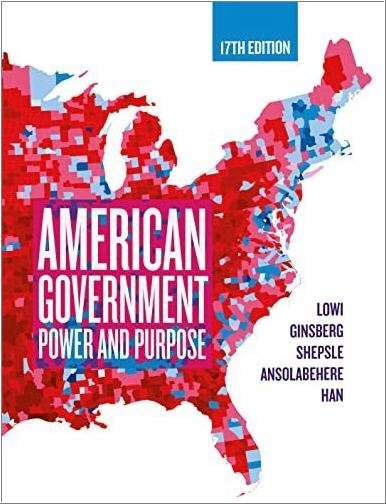
American Government: Power and Purpose 17th Edition by Theodore J. Lowi, ISBN-13: 978-1324039532
Original price was: $50.00.$19.99Current price is: $19.99.
Safe & secure checkout
Description
Description
American Government: Power and Purpose 17th Edition by Theodore J. Lowi, ISBN-13: 978-1324039532
[PDF eBook eTextbook]
- Publisher: W. W. Norton & Company; Seventeenth edition (December 28, 2022)
- Language: English
- 1008 pages (56 MB)
- ISBN-10: 1324039531
- ISBN-13: 978-1324039532
The gold standard analytical approach reinvigorated.
Table of Contents:
Cover
Publisher’s Notice
Half-title Page
Copyright
Dedication
Contents
Preface
Acknowledgments
Chapter 1: Five Principles of Politics
Making Sense of Government and Politics
Five Principles of Politics
Conclusion: Preparing to Analyze the American Political System
Analyzing the Evidence: Making Sense of Charts and Graphs
Chapter 2: Constructing a Government: The Founding and the Constitution
The First Founding: Interests and Conflicts
The Second Founding: From Compromise to Constitution
The Constitution
The Fight for Ratification: Federalists versus Antifederalists
Changing the Institutional Framework: Constitutional Amendment
Conclusion: Reflections on the Founding—Ideals or Interests?
Chapter 3: Federalism and the Separation of Powers
Who Does What? Federalism and Institutional Jurisdictions
The Separation of Powers
Conclusion: Federalism and the Separation of Powers—Collective Action or Stalemate?
Chapter 4: Civil Liberties
Origins of the Bill of Rights
Nationalizing the Bill of Rights
The Bill of Rights Today
Conclusion: Civil Liberties and Collective Action
Chapter 5: Civil Rights
What are Civil Rights?
Collective Action and the Struggle for Civil Rights
The Politics of Rights
Affirmative Action
Conclusion: Civil Liberties and Civil Rights—Regulating Collective Action
Chapter 6: Congress: The First Branch
Representation
Problems of Legislative Organization
The Organization of Congress
Rules of Lawmaking: How a Bill Becomes a Law
How Congress Decides
Beyond Legislation: Additional Congressional Powers
Conclusion: Power and Representation
Chapter 7: The Presidency as an Institution
The Constitutional Origins and Powers of the Presidency
The Rise of Presidential Government
Presidential Government
Conclusion: Presidential Power—Myths and Realities
Chapter 8: The Executive Branch
Why Bureaucracy?
How is the Executive Branch Organized?
The Problem of Bureaucratic Control
Reforming the Bureaucracy
Conclusion: Public Bureaucracies and Politics
Chapter 9: The Federal Courts
The Judicial Process
The Organization of the Court System
How Courts Work as Political Institutions
The Power of Judicial Review
The Supreme Court in Action
Judicial Decision Making
Conclusion: The Expanding Power of the Judiciary
Chapter 10: Public Opinion
What is Public Opinion?
Origins and Nature of Opinion
Public Opinion and Political Knowledge
Shaping Opinion: Political Leaders, Private Groups, and the Media
Measuring Public Opinion
How Does Public Opinion Influence Government Policy?
Conclusion: Government and the Will of the People
Chapter 11: Elections
Institutions of Elections
How Voters Decide
Campaigns: Money, Media, and Grass Roots
The 2020 and 2022 Elections
Conclusion: Elections and Accountability
Chapter 12: Political Parties
Why Do Political Parties Form?
What Functions Do Parties Perform?
Parties in Government
Parties in the Electorate
Parties as Institutions
Party Systems
Conclusion: Parties and Democracy
Chapter 13: Groups and Organized Interests
What is an Organized Interest?
What Functions Do Organized Interests Serve in American Democracy?
How Do Interests Organize Themselves for Collective Action?
How Have Groups Organized Themselves for Action Over Time?
How Do Organized Interests Influence Politics and Policy?
Are Organized Interests Effective?
Conclusion: Organized Interests in U.S. Politics
Chapter 14: The Media
The Media as a Political Institution
What Affects News Coverage?
The Public and the Media
Regulating the Media
Conclusion: Media Power and Responsibility
Chapter 15: Economic Policy
How Does Government Make a Market Economy Possible?
The Economy as a Political Issue
The Goals of Economic Policy
The Tools of Economic Policy
Who Influences Economic Policy?
Conclusion: History, Challenges, and Opportunity in Economic Policy
Chapter 16: Social Policy
What is Social Policy?
The Historical Development of U.S. Social Policy
The Foundations of the Social Welfare State
How Can Government Create Opportunity?
The Politics of Social Policy
Support for and Opposition to Social Policy
Conclusion: History Versus Collective Action in Social Policy
Chapter 17: Foreign Policy
The Goals of Foreign Policy
Who Makes American Foreign Policy?
The Instruments of Modern American Foreign Policy
Thinking Critically about Foreign Policy: The History Principle
Appendix
The Declaration of Independence
The Articles of Condeferation
The Constitution of the United States of America
Amendments to the Constitution
Federalist Papers
Endnotes
Glossary
Credits
Index
Theodore J. Lowi was John L. Senior Professor of American Institutions at Cornell University. He was elected president of the American Political Science Association in 1990 and was cited as the political scientist who made the most significant contribution to the field during the decade of the 1970s. Among his numerous books are The End of Liberalism and The Pursuit of Justice, on which he collaborated with Robert F. Kennedy.
Benjamin Ginsberg is the David Bernstein Professor of Political Science, Director of the Washington Center for the Study of American Government, and Chair of the Center for Advanced Governmental Studies at Johns Hopkins University. He is the author or coauthor of 20 books including Presidential Power: Unchecked and Unbalanced, Downsizing Democracy: How America Sidelined Its Citizens and Privatized Its Public, Politics by Other Means, The Consequences of Consent, and The Captive Public. Before joining the Hopkins faculty in 1992, Ginsberg was Professor of Government at Cornell University. His most recent book is The Fall of the Faculty: The Rise of the All-Administrative University and Why It Matters. Ginsberg’s published research focuses on political development, presidential politics, participation, and money in politics.
Kenneth A. Shepsle is the George D. Markham Professor of Government and founding member of the Institute for Quantitative Social Science at Harvard University. He is the author or coauthor of several books, including Politics in Plural Societies: A Theory of Democratic Instability, The Giant Jigsaw Puzzle: Democratic Committee Assignments in the Modern House, Models of Multiparty Electoral Competition, Making and Breaking Governments, and Analyzing Politics: Rationality, Behavior, and Institutions. He has been a member of the National Academy of Sciences and the American Academy of Arts and Sciences since 1990, and he is the recipient of fellowships by the Hoover Institution, the John Simon Guggenheim Memorial Foundation, and the Center for Advanced Study in the Behavioral Sciences. Shepsle’s research focuses on formal political theory, congressional politics, public policy, and political economy.
Stephen Ansolabehere is Professor of Government at Harvard University. He is the coauthor of The Media Game and Going Negative: How Political Advertising Alienates and Polarizes the American Electorate, which was awarded the Goldsmith Book Prize. His articles have appeared in The American Political Science Review, The Journal of Politics, Legislative Studies Quarterly, and Public Opinion Quarterly. He has been awarded fellowships by the Carnegie Corporation Fellowship and the Hoover Institution. He served as a co-director of the CalTech/MIT Voting Project, established in the wake of the 2000 presidential election to evaluate the current state of the reliability and uniformity of U.S. voting systems and propose uniform guidelines and requirements for reliable voting and performance. Ansolabehere’s research focuses on public opinion, elections, mass media, and representation.
Hahrie Han is the Inaugural Director of the SNF Agora Institute, the Stavros Niarchos Foundation Professor of Political Science, and Faculty Director of the P3 Research Lab at Johns Hopkins University. She specializes in the study of organizing, movements, civic engagement, and democracy. Her newest book was published by the University of Chicago Press in July 2021, entitled Prisms of the People: Power & Organizing in 21st Century America. She has previously published three books: How Organizations Develop Activists: Civic Associations and Leadership in the 21st Century ; Groundbreakers: How Obama’s 2.2 Million Volunteers Transformed Campaigning in America ; and Moved to Action: Motivation, Participation, and Inequality in American Politics. Her award-winning work has been published in the American Political Science Review, American Sociological Review, American Journal of Sociology, Journal of the American Medical Association (JAMA), and numerous other outlets, including the New York Times, Washington Post, and elsewhere. She is currently working on a fifth book, to be published with Knopf (an imprint of Penguin Random House), about faith and race in America, with a particular focus on evangelical megachurches
What makes us different?
• Instant Download
• Always Competitive Pricing
• 100% Privacy
• FREE Sample Available
• 24-7 LIVE Customer Support


Reviews
There are no reviews yet.