

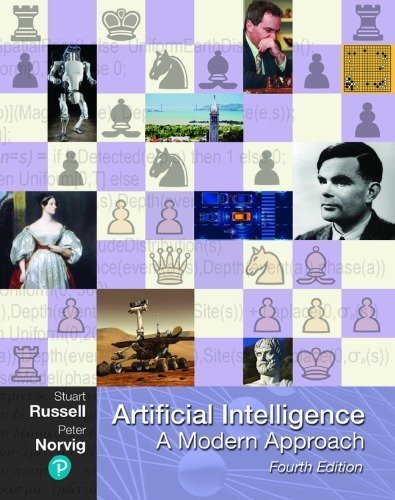
Artificial Intelligence: A Modern Approach 4th Edition by Stuart Russell, ISBN-13: 978-0134610993
Original price was: $50.00.$14.99Current price is: $14.99.
Safe & secure checkout
Description
Description
Artificial Intelligence: A Modern Approach 4th Edition by Stuart Russell, ISBN-13: 978-0134610993
[PDF eBook eTextbook] – Available Instantly
- Publisher: Pearson; 4th edition (April 28, 2020)
- Language: English
- 1136 pages
- ISBN-10: 0134610997
- ISBN-13: 978-0134610993
The most comprehensive, up-to-date introduction to the theory and practice of artificial intelligence.
The long-anticipated revision of Artificial Intelligence: A Modern Approach explores the full breadth and depth of the field of artificial intelligence (AI). The 4th Edition brings readers up to date on the latest technologies, presents concepts in a more unified manner, and offers new or expanded coverage of machine learning, deep learning, transfer learning, multiagent systems, robotics, natural language processing, causality, probabilistic programming, privacy, fairness, and safe AI.
Artificial Intelligence is your guide to the theory and practice of modern AI. It introduces major concepts using intuitive explanations and nontechnical language, before going into mathematical or algorithmic details. In-depth coverage of both basic and advanced topics provides you with a solid understanding of the frontiers of AI without compromising complexity and depth. A unified approach to AI clearly details how the various subfields of AI fit together to build actual, useful programs.
The 4th Edition has been updated to stay current with the latest technologies as well as to present concepts in a more unified manner. New chapters feature expanded coverage of probabilistic programming, multiagent decision making, deep learning and deep learning for natural language processing. Revised coverage of computer vision, natural language understanding and speech recognition reflect the impact of deep learning methods on these fields.
Table of Contents:
Preface
New to this edition
Overview of the book
Online resources
Book cover
About the Authors
Contents
I Artificial Intelligence
Chapter 1 Introduction
1.1 What Is AI?
1.1.1 Acting humanly: The Turing test approach
1.1.2 Thinking humanly: The cognitive modeling approach
1.1.3 Thinking rationally: The “laws of thought” approach
1.1.4 Acting rationally: The rational agent approach
1.1.5 Beneficial machines
1.2 The Foundations of Artificial Intelligence
1.2.1 Philosophy
1.2.2 Mathematics
1.2.3 Economics
1.2.4 Neuroscience
1.2.5 Psychology
1.2.6 Computer engineering
1.2.7 Control theory and cybernetics
1.2.8 Linguistics
1.3 The History of Artificial Intelligence
1.3.1 The inception of artificial intelligence (1943–1956)
1.3.2 Early enthusiasm, great expectations (1952–1969)
1.3.3 A dose of reality (1966–1973)
1.3.4 Expert systems (1969–1986)
1.3.5 The return of neural networks (1986–present)
1.3.6 Probabilistic reasoning and machine learning (1987–present)
1.3.7 Big data (2001–present)
1.3.8 Deep learning (2011–present)
1.4 The State of the Art
1.5 Risks and Benefits of AI
Summary
Bibliographical and Historical Notes
Chapter 2 Intelligent Agents
2.1 Agents and Environments
2.2 Good Behavior: The Concept of Rationality
2.2.1 Performance measures
2.2.2 Rationality
2.2.3 Omniscience, learning, and autonomy
2.3 The Nature of Environments
2.3.1 Specifying the task environment
2.3.2 Properties of task environments
2.4 The Structure of Agents
2.4.1 Agent programs
2.4.2 Simple reflex agents
2.4.3 Model-based reflex agents
2.4.4 Goal-based agents
2.4.5 Utility-based agents
2.4.6 Learning agents
2.4.7 How the components of agent programs work
Summary
Bibliographical and Historical Notes
II Problem-solving
Chapter 3 Solving Problems by Searching
3.1 Problem-Solving Agents
3.1.1 Search problems and solutions
3.1.2 Formulating problems
3.2 Example Problems
3.2.1 Standardized problems
3.2.2 Real-world problems
3.3 Search Algorithms
3.3.1 Best-first search
3.3.2 Search data structures
3.3.3 Redundant paths
3.3.4 Measuring problem-solving performance
3.4 Uninformed Search Strategies
3.4.1 Breadth-first search
3.4.2 Dijkstra’s algorithm or uniform-cost search
3.4.3 Depth-first search and the problem of memory
3.4.4 Depth-limited and iterative deepening search
3.4.5 Bidirectional search
3.4.6 Comparing uninformed search algorithms
3.5 Informed (Heuristic) Search Strategies
3.5.1 Greedy best-first search
3.5.2 A* search
3.5.3 Search contours
3.5.4 Satisficing search: Inadmissible heuristics and weighted A*
3.5.5 Memory-bounded search
3.5.6 Bidirectional heuristic search
3.6 Heuristic Functions
3.6.1 The effect of heuristic accuracy on performance
3.6.2 Generating heuristics from relaxed problems
3.6.3 Generating heuristics from subproblems: Pattern databases
3.6.4 Generating heuristics with landmarks
3.6.5 Learning to search better
3.6.6 Learning heuristics from experience
Summary
Bibliographical and Historical Notes
Chapter 4 Search in Complex Environments
4.1 Local Search and Optimization Problems
4.1.1 Hill-climbing search
4.1.2 Simulated annealing
4.1.3 Local beam search
4.1.4 Evolutionary algorithms
4.2 Local Search in Continuous Spaces
4.3 Search with Nondeterministic Actions
4.3.1 The erratic vacuum world
4.3.2 and–or search trees
4.3.3 Try, try again
4.4 Search in Partially Observable Environments
4.4.1 Searching with no observation
4.4.2 Searching in partially observable environments
4.4.3 Solving partially observable problems
4.4.4 An agent for partially observable environments
4.5 Online Search Agents and Unknown Environments
4.5.1 Online search problems
4.5.2 Online search agents
4.5.3 Online local search
4.5.4 Learning in online search
Summary
Bibliographical and Historical Notes
Chapter 5 Adversarial Search and Games
5.1 Game Theory
5.1.1 Two-player zero-sum games
5.2 Optimal Decisions in Games
5.2.1 The minimax search algorithm
5.2.2 Optimal decisions in multiplayer games
5.2.3 Alpha–Beta Pruning
5.2.4 Move ordering
5.3 Heuristic Alpha–Beta Tree Search
5.3.1 Evaluation functions
5.3.2 Cutting off search
5.3.3 Forward pruning
5.3.4 Search versus lookup
5.4 Monte Carlo Tree Search
5.5 Stochastic Games
5.5.1 Evaluation functions for games of chance
5.6 Partially Observable Games
5.6.1 Kriegspiel: Partially observable chess
5.6.2 Card games
5.7 Limitations of Game Search Algorithms
Summary
Bibliographical and Historical Notes
Chapter 6 Constraint Satisfaction Problems
6.1 Defining Constraint Satisfaction Problems
6.1.1 Example problem: Map coloring
6.1.2 Example problem: Job-shop scheduling
6.1.3 Variations on the CSP formalism
6.2 Constraint Propagation: Inference in CSPs
6.2.1 Node consistency
6.2.2 Arc consistency
6.2.3 Path consistency
6.2.4 K-consistency
6.2.5 Global constraints
6.2.6 Sudoku
6.3 Backtracking Search for CSPs
6.3.1 Variable and value ordering
6.3.2 Interleaving search and inference
6.3.3 Intelligent backtracking: Looking backward
6.3.4 Constraint learning
6.4 Local Search for CSPs
6.5 The Structure of Problems
6.5.1 Cutset conditioning
6.5.2 Tree decomposition
6.5.3 Value symmetry
Summary
Bibliographical and Historical Notes
III Knowledge, reasoning, and planning
Chapter 7 Logical Agents
7.1 Knowledge-Based Agents
7.2 The Wumpus World
7.3 Logic
7.4 Propositional Logic: A Very Simple Logic
7.4.1 Syntax
7.4.2 Semantics
7.4.3 A simple knowledge base
7.4.4 A simple inference procedure
7.5 Propositional Theorem Proving
7.5.1 Inference and proofs
7.5.2 Proof by resolution
Conjunctive normal form
A resolution algorithm
Completeness of resolution
7.5.3 Horn clauses and definite clauses
7.5.4 Forward and backward chaining
7.6 Effective Propositional Model Checking
7.6.1 A complete backtracking algorithm
7.6.2 Local search algorithms
7.6.3 The landscape of random SAT problems
7.7 Agents Based on Propositional Logic
7.7.1 The current state of the world
7.7.2 A hybrid agent
7.7.3 Logical state estimation
7.7.4 Making plans by propositional inference
Summary
Bibliographical and Historical Notes
Chapter 8 First-Order Logic
8.1 Representation Revisited
8.1.1 The language of thought
8.1.2 Combining the best of formal and natural languages
8.2 Syntax and Semantics of First-Order Logic
8.2.1 Models for first-order logic
8.2.2 Symbols and interpretations
8.2.3 Terms
8.2.4 Atomic sentences
8.2.5 Complex sentences
8.2.6 Quantifiers
Universal quantification (∀)
Existential quantification (∃)
Nested quantifiers
Connections between ∀ and ∃
8.2.7 Equality
8.2.8 Database semantics
8.3 Using First-Order Logic
8.3.1 Assertions and queries in first-order logic
8.3.2 The kinship domain
8.3.3 Numbers, sets, and lists
8.3.4 The wumpus world
8.4 Knowledge Engineering in First-Order Logic
8.4.1 The knowledge engineering process
8.4.2 The electronic circuits domain
Identify the questions
Assemble the relevant knowledge
Decide on a vocabulary
Encode general knowledge of the domain
Encode the specific problem instance
Pose queries to the inference procedure
Debug the knowledge base
Summary
Bibliographical and Historical Notes
Chapter 9 Inference in First-Order Logic
9.1 Propositional vs. First-Order Inference
9.1.1 Reduction to propositional inference
9.2 Unification and First-Order Inference
9.2.1 Unification
9.2.2 Storage and retrieval
9.3 Forward Chaining
9.3.1 First-order definite clauses
9.3.2 A simple forward-chaining algorithm
9.3.3 Efficient forward chaining
Matching rules against known facts
Incremental forward chaining
Irrelevant facts
9.4 Backward Chaining
9.4.1 A backward-chaining algorithm
9.4.2 Logic programming
9.4.3 Redundant inference and infinite loops
9.4.4 Database semantics of Prolog
9.4.5 Constraint logic programming
9.5 Resolution
9.5.1 Conjunctive normal form for first-order logic
9.5.2 The resolution inference rule
9.5.3 Example proofs
9.5.4 Completeness of resolution
9.5.5 Equality
9.5.6 Resolution strategies
Practical uses of resolution theorem provers
Summary
Bibliographical and Historical Notes
Chapter 10 Knowledge Representation
10.1 Ontological Engineering
10.2 Categories and Objects
10.2.1 Physical composition
10.2.2 Measurements
10.2.3 Objects: Things and stuff
10.3 Events
10.3.1 Time
10.3.2 Fluents and objects
10.4 Mental Objects and Modal Logic
10.4.1 Other modal logics
10.5 Reasoning Systems for Categories
10.5.1 Semantic networks
10.5.2 Description logics
10.6 Reasoning with Default Information
10.6.1 Circumscription and default logic
10.6.2 Truth maintenance systems
Summary
Bibliographical and Historical Notes
Chapter 11 Automated Planning
11.1 Definition of Classical Planning
11.1.1 Example domain: Air cargo transport
11.1.2 Example domain: The spare tire problem
11.1.3 Example domain: The blocks world
11.2 Algorithms for Classical Planning
11.2.1 Forward state-space search for planning
11.2.2 Backward search for planning
11.2.3 Planning as Boolean satisfiability
11.2.4 Other classical planning approaches
11.3 Heuristics for Planning
11.3.1 Domain-independent pruning
11.3.2 State abstraction in planning
11.4 Hierarchical Planning
11.4.1 High-level actions
11.4.2 Searching for primitive solutions
11.4.3 Searching for abstract solutions
11.5 Planning and Acting in Nondeterministic Domains
11.5.1 Sensorless planning
11.5.2 Contingent planning
11.5.3 Online planning
11.6 Time, Schedules, and Resources
11.6.1 Representing temporal and resource constraints
11.6.2 Solving scheduling problems
11.7 Analysis of Planning Approaches
Summary
Bibliographical and Historical Notes
IV Uncertain knowledge and reasoning
Chapter 12 Quantifying Uncertainty
12.1 Acting under Uncertainty
12.1.1 Summarizing uncertainty
12.1.2 Uncertainty and rational decisions
12.2 Basic Probability Notation
12.2.1 What probabilities are about
12.2.2 The language of propositions in probability assertions
12.2.3 Probability axioms and their reasonableness
12.3 Inference Using Full Joint Distributions
12.4 Independence
12.5 Bayes’ Rule and Its Use
12.5.1 Applying Bayes’ rule: The simple case
12.5.2 Using Bayes’ rule: Combining evidence
12.6 Naive Bayes Models
12.6.1 Text classification with naive Bayes
12.7 The Wumpus World Revisited
Summary
Bibliographical and Historical Notes
Chapter 13 Probabilistic Reasoning
13.1 Representing Knowledge in an Uncertain Domain
13.2 The Semantics of Bayesian Networks
13.2.1 Conditional independence relations in Bayesian networks
13.2.2 Efficient Representation of Conditional Distributions
13.2.3 Bayesian nets with continuous variables
13.2.4 Case study: Car insurance
13.3 Exact Inference in Bayesian Networks
13.3.1 Inference by enumeration
13.3.2 The variable elimination algorithm
Operations on factors
Variable ordering and variable relevance
13.3.3 The complexity of exact inference
13.3.4 Clustering algorithms
13.4 Approximate Inference for Bayesian Networks
13.4.1 Direct sampling methods
Rejection sampling in Bayesian networks
Importance sampling
13.4.2 Inference by Markov chain simulation
Gibbs sampling in Bayesian networks
Analysis of Markov chains
Why Gibbs sampling works
Complexity of Gibbs sampling
Metropolis–Hastings sampling
13.4.3 Compiling approximate inference
13.5 Causal Networks
13.5.1 Representing actions: The do-operator
13.5.2 The back-door criterion
Summary
Bibliographical and Historical Notes
Chapter 14 Probabilistic Reasoning over Time
14.1 Time and Uncertainty
14.1.1 States and observations
14.1.2 Transition and sensor models
14.2 Inference in Temporal Models
14.2.1 Filtering and prediction
14.2.2 Smoothing
14.2.3 Finding the most likely sequence
14.3 Hidden Markov Models
14.3.1 Simplified matrix algorithms
14.3.2 Hidden Markov model example: Localization
14.4 Kalman Filters
14.4.1 Updating Gaussian distributions
14.4.2 A simple one-dimensional example
14.4.3 The general case
14.4.4 Applicability of Kalman filtering
14.5 Dynamic Bayesian Networks
14.5.1 Constructing DBNs
14.5.2 Exact inference in DBNs
14.5.3 Approximate inference in DBNs
Summary
Bibliographical and Historical Notes
Chapter 15 Probabilistic Programming
15.1 Relational Probability Models
15.1.1 Syntax and semantics
15.1.2 Example: Rating player skill levels
15.1.3 Inference in relational probability models
15.2 Open-Universe Probability Models
15.2.1 Syntax and semantics
15.2.2 Inference in open-universe probability models
15.2.3 Examples
Citation matching
Nuclear treaty monitoring
15.3 Keeping Track of a Complex World
15.3.1 Example: Multitarget tracking
15.3.2 Example: Traffic monitoring
15.4 Programs as Probability Models
15.4.1 Example: Reading text
15.4.2 Syntax and semantics
15.4.3 Inference results
15.4.4 Improving the generative program to incorporate a Markov model
15.4.5 Inference in generative programs
Summary
Bibliographical and Historical Notes
Chapter 16 Making Simple Decisions
16.1 Combining Beliefs and Desires under Uncertainty
16.2 The Basis of Utility Theory
16.2.1 Constraints on rational preferences
16.2.2 Rational preferences lead to utility
16.3 Utility Functions
16.3.1 Utility assessment and utility scales
16.3.2 The utility of money
16.3.3 Expected utility and post-decision disappointment
16.3.4 Human judgment and irrationality
16.4 Multiattribute Utility Functions
16.4.1 Dominance
16.4.2 Preference structure and multiattribute utility
Preferences without uncertainty
Preferences with uncertainty
16.5 Decision Networks
16.5.1 Representing a decision problem with a decision network
16.5.2 Evaluating decision networks
16.6 The Value of Information
16.6.1 A simple example
16.6.2 A general formula for perfect information
16.6.3 Properties of the value of information
16.6.4 Implementation of an information-gathering agent
16.6.5 Nonmyopic information gathering
16.6.6 Sensitivity analysis and robust decisions
16.7 Unknown Preferences
16.7.1 Uncertainty about one’s own preferences
16.7.2 Deference to humans
Summary
Bibliographical and Historical Notes
Chapter 17 Making Complex Decisions
17.1 Sequential Decision Problems
17.1.1 Utilities over time
17.1.2 Optimal policies and the utilities of states
17.1.3 Reward scales
17.1.4 Representing MDPs
17.2 Algorithms for MDPs
17.2.1 Value Iteration
Convergence of value iteration
17.2.2 Policy iteration
17.2.3 Linear programming
17.2.4 Online algorithms for MDPs
17.3 Bandit Problems
17.3.1 Calculating the Gittins index
17.3.2 The Bernoulli bandit
17.3.3 Approximately optimal bandit policies
17.3.4 Non-indexable variants
17.4 Partially Observable MDPs
17.4.1 Definition of POMDPs
17.5 Algorithms for Solving POMDPs
17.5.1 Value iteration for POMDPs
17.5.2 Online algorithms for POMDPs
Summary
Bibliographical and Historical Notes
Chapter 18 Multiagent Decision Making
18.1 Properties of Multiagent Environments
18.1.1 One decision maker
18.1.2 Multiple decision makers
18.1.3 Multiagent planning
18.1.4 Planning with multiple agents: Cooperation and coordination
18.2 Non-Cooperative Game Theory
18.2.1 Games with a single move: Normal form games
18.2.2 Social welfare
Computing equilibria
18.2.3 Repeated games
18.2.4 Sequential games: The extensive form
Chance and simultaneous moves
Capturing imperfect information
18.2.5 Uncertain payoffs and assistance games
18.3 Cooperative Game Theory
18.3.1 Coalition structures and outcomes
18.3.2 Strategy in cooperative games
18.3.3 Computation in cooperative games
Marginal contribution nets
Coalition structures for maximum social welfare
18.4 Making Collective Decisions
18.4.1 Allocating tasks with the contract net
18.4.2 Allocating scarce resources with auctions
Common goods
18.4.3 Voting
Strategic manipulation
18.4.4 Bargaining
Bargaining with the alternating offers protocol
Impatient agents
Negotiation in task-oriented domains
The monotonic concession protocol
The Zeuthen strategy
Summary
Bibliographical and Historical Notes
V Machine Learning
Chapter 19 Learning from Examples
19.1 Forms of Learning
19.2 Supervised Learning
19.2.1 Example problem: Restaurant waiting
19.3 Learning Decision Trees
19.3.1 Expressiveness of decision trees
19.3.2 Learning decision trees from examples
19.3.3 Choosing attribute tests
19.3.4 Generalization and overfitting
19.3.5 Broadening the applicability of decision trees
19.4 Model Selection and Optimization
19.4.1 Model selection
19.4.2 From error rates to loss
19.4.3 Regularization
19.4.4 Hyperparameter tuning
19.5 The Theory of Learning
19.5.1 PAC learning example: Learning decision lists
19.6 Linear Regression and Classification
19.6.1 Univariate linear regression
19.6.2 Gradient descent
19.6.3 Multivariable linear regression
19.6.4 Linear classifiers with a hard threshold
19.6.5 Linear classification with logistic regression
19.7 Nonparametric Models
19.7.1 Nearest-neighbor models
19.7.2 Finding nearest neighbors with k-d trees
19.7.3 Locality-sensitive hashing
19.7.4 Nonparametric regression
19.7.5 Support vector machines
19.7.6 The kernel trick
19.8 Ensemble Learning
19.8.1 Bagging
19.8.2 Random forests
19.8.3 Stacking
19.8.4 Boosting
19.8.5 Gradient boosting
19.8.6 Online learning
19.9 Developing Machine Learning Systems
19.9.1 Problem formulation
19.9.2 Data collection, assessment, and management
Feature engineering
Exploratory data analysis and visualization
19.9.3 Model selection and training
19.9.4 Trust, interpretability, and explainability
19.9.5 Operation, monitoring, and maintenance
Summary
Bibliographical and Historical Notes
Chapter 20 Learning Probabilistic Models
20.1 Statistical Learning
20.2 Learning with Complete Data
20.2.1 Maximum-likelihood parameter learning: Discrete models
20.2.2 Naive Bayes models
20.2.3 Generative and discriminative models
20.2.4 Maximum-likelihood parameter learning: Continuous models
20.2.5 Bayesian parameter learning
20.2.6 Bayesian linear regression
20.2.7 Learning Bayes net structures
20.2.8 Density estimation with nonparametric models
20.3 Learning with Hidden Variables: The EM Algorithm
20.3.1 Unsupervised clustering: Learning mixtures of Gaussians
20.3.2 Learning Bayes net parameter values for hidden variables
20.3.3 Learning hidden Markov models
20.3.4 The general form of the EM algorithm
20.3.5 Learning Bayes net structures with hidden variables
Summary
Bibliographical and Historical Notes
Chapter 21 Deep Learning
21.1 Simple Feedforward Networks
21.1.1 Networks as complex functions
21.1.2 Gradients and learning
21.2 Computation Graphs for Deep Learning
21.2.1 Input encoding
21.2.2 Output layers and loss functions
21.2.3 Hidden layers
21.3 Convolutional Networks
21.3.1 Pooling and downsampling
21.3.2 Tensor operations in CNNs
21.3.3 Residual networks
21.4 Learning Algorithms
21.4.1 Computing gradients in computation graphs
21.4.2 Batch normalization
21.5 Generalization
21.5.1 Choosing a network architecture
21.5.2 Neural architecture search
21.5.3 Weight decay
21.5.4 Dropout
21.6 Recurrent Neural Networks
21.6.1 Training a basic RNN
21.6.2 Long short-term memory RNNs
21.7 Unsupervised Learning and Transfer Learning
21.7.1 Unsupervised learning
Probabilistic PCA: A simple generative model
Autoencoders
Deep autoregressive models
Generative adversarial networks
Unsupervised translation
21.7.2 Transfer learning and multitask learning
21.8 Applications
21.8.1 Vision
21.8.2 Natural language processing
21.8.3 Reinforcement learning
Summary
Bibliographical and Historical Notes
Chapter 22 Reinforcement Learning
22.1 Learning from Rewards
22.2 Passive Reinforcement Learning
22.2.1 Direct utility estimation
22.2.2 Adaptive dynamic programming
22.2.3 Temporal-difference learning
22.3 Active Reinforcement Learning
22.3.1 Exploration
22.3.2 Safe exploration
22.3.3 Temporal-difference Q-learning
22.4 Generalization in Reinforcement Learning
22.4.1 Approximating direct utility estimation
22.4.2 Approximating temporal-difference learning
22.4.3 Deep reinforcement learning
22.4.4 Reward shaping
22.4.5 Hierarchical reinforcement learning
22.5 Policy Search
22.6 Apprenticeship and Inverse Reinforcement Learning
22.7 Applications of Reinforcement Learning
22.7.1 Applications in game playing
22.7.2 Application to robot control
Summary
Bibliographical and Historical Notes
VI Communicating, perceiving, and acting
Chapter 23 Natural Language Processing
23.1 Language Models
23.1.1 The bag-of-words model
23.1.2 N-gram word models
23.1.3 Other n-gram models
23.1.4 Smoothing n-gram models
23.1.5 Word representations
23.1.6 Part-of-speech (POS) tagging
23.1.7 Comparing language models
23.2 Grammar
23.2.1 The lexicon of E0
23.3 Parsing
23.3.1 Dependency parsing
23.3.2 Learning a parser from examples
23.4 Augmented Grammars
23.4.1 Semantic interpretation
23.4.2 Learning semantic grammars
23.5 Complications of Real Natural Language
23.6 Natural Language Tasks
Summary
Bibliographical and Historical Notes
Chapter 24 Deep Learning for Natural Language Processing
24.1 Word Embeddings
24.2 Recurrent Neural Networks for NLP
24.2.1 Language models with recurrent neural networks
24.2.2 Classification with recurrent neural networks
24.2.3 LSTMs for NLP tasks
24.3 Sequence-to-Sequence Models
24.3.1 Attention
24.3.2 Decoding
24.4 The Transformer Architecture
24.4.1 Self-attention
24.4.2 From self-attention to transformer
24.5 Pretraining and Transfer Learning
24.5.1 Pretrained word embeddings
24.5.2 Pretrained contextual representations
24.5.3 Masked language models
24.6 State of the art
Summary
Bibliographical and Historical Notes
Chapter 25 Computer Vision
25.1 Introduction
25.2 Image Formation
25.2.1 Images without lenses: The pinhole camera
25.2.2 Lens systems
25.2.3 Scaled orthographic projection
25.2.4 Light and shading
25.2.5 Color
25.3 Simple Image Features
25.3.1 Edges
25.3.2 Texture
25.3.3 Optical flow
25.3.4 Segmentation of natural images
25.4 Classifying Images
25.4.1 Image classification with convolutional neural networks
25.4.2 Why convolutional neural networks classify images well
25.5 Detecting Objects
25.6 The 3D World
25.6.1 3D cues from multiple views
25.6.2 Binocular stereopsis
25.6.3 3D cues from a moving camera
25.6.4 3D cues from one view
25.7 Using Computer Vision
25.7.1 Understanding what people are doing
25.7.2 Linking pictures and words
25.7.3 Reconstruction from many views
25.7.4 Geometry from a single view
25.7.5 Making pictures
25.7.6 Controlling movement with vision
Summary
Bibliographical and Historical Notes
Chapter 26 Robotics
26.1 Robots
26.2 Robot Hardware
26.2 Types of robots from the hardware perspective
26.2.2 Sensing the world
26.2.3 Producing motion
26.3 What kind of problem is robotics solving?
26.4 Robotic Perception
26.4.1 Localization and mapping
26.4.2 Other types of perception
26.4.3 Supervised and unsupervised learning in robot perception
26.5 Planning and Control
26.5.1 Configuration space
26.5.2 Motion planning
Visibility graphs
Voronoi diagrams
Cell decomposition
Randomized motion planning
Rapidly-exploring random trees
Trajectory optimization for kinematic planning
26.5.3 Trajectory tracking control
Plans versus policies
26.5.4 Optimal control
26.6 Planning Uncertain Movements
26.7 Reinforcement Learning in Robotics
26.7.1 Exploiting models
26.7.2 Exploiting other information
26.8 Humans and Robots
26.8.1 Coordination
Humans as approximately rational agents
Predicting human action
Human predictions about the robot
Humans as black box agents
26.8.2 Learning to do what humans want
Preference learning: Learning cost functions
Learning policies directly via imitation
26.9 Alternative Robotic Frameworks
26.9.1 Reactive controllers
26.9.2 Subsumption architectures
26.10 Application Domains
Summary
Bibliographical and Historical Notes
VII Conclusions
Chapter 27 Philosophy, Ethics, and Safety of AI
27.1 The Limits of AI
27.1.1 The argument from informality
27.1.2 The argument from disability
27.1.3 The mathematical objection
27.1.4 Measuring AI
27.2 Can Machines Really Think?
27.2.1 The Chinese room
27.2.2 Consciousness and qualia
27.3 The Ethics of AI
27.3.1 Lethal autonomous weapons
27.3.2 Surveillance, security, and privacy
27.3.3 Fairness and bias
27.3.4 Trust and transparency
27.3.5 The future of work
27.3.6 Robot rights
27.3.7 AI Safety
Summary
Bibliographical and Historical Notes
Chapter 28 The Future of AI
28.1 AI Components
28.2 AI Architectures
Appendix A Mathematical Background
A.1 Complexity Analysis and O() Notation
A.1.1 Asymptotic analysis
A.1.2 NP and inherently hard problems
A.2 Vectors, Matrices, and Linear Algebra
A.3 Probability Distributions
Bibliographical and Historical Notes
Appendix B Notes on Languages and Algorithms
B.1 Defining Languages with Backus–Naur Form (BNF)
B.2 Describing Algorithms with Pseudocode
B.3 Online Supplemental Material
Bibliography
Index
Symbols
Stuart Russell was born in 1962 in Portsmouth, England. He received his B.A. with first-class honours in physics from Oxford University in 1982, and his Ph.D. in computer science from Stanford in 1986. He then joined the faculty of the University of California at Berkeley, where he is a professor and former chair of computer science, director of the Center for Human-Compatible AI, and holder of the Smith–Zadeh Chair in Engineering. In 1990, he received the Presidential Young Investigator Award of the National Science Foundation, and in 1995 he was co-winner of the Computers and Thought Award. He is a Fellow of the American Association for Artificial Intelligence, the Association for Computing Machinery, and the American Association for the Advancement of Science, and Honorary Fellow of Wadham College, Oxford, and an Andrew Carnegie Fellow. He held the Chaire Blaise Pascal in Paris from 2012 to 2014. He has published over 300 papers on a wide range of topics in artificial intelligence. His other books include: The Use of Knowledge in Analogy and Induction, Do the Right Thing: Studies in Limited Rationality (with Eric Wefald), and Human Compatible: Artificial Intelligence and the Problem of Control.
Peter Norvig is currently Director of Research at Google, Inc., and was the director responsible for the core Web search algorithms from 2002 to 2005. He is a Fellow of the American Association for Artificial Intelligence and the Association for Computing Machinery. Previously, he was head of the Computational Sciences Division at NASA Ames Research Center, where he oversaw NASA’s research and development in artificial intelligence and robotics, and chief scientist at Junglee, where he helped develop one of the first Internet information extraction services. He received a B.S. in applied mathematics from Brown University and a Ph.D. in computer science from the University of California at Berkeley. He received the Distinguished Alumni and Engineering Innovation awards from Berkeley and the Exceptional Achievement Medal from NASA. He has been a professor at the University of Southern California and a research faculty member at Berkeley. His other books are: Paradigms of AI Programming: Case Studies in Common Lisp, Verbmobil: A Translation System for Face-to-Face Dialog, and Intelligent Help Systems for UNIX.
The two authors shared the inaugural AAAI/EAAI Outstanding Educator award in 2016.
What makes us different?
• Instant Download
• Always Competitive Pricing
• 100% Privacy
• FREE Sample Available
• 24-7 LIVE Customer Support


Reviews
There are no reviews yet.