

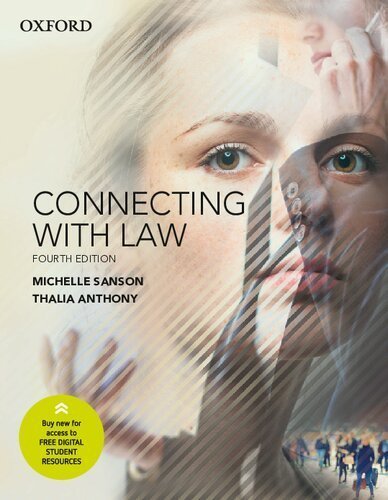
Connecting with Law 4th Edition by Michelle Sanson, ISBN-13: 978-0190310844
Original price was: $50.00.$14.99Current price is: $14.99.
Safe & secure checkout
Description
Description
Connecting with Law 4th Edition by Michelle Sanson, ISBN-13: 978-0190310844
[PDF eBook eTextbook] – Available Instantly
- Publisher: Oxford University Press; 4th edition (February 21, 2019)
- Language: English
- 724 pages
- ISBN-10: 0190310847
- ISBN-13: 978-0190310844
Think like a lawyer; unlock your future.
Connecting With Law, fourth edition, will challenge students’ assumptions and develop their critical thinking skills while teaching them the practical knowledge they need to succeed in law. Fully revised to incorporate the latest legal developments in Australia, this text introduces students to the foundations of law and the Australian legal system, engaging them with contemporary examples and case studies and helping them to connect with the law.
NEW TO THIS EDITION:
– Updated to incorporate the latest legislation, cases and developments, including:
– the recent Australian Marriage Postal Survey
– the First Nations Constitutional Convention and the Uluru Statement from the Heart
– the Adani coal mine proposal
– Equality, Capacity and Disability in Commonwealth Laws (ALRC Report 124)
– New and updated examples and exercises throughout the text to develop practical skills and develop critical thinking and reflective skills
– Significantly revised throughout, with new discussion on:
– Alternative Dispute Resolution (ADR)
– Indigenous Jurisprudence
– Ecological Jurisprudence
– Sovereignty and imposition of English law
– Technocratic justice
– Freedom of speech
– Marginalised communities and access to justice
– New practitioner profiles showcasing a diverse array of careers in the legal profession and beyond.
Table of Contents:
List of Figures xii
Table of Cases xiv
Table of Statutes xxi
Preface xxx
Guided Tour xxxi
Acknowledgments xxxiii
About the Book xxxiv
1 Learning Law: How Can I Develop a Legal Mind? 1
1 Law as a discipline 2
Re ection exercise 3
2 Legal reasoning 4
Exercise: Inductive and deductive reasoning 7
Exercise: What’s your reasoning? 8
3 Outcomes of your legal education 10
Exercise: Priestley 11 requirements 13
Exercise: Critical thinking 26
Exercise: Assessing sources 29
4 Success in law school 42
Exercise: Basic IRAC application 47
2 Sources: What Is the Law Itself? 57
1 Primary and secondary sources of law 58
Exercise: Sources practice 59
2 Legislation 59
Exercise: Anatomy of an Act 69
3 Cases 76
Exercise: Reading a citation 81
Exercise: Case summary 1 92
Exercise: Case summary 2 93
4 Secondary sources 97
3 Legal Institutions: How Is Law Made? 111
1 Government in Australia 113
Re ection exercise: Rule of law perspectives 117
2 Constitutions of the Commonwealth and the states and territories 117
3 Parliament’s role in creating law 125
4 The executive’s role in administering law 128
5 The judicature’s role in interpreting law 132
Problem exercise: Intra or ultra vires 143
6 Alternatives to courts 145
4 Classifying and Practising Law: How Are Cases Resolved? 157
1 Major legal classifications 159
2 Branches of substantive law 163
3 Aspects of procedural law 178
5 Research: How Do I Find the Law? 187
1 The importance of legal research 189
2 Legal research methodology 189
Exercise: Research types 190
Exercise: Research strategy scenario 192
Exercise: Ranking sources 199
3 Using a library catalogue or search engine 200
Exercise: Boolean searching 202
4 Finding legislation 203
Exercise: Finding a bill 209
5 Finding cases 212
Exercise: Using FirstPoint and CaseBase 220
Exercise: Searching phrases in CaseBase 222
6 Finding and using secondary sources 223
7 Legal referencing 234
6 Communication: How Do I Engage with Others
about the Law? 241
1 The importance of communication 242
2 Formulation: Preparing to communicate 245
Exercise: Reading a case for a particular purpose 248
Exercise: Preparing to be excused from jury duty 250
3 Engagement: In- person communications 255
4 Engagement: Written communications 265
Problem exercise: Drone on, party people 273
Exercise: Drafting a submission 278
Exercise: Advising Alan 282
Exercise: Hitting the right tone 282
Exercise: Keeping it clear 283
5 Collaboration 284
Re ection exercise: Good team, bad team 287
Exercise: Group work scenario 292
6 Review: Continual improvement 296
7 Jurisprudence: What Is Law? 301
1 Introduction 303
2 Early and continuing jurisprudence: Indigenous jurisprudence 306
3 The birth of modern jurisprudence 307
4 Modernism, Marxism and socio- legal theory 324
5 Legal realism 329
6 Critical legal theories 331
7 Dominant jurisprudence today 342
Exercise: Applying jurisprudence 349
8 History: How Did Australian Law Develop? 353
1 Legal systems of Indigenous societies and their early exclusion
from the common law 356
2 Displacement of Indigenous laws 358
3 Reception of English law 363
4 Military origins of the Australian legal system 363
5 Key concepts from English legal and constitutional history 364
6 How English legal and constitutional history apply to Australia 369
7 Adoption of English common law— from the frontier to the
Australia Acts 371
8 Federation and British remnants today 376
9 Australia: Where Do Indigenous Laws Fit In? 379
1 Historical developments in official policies relating to Indigenous
people: Exclusion and inclusion 381
Exercise: e intervention 386
2 Recognition of Indigenous rights to land 389
3 Developments since Mabo 395
4 Other forms of recognition of Indigenous rights to land 399
5 Persistent non- recognition of Indigenous laws 405
6 Alternative paths for incorporating customary law into the
common law 407
7 Filling the legal gap— treaty and sovereignty rights 414
10 Precedent: How Do Judicial Decisions Become Law? 417
1 Introduction to precedent 418
2 Key concepts in the law of precedent 420
Exercise: Low blow for a high roller 422
Exercise: Finding more than one ratio 426
Exercise: e ratio of disturbance 431
3 Applying precedent 435
Exercise: Which judgment is which? 439
4 Judicial approaches to precedent 442
Exercise: Judging Sophie 442
5 Problem solving using precedent 449
Exercise: Which precedent takes precedence? 449
Exercise: Application of precedents 450
Exercise: Distinguish the precedent 455
Exercise: Jurisprudence in precedent 457
11 Statutory Interpretation: How Do Courts
Interpret Legislation? 465
1 Introduction to statutory interpretation 466
2 Modern statutory approach 470
Exercise: ‘Make poverty history’ 476
Exercise: ‘Penalty for possession’ 478
3 Traditional common law approaches 480
4 Other tools of statutory interpretation 485
Exercise: Applying ejusdem generis 491
Exercise: Latin maxims 492
Exercise: Getting out of military service 495
Exercise: Betel nut therapy 496
5 Applying the rules of statutory interpretation 498
Exercise: Jimbo and Baba visit Parliament House 499
Exercise: No standing 500
Exercise: Double jeopardy 501
Exercise: Danny and his motorbike 503
Exercise: Supergrass 509
Exercise: Olympic ring accessorising 510
12 The Profession: What Do Lawyers Do? 517
1 Overview of Australian legal practice 518
2 Solicitors 527
Exercise: Con dentiality and disclosure 539
3 Barristers 542
4 Judicial officers 554
5 Some other roles in the legal profession 556
6 Ethics 558
Exercise: Ethical decision making 560
13 Law in Society: What Are the Problems and Remedies for
Accessing Justice? 564
1 Access to justice— key issues 565
2 Access to justice for specific groups 570
Exercise 574
3 The role of legal aid 581
4 Other initiatives to promote access to justice 588
14 My Law Career: How Can I Best Prepare for It? 595
1 What is a law career ‘for’? 596
2 Is law really for me? How do I know? 599
Exercise: Am I suited to becoming a lawyer? 606
3 What kind of career can I expect as a lawyer? 608
4 Important choices of subjects and course structures 621
5 What can I do as a student to become the lawyer I want to be? 624
6 Maintaining wellbeing 628
Glossary 635
Index 645
What makes us different?
• Instant Download
• Always Competitive Pricing
• 100% Privacy
• FREE Sample Available
• 24-7 LIVE Customer Support




Reviews
There are no reviews yet.