

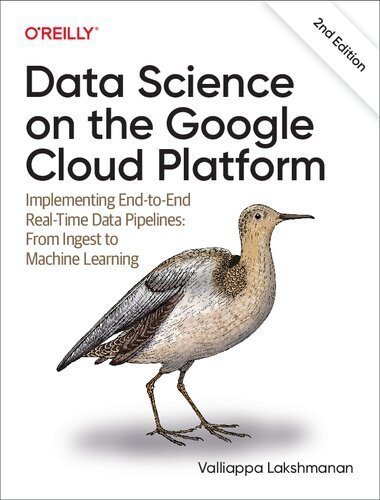
Data Science on the Google Cloud Platform 2nd Edition by Valliappa Lakshmanan, ISBN-13: 978-1098118952
Original price was: $50.00.$19.99Current price is: $19.99.
Safe & secure checkout
Description
Description
Data Science on the Google Cloud Platform: Implementing End-to-End Real-Time Data Pipelines: From Ingest to Machine Learning 2nd Edition by Valliappa Lakshmanan, ISBN-13: 978-1098118952
[PDF eBook eTextbook]
- Publisher: O’Reilly Media; 2nd edition (May 3, 2022)
- Language: English
- 459 pages
- ISBN-10: 1098118952
- ISBN-13: 978-1098118952
Learn how easy it is to apply sophisticated statistical and machine learning methods to real-world problems when you build using Google Cloud Platform (GCP). This hands-on guide shows data engineers and data scientists how to implement an end-to-end data pipeline with cloud native tools on GCP.
Throughout this updated second edition, you’ll work through a sample business decision by employing a variety of data science approaches. Follow along by building a data pipeline in your own project on GCP, and discover how to solve data science problems in a transformative and more collaborative way.
You’ll learn how to:
- Employ best practices in building highly scalable data and ML pipelines on Google Cloud
- Automate and schedule data ingest using Cloud Run
- Create and populate a dashboard in Data Studio
- Build a real-time analytics pipeline using Pub/Sub, Dataflow, and BigQuery
- Conduct interactive data exploration with BigQuery
- Create a Bayesian model with Spark on Cloud Dataproc
- Forecast time series and do anomaly detection with BigQuery ML
- Aggregate within time windows with Dataflow
- Train explainable machine learning models with Vertex AI
- Operationalize ML with Vertex AI Pipelines
Table of Contents:
Preface
Who This Book Is For
Conventions Used in This Book
Using Code Examples
O’Reilly Online Learning
How to Contact Us
Acknowledgments
1. Making Better Decisions Based on Data
Many Similar Decisions
The Role of Data Scientists
Scrappy Environment
Full Stack Cloud Data Scientists
Collaboration
Best Practices
Simple to Complex Solutions
Cloud Computing
Serverless
A Probabilistic Decision
Probabilistic Approach
Probability Density Function
Cumulative Distribution Function
Choices Made
Choosing Cloud
Not a Reference Book
Getting Started with the Code
Agile Architecture for Data Science on Google Cloud
What Is Agile Architecture?
No-Code, Low-Code
Use Managed Services
Summary
Suggested Resources
2. Ingesting Data into the Cloud
Airline On-Time Performance Data
Knowability
Causality
Training–Serving Skew
Downloading Data
Hub-and-Spoke Architecture
Dataset Fields
Separation of Compute and Storage
Scaling Up
Scaling Out with Sharded Data
Scaling Out with Data-in-Place
Ingesting Data
Reverse Engineering a Web Form
Dataset Download
Exploration and Cleanup
Uploading Data to Google Cloud Storage
Loading Data into Google BigQuery
Advantages of a Serverless Columnar Database
Staging on Cloud Storage
Access Control
Ingesting CSV Files
Partitioning
Scheduling Monthly Downloads
Ingesting in Python
Cloud Run
Securing Cloud Run
Deploying and Invoking Cloud Run
Scheduling Cloud Run
Summary
Code Break
Suggested Resources
3. Creating Compelling Dashboards
Explain Your Model with Dashboards
Why Build a Dashboard First?
Accuracy, Honesty, and Good Design
Loading Data into Cloud SQL
Create a Google Cloud SQL Instance
Create Table of Data
Interacting with the Database
Querying Using BigQuery
Schema Exploration
Using Preview
Using Table Explorer
Creating BigQuery View
Building Our First Model
Contingency Table
Threshold Optimization
Building a Dashboard
Getting Started with Data Studio
Creating Charts
Adding End-User Controls
Showing Proportions with a Pie Chart
Explaining a Contingency Table
Modern Business Intelligence
Digitization
Natural Language Queries
Connected Sheets
Summary
Suggested Resources
4. Streaming Data: Publication and Ingest with Pub/Sub and Dataflow
Designing the Event Feed
Transformations Needed
Architecture
Getting Airport Information
Sharing Data
Time Correction
Apache Beam/Cloud Dataflow
Parsing Airports Data
Adding Time Zone Information
Converting Times to UTC
Correcting Dates
Creating Events
Reading and Writing to the Cloud
Running the Pipeline in the Cloud
Publishing an Event Stream to Cloud Pub/Sub
Speed-Up Factor
Get Records to Publish
How Many Topics?
Iterating Through Records
Building a Batch of Events
Publishing a Batch of Events
Real-Time Stream Processing
Streaming in Dataflow
Windowing a Pipeline
Streaming Aggregation
Using Event Timestamps
Executing the Stream Processing
Analyzing Streaming Data in BigQuery
Real-Time Dashboard
Summary
Suggested Resources
5. Interactive Data Exploration with Vertex AI Workbench
Exploratory Data Analysis
Exploration with SQL
Reading a Query Explanation
Exploratory Data Analysis in Vertex AI Workbench
Jupyter Notebooks
Creating a Notebook
Jupyter Commands
Installing Packages
Jupyter Magic for Google Cloud
Exploring Arrival Delays
Basic Statistics
Plotting Distributions
Quality Control
Arrival Delay Conditioned on Departure Delay
Evaluating the Model
Random Shuffling
Splitting by Date
Training and Testing
Summary
Suggested Resources
6. Bayesian Classifier with Apache Spark on Cloud Dataproc
MapReduce and the Hadoop Ecosystem
How MapReduce Works
Apache Hadoop
Google Cloud Dataproc
Need for Higher-Level Tools
Jobs, Not Clusters
Preinstalling Software
Quantization Using Spark SQL
JupyterLab on Cloud Dataproc
Independence Check Using BigQuery
Spark SQL in JupyterLab
Histogram Equalization
Bayesian Classification
Bayes in Each Bin
Evaluating the Model
Dynamically Resizing Clusters
Comparing to Single Threshold Model
Orchestration
Submitting a Spark Job
Workflow Template
Cloud Composer
Autoscaling
Serverless Spark
Summary
Suggested Resources
7. Logistic Regression Using Spark ML
Logistic Regression
How Logistic Regression Works
Spark ML Library
Getting Started with Spark Machine Learning
Spark Logistic Regression
Creating a Training Dataset
Training the Model
Predicting Using the Model
Evaluating a Model
Feature Engineering
Experimental Framework
Feature Selection
Feature Transformations
Feature Creation
Categorical Variables
Repeatable, Real Time
Summary
Suggested Resources
8. Machine Learning with BigQuery ML
Logistic Regression
Presplit Data
Interrogating the Model
Evaluating the Model
Scale and Simplicity
Nonlinear Machine Learning
XGBoost
Hyperparameter Tuning
Vertex AI AutoML Tables
Time Window Features
Taxi-Out Time
Compounding Delays
Causality
Time Features
Departure Hour
Transform Clause
Categorical Variable
Feature Cross
Summary
Suggested Resources
9. Machine Learning with TensorFlow in Vertex AI
Toward More Complex Models
Preparing BigQuery Data for TensorFlow
Reading Data into TensorFlow
Training and Evaluation in Keras
Model Function
Features
Inputs
Training the Keras Model
Saving and Exporting
Deep Neural Network
Wide-and-Deep Model in Keras
Representing Air Traffic Corridors
Bucketing
Feature Crossing
Wide-and-Deep Classifier
Deploying a Trained TensorFlow Model to Vertex AI
Concepts
Uploading Model
Creating Endpoint
Deploying Model to Endpoint
Invoking the Deployed Model
Summary
Suggested Resources
10. Getting Ready for MLOps with Vertex AI
Developing and Deploying Using Python
Writing model.py
Writing the Training Pipeline
Predefined Split
AutoML
Hyperparameter Tuning
Parameterize Model
Shorten Training Run
Metrics During Training
Hyperparameter Tuning Pipeline
Best Trial to Completion
Explaining the Model
Configuring Explanations Metadata
Creating and Deploying Model
Obtaining Explanations
Summary
Suggested Resources
11. Time-Windowed Features for Real-Time Machine Learning
Time Averages
Apache Beam and Cloud Dataflow
Reading and Writing
Time Windowing
Machine Learning Training
Machine Learning Dataset
Training the Model
Streaming Predictions
Reuse Transforms
Input and Output
Invoking Model
Reusing Endpoint
Batching Predictions
Streaming Pipeline
Writing to BigQuery
Executing Streaming Pipeline
Late and Out-of-Order Records
Possible Streaming Sinks
Summary
Suggested Resources
12. The Full Dataset
Four Years of Data
Creating Dataset
Training Model
Evaluation
Summary
Suggested Resources
Conclusion
A. Considerations for Sensitive Data Within Machine Learning Datasets
Handling Sensitive Information
Sensitive Data in Columns
Sensitive Data in Natural Language Datasets
Sensitive Data in Free-Form Unstructured Data
Sensitive Data in a Combination of Fields
Sensitive Data in Unstructured Content
Protecting Sensitive Data
Removing Sensitive Data
Masking Sensitive Data
Coarsening Sensitive Data
Establishing a Governance Policy
Index
About the Author
Valliappa (Lak) Lakshmanan is the director of analytics and AI solutions at Google Cloud, where he leads a team building cross-industry solutions to business problems. His mission is to democratize machine learning so that it can be done by anyone anywhere. Lak is the author or coauthor of Practical Machine Learning for Computer Vision, Machine Learning Design Patterns, Data Governance The Definitive Guide, Google BigQuery The Definitive Guide, and Data Science on the Google Cloud Platform.
What makes us different?
• Instant Download
• Always Competitive Pricing
• 100% Privacy
• FREE Sample Available
• 24-7 LIVE Customer Support


Reviews
There are no reviews yet.