

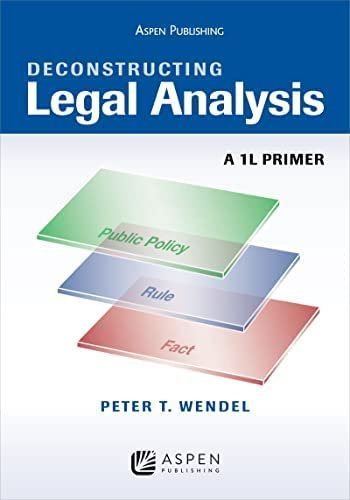
Deconstructing Legal Analysis: A 1L Primer by Peter T. Wendel, ISBN-13: 978-0735584754
Original price was: $50.00.$14.99Current price is: $14.99.
Safe & secure checkout
Description
Description
Deconstructing Legal Analysis: A 1L Primer by Peter T. Wendel, ISBN-13: 978-0735584754
[PDF eBook eTextbook]
- Publisher: Aspen Publishers (September 30, 2009)
- Language: English
- 224 pages
- ISBN-10: 0735584753
- ISBN-13: 978-0735584754
Peter T. Wendel has taught academic success workshops at over thirty-five law schools throughout the country. In Deconstructing Legal Analysis: A 1L Primer, he provides a variety of time-tested techniques including a unique model for visualizing legal analysis to teach students how to think like lawyers and take law school exams.
Deconstructing Legal Analysis: A 1L Primer features: a unique, visual pedagogical method that illustrates a relational analysis of facts, rules, and public policy an interactive approach that consistently encourages students to write down their answers to carefully guided questions a great teaching case, Pierson v. Post, showing how a layperson reads a case as compared to how a lawyer would read the same case useful templates and methods for legal analysis and essay-exam writing, such as IRAC and IRRAC exam-taking tips and guidance that emphasize flexibility, rather than a formulaic approach If experience is the best teacher, then Deconstructing Legal Analysis is an essential for academic success in law school.
Table of Contents:
Title Page
Copyright
About Wolters Kluwer Law & Business
Dedication
Summary of Contents
Contents
Preface
PART I DECONSTRUCTING LEGAL ANALYSIS: LEARNING HOW TO
THINK LIKE A LAWYER
Chapter 1 Introduction
Chapter 2 The Traditional “Darwinian” Approach
A. Introduction
B. “Swim”
C. Pierson v. Post
D. Read, Analyze, and Be Prepared to Discuss
1. Read
2. Analyze
3. Be Prepared to Discuss
E. Case Briefing
F. Conclusion
Chapter 3 The Evolution of a Case from an Analytical Perspective
A. The Genesis of a Case
B. The Role of the Lawyer
C. The “Vertical” Analytical Evolution of a Case
1. The Factual Plane
2. The Rule Plane
D. Pre-Trial
E. The Trial
F. The Appeal
Chapter 4 “Thinking Like a Lawyer”
A. A Conceptual Understanding
B. Ranking the Planes
1. Which Plane Is the
Most Important?
2. Which Plane Is the
Second Most Important?
3. Which Plane Is the
Least Important?
Chapter 5 Re-analyzing Pierson v. Post
A. Appellate Opinion = Question of Law
B. Find the Answer—the Rule of Law
C. Find the Rationale for the Rule: The Public
Policy
1. Did the Court Get It
Right?
2. Justice and Fairness
D. The Holding
E. The Rationale for the Holding
1. Analyze Each Element
2. See Both Sides
F. Recap
G. Get Comfortable with the Rule
1. The Scope of the Rule
2. The Sharpness of the
Rule
H. Conclusion
Chapter 6 Briefing a Case from an Analytical Perspective
A. Introduction
B. Typical Brief
C. Why You should Brief Your Cases
D. How to Brief
1. Identify the Case
2. The Facts
3. Procedural Posture of
the Case
4. Issue
5. Rule Statement
6. Public Policy
Considerations
7. Holding
8. Rationale
9. Critique/Analysis
10. Dissenting Opinion
E. Conclusion
Chapter 7 The “What if …” Game
A. The Socratic Approach
B. The “What If …” Game
1. “What if …”—First
Hypothetical
2. “What if …”—Second
Hypothetical
3. “What if …”—Third
Hypothetical
4. “What if …”—Fourth
Hypothetical
C. Conclusion
Chapter 8 Introspective Legal Analysis: Russian Dolls
A. Introduction
B. Adverse Possession—Background
C. Howard v. Kunto
D. Analyzing Howard v. Kunto
1. The Evolution of the
Case
2. The Question of Law on
Appeal
3. The Larger Analytical
Process
4. Issues Within the Issue
5. Visualizing the
Application Process
6. The Spectrum: Bright
Line Rules vs. Soft, Fact-
Sensitive Rules
7. Howard v. Kunto—
Application of Adverse
Possession
8. Analysis of Typical
Student Analysis
E. Legal Analysis—It Depends
F. Conclusion
PART II THE EXAM TAKING PROCESS
Chapter 9 Complete the Circle: See the Big Picture
Chapter 10 Writing Style: Write Like a Judge
Chapter 11 How to “Analyze” an Issue: IRAC vs. IRRAC
A. Introduction
B. See the Relationship between Your Outline
and the Exam
C. IRAC vs. IRRAC
D. Writing Your Analysis
E. Different Types of IRRACs: Variations on a
Theme
1. Split in the Jurisdictions
as to the Rule
2. Split in the Jurisdictions
as to the Element
F. Competing Rules
1. Affirmative Defenses
G. Writing Your Outline
H. The Quality of Your Analysis vs. The
Quality of Your Writing
Chapter 12 The Circuitry Behind Issue Spotting
A. Issue Spotting—Why?
B. Issue Spotting—How?
C. The Triggering Fact
D. Triggering Facts vs. Set-Up Facts
Chapter 13 The Macro Organization of Your Exam Essay
A. Introduction
B. “Sliders”—The Parallel “Legal” World
C. General Rule—Take the Issues in
Chronological Order
D. Call of the Question: “Would” vs. “Should”
vs. “State of Nirvana”
Chapter 14 Multiple Choice Questions: Mini-Essays
A. The Analytical Options
B. Analyze as If It Were an Essay
C. Use the “Other” Answers to Check Your
Analysis
D. Watch Your Time
Chapter 15 Post-Exam Blues: How to Self-Diagnose Your Exam
Performance
A. Introduction
B. Typical Professorial Feedback
C. There Are Only Two Ways You Can Lose
Points on an Exam
D. Diagnosing Your Exam Writing Style
E. Issue Spotting Exercises—Triggering Facts
F. Compare Your Multiple Choice vs. Essay
Grades
G. Don’t Kill the Messenger, Instead Spend
Some Time with Him or Her
PART III TIME TO TAKE OFF THE TRAINING WHEELS: VARIATIONS
ON THE LEGAL ANALYSIS THEME
Chapter 16 Extrospective Legal Analysis: Case Synthesis
A. Conceptual Overview
B. Referencing a Prior Case
1. Citing to a Case
2. Discussing a Case:
Binding vs. Persuasive
Authority
3. Same Case vs. Different
Case
C. Case Synthesis
D. Example of Case Synthesis: Kelly v.
Gwinnell
E. Analyzing the Court’s Opinion
1. How It Is Written
a. Issue Statement
b. “Question of First
Impression”
2. How the Court
Analyzed the Issue—Case
Synthesis
a. Overview
b. The Backdrop
c. Articulating the
Public Policy
Consideration
d. Transitioning Back
to the Legal Plane
e. The Analytical
Steps Inherent in
Case Synthesis
3. Recap of Case Synthesis
in the context of Kelly v.
Gwinnell
4. Case Synthesis: Skill or
Art?
F. What If …
1. First Hypothetical
2. Analysis of First
Hypothetical
3. Second Hypothetical
4. Analysis of Second
Hypothetical
Chapter 17 Legal Analysis and Statutory Construction
A. Introduction
B. Theoretical Perspective
C. More Practical Perspective
D. The Legislative Intent Approach
E. The Textualist Approach
F. The Realist/Pragmatic Approach
G. The Three Planes
PART IV CONCLUSION
Chapter 18 Miscellaneous Law School and Exam Taking Tips
What makes us different?
• Instant Download
• Always Competitive Pricing
• 100% Privacy
• FREE Sample Available
• 24-7 LIVE Customer Support




Reviews
There are no reviews yet.