

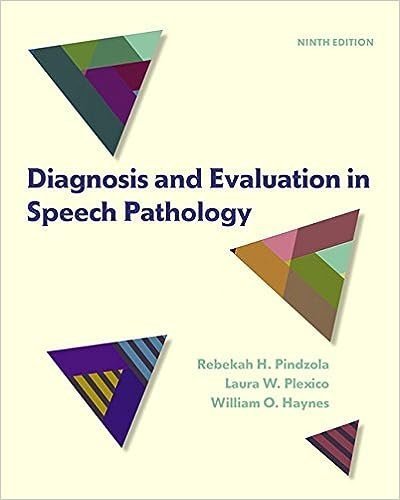
Diagnosis and Evaluation in Speech Pathology 9th Edition by Rebekah Pindzola, ISBN-13: 978-0133823905
Original price was: $100.00.$19.99Current price is: $19.99.
Safe & secure checkout
Description
Description
Diagnosis and Evaluation in Speech Pathology 9th Edition by Rebekah Pindzola, ISBN-13: 978-0133823905
[PDF eBook eTextbook]
- Publisher: Pearson; 9th edition (February 20, 2015)
- Language: English
- 504 pages
- ISBN-10: 0133823903
- ISBN-13: 978-0133823905
Diagnosis and Evaluation in Speech Pathology presents practical, useful assessment issues and tips on specific speech-language-swallowing disorders; provides flexible ways to assess the disorders through both standardized and non-standardized appraisal; and guides readers’ attention through a wide variety of learning tools, including new assessment materials available commercially through research publications and via social media, learning objectives and self-assessment questions for each chapter, and concluding remarks that wrap up the information covered. The material also aids the clinician with accountability to third party payors.
The new Ninth Edition of Diagnosis and Evaluation in Speech Pathology features:
- Updating throughout.
- A new chapter on adult dysphagia and pediatric feeding and swallowing disorders.
- A new chapter on issues of head and neck cancer and alaryngeal speech rehabilitation.
- A revised chapter on report writing.
- Current clinical insights into diagnosing and evaluating communications disorders,
- Two new Appendices, one showing how to conduct oral peripheral examinations and the other presenting standard reading passages, which can be used in various types of assessment.
Table of Contents:
Diagnosis and Evaluation in Speech Pathology
Preface
New to this Edition
Contents
CHAPTER 1Introduction to Diagnosis and Evaluation Philosophical Issues and General Guidelines
Diagnosis and Evaluation Defined
Broadening the Notion of Assessment
Illustrating the Importance of Measurement in Current Trends
Evidence-Based Practice in Speech-Language Pathology
The Response to Intervention (RTI) Model
Dynamic Assessment
The Importance of Functional Measurements: The World Health Organization, U.S. Department of Education, and American Speech-Language-Hearing Association
Diagnosis to Determine the Reality of the Problem
Diagnosis to Determine the Etiology of the Problem
Diagnosis to Provide Clinical Focus
Diagnosis: Science and Art
Diagnosis Versus Eligibility
The Diagnostician as a Factor
The Client–Clinician Relationship
The Client as a Factor: Children, Adolescents, and Older Adults
Young Children
Adolescents
Older Adults
Putting the Diagnosis to Work
Conclusion and Self-Assessment
CHAPTER 2Interviewing
The Importance of Interviewing
The Nature of Interviewing
Common Interviewing Considerations
The Clinician’s Fears
Lack of Specific Purpose
Failure to Consider the Client’s Clutural Background
An Approach to Interviewing
Goal One: Obtain Information
Setting the Tone
Asking the Questions
The Presenting Story
Nonverbal Messages
Things to Avoid in the Interview
Goal Two: Give Information
The Questions Clients Ask
Goal Three: Provide Counseling
Using Interviewing Skills Beyond the Diagnostic Evaluation
Improving your Interview Skills
Conclusion and Self-Assessment
CHAPTER 3Psychometric Considerations in Diagnosis and Evaluation
Common Types of Tests
The Foundation of the Test or Measure
Validity
Reliability
Some Quantitative Background for Test Interpretation
Central Tendency, Variation, and the Normal Curve
Types of Scores Found on Formal Tests
The Age and Grade Score Trap
Standard Error of Measurement and Confidence Intervals
Sensitivity and Specificity: Key Concepts in Evidence-Based Practice
Criteria for Evaluating Standardized Tests
Test Administration and Scoring
Reliability
The Standardization Sample
Validity
Common Errors in the Use of Norm-Referenced Tests
Multicultural Considerations
Conclusion and Self-Assessment
CHAPTER 4Assessment of Children with Limited Language
LEARNING OUTCOMES
The Process of Becoming a Communicator: Getting the Big Picture
Focusing on the Child’s Language Level: Nonverbal, Single-Word, and Early Multiword Communicators
Considering Etiology
Why is Early Language Assessment So Difficult?
Models to Consider in Language Assessment
Theoretical Considerations in Language Assessment
Language Screening
Assessment that Focuses on Early Communication and Variables that Predict Language Growth
Specific Assessment Areas: Procedures, Considerations, and Directions for Further Study
Preassessment and Pertinent Historical Information
Preassessment
The Parent Interview
Assessment of Social Prerequisites and Caretaker–Child Interaction
Adaptive Behavior Scales
Assessment of Play to Gain Insight into Cognitive Attainments Associated with Communication
Assessment of Communicative Intent and Function
Use of Tests and Formal Procedures with Limited-Language Children
Assessment of Structure and Function in Early Utterances
Single-Word Utterances
The Case of Late Talkers
Early Multiword Utterances
Assessment of Children’s Early Language Comprehension
Confounding Factors: Nonlinguistic Context
Confounding Factors: Comprehension Strategies
Assessment of Utterances Using Length Measures
Infant, Toddler, and Family Assessment
Assessment of Special Populations
Communication Is the Major Focus
Increased Probability of Focusing Assessment on Precommunicative Areas
Increased Possibility of Recommending Augmentative/Alternative Communication Modes
Prognostic Implications
Noting Specific Characteristics
Assessing Children from Culturally and Linguistically Different Backgrounds
Consolidating Data and Arriving at Treatment Recommendations
Data Obtained in the Evaluation
Analyses Performed on the Data
Areas of Concern and Strength
Recommendations
Conclusion and Self-Assessment
CHAPTER 5Assessment of School-Age and Adolescent Language Disorders
LEARNING OUTCOMES
Students with Language Problems: The High-Risk Groups
Screening School-Age and Adolescent Language Disorders
Understanding Common Core State Standards
Use of Standardized Tests with Syntax-Level Children
Nonstandardized Testing
Language Sampling: A General Look at the Process
Later Language Development: Emerging Data
Testing Language Comprehension
Assessment of Syntax Using Analysis Packages
Assessment of Conversational Pragmatics
Evaluation of General Pragmatic Parameters: Identification of a Potential Problem
Narrowing the Focus: Assessment of Narrative Production
Assessment of Topic Manipulation in Clinical Discourse
Assessment of Repairs: The Contingent Query
Assessment of Cohesive Adequacy
Issues of Memory, Processing Load, and Executive Loading
Evaluating Literacy and School Curriculum
Conclusion and Self-Assessment
CHAPTER 6Assessment of Speech-Sound Disorders
LEARNING OUTCOMES
Multiple Components Contributing to Sound Production
Seven Important Knowledge Areas for Evaluation of Articulation and Phonological Disorders
Overview of the Articulation/Phonology Assessment Process
Screening for Speech-Sound Disorders
Traditional Assessment Procedures
Test Procedures that Evaluate Phonetic Context Effects
Assessment of Speech Sounds in Early Intervention
The Phonetic and Phonemic Inventories
Distinctive Feature Analysis
Phonological Analysis
The Intersection between Phonology and the Lexicon
Computer-Assisted Analysis of Phonology
Assessment of Phonological Knowledge
Other Testing
Integrating Data from the Assessment
Severity and Intelligibility
Conclusion and Self-Assessment
Long-Term Impacts
CHAPTER 7 Disorders of Fluency
LEARNING OUTCOMES
Differential Diagnosis
Sorting out the Types of Fluency Disorders
Episodic Stress Reaction
Psychogenic Stuttering
Neurogenic Stuttering
Cluttering
Distinguishing among Subtypes of Stuttering
Differentiating Stuttering from Nonstuttering Disfluencies
The Appraisal of Stuttering
Case History Information and Parent Materials
Initial Interview with the Parents
Case History Interview with Older Clients
Differentiating and Predictive Scales
Severity Scales
The Assessment Process
An Overall Description
Core Behaviors
Struggle-Tension Features
Covert Measures
Evaluation at the Onset of Stuttering
Prognosis with Young Children
Evaluation of the School-Age Student
Elementary Students
Junior and Senior High School Students
Prognosis
Assessment of the Adult Who Stutters
Prognosis
Multicultural Considerations in Fluency Disorders
Conclusion and Self-Assessment
CHAPTER 8 Assessment of Aphasia and Adult Language Disorders
LEARNING OUTCOMES
The Nature of Aphasia
Case History
Diagnosis and Formal Testing
Screening for Aphasia
Standardized Testing
The Porch Index of Communicative Ability–Revised
The Boston Diagnostic Aphasia Examination
Western Aphasia Battery–Revised
Communicative Abilities in Daily Living, Second Edition
Differential Diagnosis and Other Language Disorders
Motor Speech Disorders
Right Hemisphere Damage
Psychosis
Language of Confusion
Sequela of Traumatic Brain Injury
Mild Cognitive Impairment
The Dementias and Cognitive Assessment
Cautionary Thoughts on Formal Diagnostic Testing
The Art of Informal Assessment
Summary Findings and Prognostic Indicators
Prognosis
Conclusion and Self-Assessment
CHAPTER 9 Motor Speech Disorders
LEARNING OUTCOMES
Apraxia of Speech in Adults
The Characteristics of Adult Apraxia of Speech
Case History Oral Exam and Prognostic Factors
The Evaluation of Apraxia
Differentiating Apraxia from Other Disorders
Childhood Apraxia of Speech
Differential Diagnosis
Case History Indicators
Assessing Childhood Apraxia
The Adult Dysarthrias
Differential Diagnosis
Flaccid Dysarthria
Spastic Dysarthria
Ataxic Dysarthria
Hypokinetic Dysarthria
Hyperkinetic Dysarthrias
Mixed Dysarthrias
The Appraisal of Dysarthria
Cerebral Palsies and Dysarthria in Children
The Assessment of a Child with Cerebral Palsy
Assessing Augmentative and Alternative Communication Needs
Conclusion and Self-Assessment
CHAPTER 10Adult Dysphagia and Pediatric Feeding and Swallowing Disorders
LEARNING OUTCOMES
Deglutition in Typical Adults
The Oral Phase, Including Preparation and Transit
The Pharyngeal Phase
Initiation of the Esophageal Phase
Adult Dysphagia: Causes and Assessment Goals
Bedside, General, and Noninstrumental Assessment of the Adult
Screening or Testing of Communicative Abilities
Oral Peripheral Testing
Case History and Sensory Symptom Information
Noninstrumental and Brief Bedside Swallow Assessments
Clinical and Instrumental Adult Assessments
Imaging Adults to Assess Swallowing
Videofluoroscopic Swallowing Study or Modified Barium Swallow
Fiberoptic Endoscopic Evaluation of Swallowing (FEES)
Imaging Probes and Trial Swallowing Strategies
Bolus Flow and Aspiration
Functional Outycomes and Quality of Life in Adult Patients
Pediatric Feeding and Swallowing Disorders
Pediatric Assessment Goals
Pediatric Dysphagia Case History
Oral Motor Examination
Developmental Age Aspects of Assessment
Infant Assessment Considerations
Toddler Assessment Considerations
Preschool and School-Age Assessment Considerations
Assessment Scales, Observation of a Trial Feeding, and Instrumental Analysis
Observation of a Trial Feeding
Indications for Specialized Studies
Conclusion and Self-Assessment
CHAPTER 11 Laryngeal Voice Disorders
LEARNING OUTCOMES
The Nature of Vocal Disturbances
The Diagnostic Process
The Total Case History
Sizing up Referral Information
Case History Questionnaire and Interview
Family Data
Onset of the Problem
Course of Development
Description of Daily Vocal Performance and Problem Variability
Social Adjustment
Vocation
Health
Patient Impact Ratings
Preliminary Screenings
Perceptual, Acoustic, and Aerodynamic Assessment
Feature Assessment
Pitch
Loudness
Quality
Breath
Rate and Rhythm
Visual Assessment
Informal Assessment Probes
Prognosis
Conclusion and Self-Assessment
CHAPTER 12 Assessment of Resonance Imbalance
LEARNING OUTCOMES
Types of Abnormal Resonance
Hyponasality
Hypernasality
Nasal Emission
Nasal Rustle
Cul-de-Sac Resonance
Mixed Resonance
Thin Vocal Resonance
Case History and General Voice Assessment
Assessment Techniques and Probes for Resonance Imbalance
Hyponasality
Hypernasality
Nasal Emission
Cul-de-Sac Resonance
Thin Vocal Resonance
Assessment Associated with Cleft Palate and VPI
Case History
Oral Peripheral Examination
Perceptual Assessment of Nasal Resonance and Voice
Articulation/Phonology and Intelligibility Testing
Instrumental VP Assessment: Low-Tech
Instrumental VP Assessments: Acoustic
Spectrography
Nasometry
Instrumental VP Assessments: Aerodynamic
Manometry
Nasality Severity Index
Instrumental VP Assessments: Imaging
Lateral Cephalometry
Nasopharyngoscopy
Magnetic Resonance Imaging
Other Assessments Important with Cleft Palate and VPI Cases
Feeding Issues
Auditory Issues
Language Assessment
Self-Esteem and Daily Impact
Prognosis Associated with Resonance Imbalance
Conclusion and Self-Assessment
CHAPTER 13 Cancer and Alaryngeal Voice Disorders
LEARNING OUTCOMES
Laryngeal Cancer Primer
Physician Assessment of Cancer and Prognosis
Prevalence of Laryngeal Cancer and Multicultural Issues
The Total Laryngectomy and the Laryngectomee
The Counseling Process
The Preoperative Visit
Family and Spouse Counseling
Laryngectomee Visitation
Postoperative Counseling
Initial Assessment Themes
Background and Current Status Information
Determining the Direction for Speech
Assessing Artificial Larynx Speech
Early Artificial Larynx Attempts
Further Assessing Artificial Larynx Speech
Frequency Range
Speech Rate
Intensity Variations
Extraneous Noise
Inappropriate Pauses
Consonantal Differentiation
Assessing Esophageal Speech
Early Esophageal Speech Attempts
Further Assessing Esophageal Speech
Pitch Level
Inflection
Quality
Excess Noise
Visual Mannerisms
Rate of Speech
Words per Charge
Latency of Air Charge
Latency of Phrasal Pauses
Articulatory Intelligibility
Early Speech Attempts with a Tracheoesophageal Prosthesis
Prosthesis Fitting
Voice Failure Assessment
Tracheostoma Valve
Tracheostoma Valve Contraindications
Valve Fitting
Ongoing TEP Speech Assessments and Refinements
Prognostic Indicators for Success
Conclusion and Self-Assessment
CHAPTER 14 The Diagnostic Report and Financial Essentials
LEARNING OUTCOMES
The Report and Format Options
Routine Information
Statement of the Problem
Historical Information
Evaluation
Clinical Impressions
Summary
Recommendations
The Writing Process
Style
Supervisory Writing Feedback
The Writing Audit
Confidentiality
Additional Details for Writing in Medical Settings
Additional Details for Writing in School Settings
Follow-Up and Reassessment Reports
Reporting Financial Essentials
The ICD-10 System
Procedural Coding System
Clinical Modification
The Current Procedural Terminology System
Other Codes of Note
Conclusion and Self-Assessment
Appendix AThe Oral Peripheral Examination
Tools You Will Need
Areas to Be Assessed
Appendix B Assessment Resources
Developmental Milestones
Transcription Symbols Selected from the International Phonetic Alphabet
Screening the Client’s Hearing
When to Refer
Patient Performance
What to Test
What Constitutes Failure
Hearing-Related Questions to Ask the Parent of a Client
Auditory Processing Disorder Considerations
Reading Passages Useful in Assessing Speech and Language
Appendix C Early Child Language Assessment Interview Protocol
General Information
Pertinent History
Biological Prerequisites for Communication Development
Birth and General Health
Auditory Status
Neurological Status
General Development
Social Prerequisites for Communication Development
Cognitive Prerequisites to Communication Development
Communication Development
Appendix D Coding Sheet for Early Multiword Analysis
Appendix E Summary Sheet for Early Multiword Analysis
Appendix F Data Consolidation in Limited Language Evaluations
References
Index
Rebekah H. Pindzola, Professor Emeritus, has served the clinical and academic professions in numerous capacities. At Auburn University she rose through the ranks of assistant, associate, and full professor and provided administrative leadership as Chair of the Department of Communication Disorder, Director of the AU Speech and Hearing Clinic as well as to the College of Liberal Arts as Associate Dean and Interim Dean. She has coauthored popular clinical books and intervention materials.
Dr. Laura Plexico is an Associate Professor and certified Speech-Language Pathologist who specializes in the area of fluency disorders and speech acoustics. She currently lives in auburn Alabama and teaches undergraduate and graduate courses and provides clinical services in the Department of Communication Disorders at Auburn University. She teaches courses in fluency, speech science, counseling and clinical problem solving. Dr. Plexico’s research interests include understanding the cognitive and affective consequences of stuttering, factors that influence successful stuttering management, and factors that influence the acoustic assessment of the voice.
William O. Haynes, Ph.D., earned his Bachelor’s and Master’s degrees from Northern Michigan University in Speech-Language Pathology and completed his doctoral degree in communication disorders at Bowing Green State University. Dr. Haynes taught at Auburn University (AL) in the Department of Communication Disorders for 33 years serving two terms as department chairperson. His areas of expertise are child/adolescent language development and disorders, diagnosis of communication disorders and research methods.
What makes us different?
• Instant Download
• Always Competitive Pricing
• 100% Privacy
• FREE Sample Available
• 24-7 LIVE Customer Support


Reviews
There are no reviews yet.