

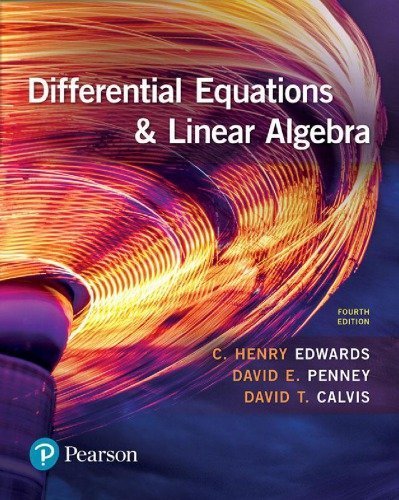
Differential Equations and Linear Algebra 4th Edition by C. Henry Edwards, ISBN-13: 978-0134497181
Original price was: $50.00.$14.99Current price is: $14.99.
Safe & secure checkout
Description
Description
Differential Equations and Linear Algebra 4th Edition by C. Henry Edwards, ISBN-13: 978-0134497181
[PDF eBook eTextbook]
- Publisher: Pearson; 4th edition (January 4, 2017)
- Language: English
- 768 pages
- ISBN-10: 013449718X
- ISBN-13: 978-0134497181
For courses in Differential Equations and Linear Algebra .
Table of Contents:
Differential Equations & Linear Algebra
Contents
Application Modules
Preface
Principal Features of This Revision
Features of This Text
Supplements
1 First-Order Differential Equations
1.1 Differential Equations and Mathematical Models
Differential Equations and Mathematical Models
Mathematical Models
Examples and Terminology
Solution
Solution
1.1 Problems
Differential Equations as Models
1.2 Integrals as General and Particular Solutions
Solution
Velocity and Acceleration
Solution
Physical Units
Vertical Motion with Gravitational Acceleration
A Swimmer’s Problem
1.2 Problems
Velocity Given Graphically
1.3 Slope Fields and Solution Curves
Slope Fields and Graphical Solutions
Solution
Applications of Slope Fields
Existence and Uniqueness of Solutions
1.3 Problems
1.3 Application Computer-Generated Slope Fields and Solution Curves
1.4 Separable Equations and Applications
Solution
Implicit, General, and Singular Solutions
Solution
Natural Growth and Decay
The Natural Growth Equation
Solution
Solution
Cooling and Heating
Solution
Torricelli’s Law
Solution
1.4 Problems
Torricelli’s Law
1.4 Application The Logistic Equation
1.5 Linear First-Order Equations
Solution
Solution
A Closer Look at the Method
Solution
Mixture Problems
Solution
Solution
1.5 Problems
Mixture Problems
Polluted Reservoir
1.5 Application Indoor Temperature Oscillations
1.6 Substitution Methods and Exact Equations
Solution
Homogeneous Equations
Solution
Solution
Bernoulli Equations
Flight Trajectories
Solution
Exact Differential Equations
Solution
Reducible Second-Order Equations
Solution
Solution
1.6 Problems
1.6 Application Computer Algebra Solutions
Chapter 1 Summary
Chapter 1 Review Problems
2 Mathematical Models and Numerical Methods
2.1 Population Models
Bounded Populations and the Logistic Equation
Limiting Populations and Carrying Capacity
Solution
Historical Note
More Applications of the Logistic Equation
Solution
Doomsday versus Extinction
Solution
2.1 Problems
2.1 Application Logistic Modeling of Population Data
2.2 Equilibrium Solutions and Stability
Stability of Critical Points
Harvesting a Logistic Population
Bifurcation and Dependence on Parameters
2.2 Problems
Constant-Rate Harvesting
2.3 Acceleration–Velocity Models
Resistance Proportional to Velocity
Solution
Resistance Proportional to Square of Velocity
Variable Gravitational Acceleration
Solution
Escape Velocity
2.3 Problems
2.3 Application Rocket Propulsion
Constant Thrust
No Resistance
Free Space
2.4 Numerical Approximation: Euler’s Method
Solution
Local and Cumulative Errors
A Word of Caution
Solution
2.4 Problems
2.4 Application Implementing Euler’s Method
Famous Numbers Investigation
2.5 A Closer Look at the Euler Method
Solution
An Improvement in Euler’s Method
Answer
2.5 Problems
Decreasing Step Size
2.5 Application Improved Euler Implementation
Famous Numbers Revisited
Logistic Population Investigation
Periodic Harvesting and Restocking
2.6 The Runge–Kutta Method
Solution
2.6 Problems
Velocity-Acceleration Problems
2.6 Application Runge–Kutta Implementation
Famous Numbers Revisited, One Last Time
The Skydiver’s Descent
3 Linear Systems and Matrices
3.1 Introduction to Linear Systems
Two Equations in Two Unknowns
Three Possibilities
The Method of Elimination
Three Equations in Three Unknowns
Solution
Solution
A Differential Equations Application
3.1 Problems
3.2 Matrices and Gaussian Elimination
Coefficient Matrices
Elementary Row Operations
Echelon Matrices
Gaussian Elimination
3.2 Problems
3.2 Application Automated Row Reduction
3.3 Reduced Row-Echelon Matrices
Solution
The Three Possibilities
Homogeneous Systems
Equal Numbers of Equations and Variables
3.3 Problems
3.3 Application Automated Row Reduction
3.4 Matrix Operations
Vectors
Matrix Multiplication
Matrix Equations
Matrix Algebra
3.4 Problems
3.5 Inverses of Matrices
The Inverse Matrix A-1
How to Find A-1
Solution
Matrix Equations
Solution
Nonsingular Matrices
3.5 Problems
3.5 Application Automated Solution of Linear Systems
3.6 Determinants
Higher-Order Determinants
Row and Column Properties
The Transpose of a Matrix
Determinants and Invertibility
Cramer’s Rule for n×n Systems
Solution
Inverses and the Adjoint Matrix
Solution
Computational Efficiency
3.6 Problems
3.7 Linear Equations and Curve Fitting
Solution
Modeling World Population Growth
Geometric Applications
Solution
Solution
3.7 Problems
Population Modeling
4 Vector Spaces
4.1 The Vector Space R3
The Vector Space R2
Solution
Linear Independence in R3
Basis Vectors in R3
Subspaces of R3
4.1 Problems
4.2 The Vector Space Rn and Subspaces
Definition of a Vector Space
Subspaces
4.2 Problems
4.3 Linear Combinations and Independence of Vectors
Linear Independence
4.3 Problems
4.4 Bases and Dimension for Vector Spaces
Bases for Solution Spaces
Solution
4.4 Problems
4.5 Row and Column Spaces
Row Space and Row Rank
Column Space and Column Rank
Solution
Rank and Dimension
Nonhomogeneous Linear Systems
4.5 Problems
4.6 Orthogonal Vectors in Rn
Solution
Orthogonal Complements
4.6 Problems
4.7 General Vector Spaces
Function Spaces
Solution
Solution
Solution Spaces of Differential Equations
4.7 Problems
5 Higher-Order Linear Differential Equations
5.1 Introduction: Second-Order Linear Equations
A Typical Application
Homogeneous Second-Order Linear Equations
Solution
Linearly Independent Solutions
General Solutions
Linear Second-Order Equations with Constant Coefficients
Solution
5.1 Problems
5.1 Application Plotting Second-Order Solution Families
5.2 General Solutions of Linear Equations
Existence and Uniqueness of Solutions
Linearly Independent Solutions
Solution
Solution
General Solutions
Nonhomogeneous Equations
Solution
5.2 Problems
5.2 Application Plotting Third-Order Solution Families
5.3 Homogeneous Equations with Constant Coefficients
The Characteristic Equation
Distinct Real Roots
Solution
Polynomial Differential Operators
Repeated Real Roots
Solution
Complex-Valued Functions and Euler’s Formula
Complex Roots
Solution
Solution
Repeated Complex Roots
Solution
Solution
5.3 Problems
5.3 Application Approximate Solutions of Linear Equations
5.4 Mechanical Vibrations
The Simple Pendulum
Free Undamped Motion
Solution
Free Damped Motion
Solution
5.4 Problems
Simple Pendulum
Free Damped Motion
Differential Equations and Determinism
5.5 Nonhomogeneous Equations and Undetermined Coefficients
Solution
Solution
Solution
Solution
The General Approach
Solution
Solution
Solution
The Case of Duplication
Solution
Solution
Solution
Variation of Parameters
Solution
5.5 Problems
5.5 Application Automated Variation of Parameters
5.6 Forced Oscillations and Resonance
Undamped Forced Oscillations
Solution
Beats
Resonance
Modeling Mechanical Systems
Solution
Solution
Damped Forced Oscillations
Solution
5.6 Problems
Automobile Vibrations
5.6 Application Forced Vibrations
6 Eigenvalues and Eigenvectors
6.1 Introduction to Eigenvalues
The Characteristic Equation
Solution
Solution
Eigenspaces
Solution
6.1 Problems
6.2 Diagonalization of Matrices
Similarity and Diagonalization
6.2 Problems
6.3 Applications Involving Powers of Matrices
Solution
Transition Matrices
Predator-Prey Models
The Cayley-Hamilton Theorem
6.3 Problems
Predator-Prey
7 Linear Systems of Differential Equations
7.1 First-Order Systems and Applications
Initial Applications
First-Order Systems
Solution
Simple Two-Dimensional Systems
Linear Systems
7.1 Problems
7.1 Application Gravitation and Kepler’s Laws of Planetary Motion
7.2 Matrices and Linear Systems
First-Order Linear Systems
Independence and General Solutions
Initial Value Problems and Elementary Row Operations
Solution
Nonhomogeneous Solutions
7.2 Problems
7.3 The Eigenvalue Method for Linear Systems
The Eigenvalue Method
Distinct Real Eigenvalues
Solution
Compartmental Analysis
Solution
Complex Eigenvalues
Solution
Solution
7.3 Problems
Cascading Brine Tanks
Interconnected Brine Tanks
Open Three-Tank System
Closed Three-Tank System
7.3 Application Automatic Calculation of Eigenvalues and Eigenvectors
7.4 A Gallery of Solution Curves of Linear Systems
Systems of Dimension n=2
Real Eigenvalues
Saddle Points
Nodes: Sinks and Sources
Zero Eigenvalues and Straight-Line Solutions
Repeated Eigenvalues; Proper and Improper Nodes
The Special Case of a Repeated Zero Eigenvalue
Complex Conjugate Eigenvalues and Eigenvectors
Pure Imaginary Eigenvalues: Centers and Elliptical Orbits
Solution
Complex Eigenvalues: Spiral Sinks and Sources
Solution
Solution
A 3-Dimensional Example
7.4 Problems
7.4 Application Dynamic Phase Plane Graphics
7.5 Second-Order Systems and Mechanical Applications*
Solution of Second-Order Systems
Forced Oscillations and Resonance
Periodic and Transient Solutions
7.5 Problems
The Two-Axle Automobile
7.5 Application Earthquake-Induced Vibrations of Multistory Buildings
7.6 Multiple Eigenvalue Solutions
Solution
Defective Eigenvalues
The Case of Multiplicity k=2
Solution
Generalized Eigenvectors
Solution
The General Case
An Application
The Jordan Normal Form
The General Cayley-Hamilton Theorem
7.6 Problems
7.6 Application Defective Eigenvalues and Generalized Eigenvectors
7.7 Numerical Methods for Systems
Euler Methods for Systems
The Runge–Kutta Method and Second-Order Equations
Higher-Order Systems
Solution
Variable Step Size Methods
Earth–Moon Satellite Orbits
7.7 Problems
Batted Baseball
7.7 Application Comets and Spacecraft
Your Spacecraft Landing
Kepler’s Law of Planetary (or Satellite) Motion
Halley’s Comet
Your Own Comet
8 Matrix Exponential Methods
8.1 Matrix Exponentials and Linear Systems
Fundamental Matrix Solutions
Solution
Exponential Matrices
Matrix Exponential Solutions
Solution
General Matrix Exponentials
Solution
8.1 Problems
8.1 Application Automated Matrix Exponential Solutions
8.2 Nonhomogeneous Linear Systems
Undetermined Coefficients
Solution
Variation of Parameters
Solution
8.2 Problems
Two Brine Tanks
8.2 Application Automated Variation of Parameters
8.3 Spectral Decomposition Methods
The Case of Distinct Eigenvalues
Second-Order Linear Systems
The General Case
8.3 Problems
9 Nonlinear Systems and Phenomena
9.1 Stability and the Phase Plane
Solution
Phase Portraits
Critical Point Behavior
Stability
Asymptotic Stability
9.1 Problems
9.1 Application Phase Plane Portraits and First-Order Equations
9.2 Linear and Almost Linear Systems
Linearization Near a Critical Point
Isolated Critical Points of Linear Systems
Almost Linear Systems
Solution
Solution
9.2 Problems
Bifurcations
9.2 Application Phase Plane Portraits of Almost Linear Systems
9.3 Ecological Models: Predators and Competitors
Competing Species
Interactions of Logistic Populations
9.3 Problems
Predator–Prey System
Competition System
Competition System
Logistic Prey Population
Doomsday vs. Extinction
9.3 Application Your Own Wildlife Conservation Preserve
9.4 Nonlinear Mechanical Systems
The Position–Velocity Phase Plane
Damped Nonlinear Vibrations
The Nonlinear Pendulum
Period of Undamped Oscillation
Damped Pendulum Oscillations
9.4 Problems
Critical Points for Damped Pendulum
Critical Points for Mass-Spring System
Critical Points for Physical Systems
Period of Oscillation
9.4 Application The Rayleigh, van der Pol, and FitzHugh-Nagumo Equations
Rayleigh’s Equation
Van der Pol’s Equation
The FitzHugh-Nagumo Equations
10 Laplace Transform Methods
10.1 Laplace Transforms and Inverse Transforms
Linearity of Transforms
Inverse Transforms
Piecewise Continuous Functions
Solution
General Properties of Transforms
10.1 Problems
10.1 Application Computer Algebra Transforms and Inverse Transforms
10.2 Transformation of Initial Value Problems
Solution of Initial Value Problems
Solution
Solution
Linear Systems
Solution
The Transform Perspective
Additional Transform Techniques
Solution
Solution
Solution
Extension of Theorem 1
10.2 Problems
10.2 Application Transforms of Initial Value Problems
10.3 Translation and Partial Fractions
Solution
Solution
Solution
Solution
Resonance and Repeated Quadratic Factors
Solution
Solution
10.3 Problems
10.3 Application Damping and Resonance Investigations
10.4 Derivatives, Integrals, and Products of Transforms
Differentiation of Transforms
Solution
Solution
Integration of Transforms
Solution
Solution
* Proofs of Theorems
10.4 Problems
10.5 Periodic and Piecewise Continuous Input Functions
Solution
Solution
Solution
Transforms of Periodic Functions
Solution
10.5 Problems
10.5 Application Engineering Functions
11 Power Series Methods
11.1 Introduction and Review of Power Series
Power Series Operations
The Power Series Method
Solution
Shift of Index of Summation
Solution
Solution
Solution
11.1 Problems
11.2 Power Series Solutions
Solution
Solution
Translated Series Solutions
Solution
Types of Recurrence Relation
Solution
The Legendre Equation
11.2 Problems
11.2 Application Automatic Computation of Series Coefficients
11.3 Frobenius Series Solutions
Types of Singular Points
The Method of Frobenius
Solution
Frobenius Series Solutions
Solution
Solution
When r1-r2 Is an Integer
Solution
Summary
11.3 Problems
11.3 Application Automating the Frobenius Series Method
11.4 Bessel Functions
The Case r=p > 0
The Case r = -p < 0
The Gamma Function
Bessel Functions of the First Kind
Bessel Functions of the Second Kind
Bessel Function Identities
Applications of Bessel Functions
Solution
Solution
11.4 Problems
References for Further Study
APPENDIX A Existence and Uniqueness of Solutions
A.1 Existence of Solutions
A.2 Linear Systems
A.3 Local Existence
A.4 Uniqueness of Solutions
A.5 Well-Posed Problems and Mathematical Models
Problems
APPENDIX B Theory of Determinants
Determinants and Elementary Row Operations
Determinants and Invertibility
Cramer’s Rule and Inverse Matrices
Inverses and the Adjoint Matrix
Answers to Selected Problems
C. Henry Edwards is emeritus professor of mathematics at the University of Georgia. He earned his Ph.D. at the University of Tennessee in 1960, and recently retired after 40 years of classroom teaching (including calculus or differential equations almost every term) at the universities of Tennessee, Wisconsin, and Georgia, with a brief interlude at the Institute for Advanced Study (Princeton) as an Alfred P. Sloan Research Fellow. He has received numerous teaching awards, including the University of Georgia’s honoratus medal in 1983 (for sustained excellence in honors teaching), its Josiah Meigs award in 1991 (the institution’s highest award for teaching), and the 1997 statewide Georgia Regents award for research university faculty teaching excellence. His scholarly career has ranged from research and dissertation direction in topology to the history of mathematics to computing and technology in the teaching and applications of mathematics. In addition to being author or co-author of calculus, advanced calculus, linear algebra, and differential equations textbooks, he is well-known to calculus instructors as author of The Historical Development of the Calculus (Springer-Verlag, 1979). During the 1990s he served as a principal investigator on three NSF-supported projects: (1) A school mathematics project including Maple for beginning algebra students, (2) A Calculus-with-Mathematica program, and (3) A MATLAB-based computer lab project for numerical analysis and differential equations students.
David E. Penney, University of Georgia, completed his Ph.D. at Tulane University in 1965 (under the direction of Prof. L. Bruce Treybig) while teaching at the University of New Orleans. Earlier he had worked in experimental biophysics at Tulane University and the Veteran’s Administration Hospital in New Orleans under the direction of Robert Dixon McAfee, where Dr. McAfee’s research team’s primary focus was on the active transport of sodium ions by biological membranes. Penney’s primary contribution here was the development of a mathematical model (using simultaneous ordinary differential equations) for the metabolic phenomena regulating such transport, with potential future applications in kidney physiology, management of hypertension, and treatment of congestive heart failure. He also designed and constructed servomechanisms for the accurate monitoring of ion transport, a phenomenon involving the measurement of potentials in microvolts at impedances of millions of megohms. Penney began teaching calculus at Tulane in 1957 and taught that course almost every term with enthusiasm and distinction until his retirement at the end of the last millennium. During his tenure at the University of Georgia he received numerous University-wide teaching awards as well as directing several doctoral dissertations and seven undergraduate research projects. He was the author of research papers in number theory and topology and was the author or co-author of textbooks on calculus, computer programming, differential equations, linear algebra, and liberal arts mathematics.
David T. Calvis is Professor of Mathematics at Baldwin Wallace University near Cleveland, Ohio. He completed a Ph.D. in complex analysis from the University of Michigan in 1988 under the direction of Fred Gehring. While at Michigan he also received a Master’s degree in Computer, Information, and Control Engineering. Having initially served at Hillsdale College in Michigan, he has been at Baldwin Wallace since 1990, most recently assisting with the creation of an Applied Mathematics program there. He has received a number of teaching awards, including BWU’s Strosacker Award for Excellence in Teaching and Student Senate Teaching Award. He is the author of a number of materials dealing with the use of computer algebra systems in mathematics instruction, and has extensive classroom experience teaching differential equations and related topics.
What makes us different?
• Instant Download
• Always Competitive Pricing
• 100% Privacy
• FREE Sample Available
• 24-7 LIVE Customer Support

Reviews
There are no reviews yet.