

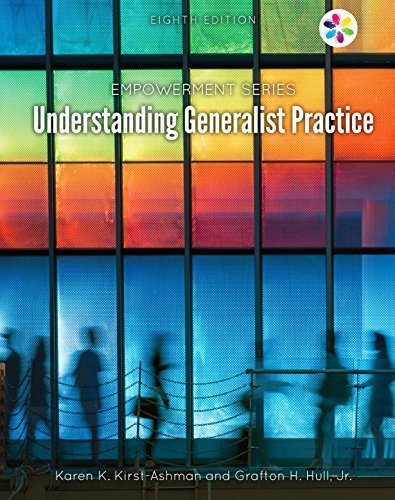
Empowerment Series: Understanding Generalist Practice 8th Edition by Karen K. Kirst-Ashman, ISBN-13: 978-1305966864
Original price was: $50.00.$14.99Current price is: $14.99.
Safe & secure checkout
Description
Description
Empowerment Series: Understanding Generalist Practice 8th Edition by Karen K. Kirst-Ashman, ISBN-13: 978-1305966864
[PDF eBook eTextbook]
- Publisher: Cengage Learning; 8th edition (January 1, 2017)
- Language: English
- 704 pages
- ISBN-10: 9781305966864
- ISBN-13: 978-1305966864
Organized around the coherent and cohesive Generalist Intervention Model, this guide to generalist social work practice incorporates the knowledge, skills, and professional values you need to work with individuals and families, as well as the foundation to work with groups, communities, and organizations. Updated to reflect current topics and practice, the book focuses on micro levels of social work practice while also discussing the interrelationship among the micro, mezzo, and macro levels. Part of the Brooks/Cole Empowerment Series, UNDERSTANDING GENERALIST PRACTICE, 8th Edition, clearly identifies content related to the latest Council on Social Work Education (CSWE) Educational Policy and Accreditation Standards (EPAS) with icons throughout the text. Learning objectives, which are correlated to chapter headings and summaries, guide your reading and reinforce your understanding.
Table of Contents:
Contents
Preface
Chapter 1: Introducing Generalist Practice: The Generalist Intervention Model
Introducing Generalist Practice
LO 1-1 Social Work Is Unique
Focus On Any Problem
Targeting The External Environment For Change
Advocacy
Professional Values And Ethics
Partnerships With Clients
Adherence To Professional Standards
LO 1-2 What Is Generalist Practice
The Definition Of Generalist Practice
LO 1-3 Defining Generalist Practice: An Eclectic Knowledge Base
An Eclectic Knowledge Base: Fields Of Practice
LO 1-4 An Eclectic Knowledge Base: Systems Theory
Major Concepts In Systems Theory
LO 1-5 An Eclectic Knowledge Base: The Ecological Perspective
Ecological Terms
Similarities Between Systems Theory And The Ecological Perspective
Differences Between Systems Theory And The Ecological Perspective
Which Perspective Is Best
An Eclectic Knowledge Base: Human Behavior And The Social Environment
Critical Thinking Questions 1.1
An Eclectic Knowledge Base: Social Welfare Policy And Policy Practice
An Eclectic Knowledge Base: Social Work Practice
An Eclectic Knowledge Base: Research-informed Practice And Practice-informed Research
Necessary Research Skills For Social Workers
An Eclectic Knowledge Base: Values And Principles That Guide Generalist Practice
LO 1-6 Defining Generalist Practice: Professional Values And Ethics
Critical Thinking Question 1.2
LO 1-7 Defining Generalist Practice: Application Of A Wide Range Of Practice Skills To Target System
Generalist Practice Skills For Working With Individuals (Micro Skills)
Generalist Practice Skills For Working With Groups (Mezzo Skills)
Generalist Practice Skills For Working With Families (Micro/Mezzo Skills)
Generalist Practice Skills For Working In And With Organizations And Communities (Macro Skills)
LO 1-8 Defining Generalist Practice: Emphasis On Client Empowerment, Strengths, And Resiliency
The Strengths Perspective
Resiliency: Seeking Strength Amid Adversity
LO 1-9 Defining Generalist Practice: The Significance Of Human Diversity
Intersectionality Of Diverse Factors
The Potential For Discrimination And Oppression
Achievement Of Cultural Competency
LO 1-10 Defining Generalist Practice: Advocacy And The Pursuit Of Social, Economic, And Environment
Defining Generalist Practice: Work Within An Organizational Structure
LO 1-11 Defining Generalist Practice: Assuming Many Professional Roles
LO 1-12 Defining Generalist Practice: Critical Thinking Skills
“Facts” May Not Be True
The Widespread Application Of Critical Thinking
Critical Thinking Questions 1.3
LO 1-13 Defining Generalist Practice: Research-informed Practice
LO 1-14 Defining Generalist Practice: Planned Change
LO 1-15 The Generalist Intervention Model (gim
Planned Change Steps In GIM
Step 1. Engagement: Engage The Client System
Step 2. Assessment: Assess The Client And Situation
Step 3. Planning: Formulate A Plan For The Intervention Process
Step 4. Implementation: Put The Plan Into Action
Step 5. Evaluation: Evaluate Results And Effectiveness
Step 6. Termination: Conclude The Planned Change Intervention Process
Step 7. Follow-Up: Reexamine The Situation And Progress Made
Other Practical Generalist Skills: A Perspective On The Rest Of The Text
Chapter Summary
Competency Notes
Highlight
1.1 Social Work, Social Work Education, And Educational Policy
1.2 Concepts In The Definition Of Generalist Practice
1.3 Summary Of Some Of The Major Terms In Systems Theory And The Ecological Perspective
1.4 Evidence-Based Practice
1.5 Achieve Competency In Ethical Practice By Applying Ethical Standards
1.6 Learn To Make Difficult Ethical Decisions
1.7 The Macro-Level Approach
1.8 Dimensions Of Diversity
1.9 Pitfalls To Critical Thinking
Chapter 2: Practice Skills For Working With Individuals
Introduction
Skills For Working With Individuals And The Generalist Intervention Model (GIM)
LO 2-1 Interviewing Techniques: Important Interpersonal Skills
Beginning The Worker-Client Relationship
LO 2-2 Verbal And Nonverbal Behavior
Eye Contact
Attentive Listening
Facial Expressions
Body Positioning
Critical Thinking Questions 2.1
LO 2-3 Warmth, Empathy, And Genuineness
Warmth
Empathy
Critical Thinking Question 2.2
Genuineness
Critical Thinking Questions 2.3
LO 2-4 Client Self-Determination And Empowerment
LO 2-5 How Do You Begin An Interview?
The Interview Setting
How To Dress For The Interview And For The Job
Thinking Ahead About An Interview With A Client
Initial Introductions
Alleviating The Client’s Anxiety
Portraying Confidence And Competence
Beginning Statement Of Purpose And Role
LO 2-6 Conducting The Interview
Verbal Responses To The Client
Interviewing, Specific Techniques, And The Planned Change Process
LO 2-9 Critical Thinking: Challenges In Interviewing
LO 2-10 Dealing With Diversity: Cross-Cultural Awareness In Interviewing
Silence In The Interview
Critical Thinking Questions 2.4
Confronting Clients
Involuntary Clients
Suspicion Of Untruth
LO 2-12 Terminating The Interview
LO 2-13 Using Micro-Practice Skills In Multiple Roles
Chapter Summary
Competency Notes
Highlights
2.1 Practicing Empathic Responses
2.2 Using Direct And Indirect Questions
LO 2-7 2.3 Ethnographic Interviewing
2.4 Critical Thinking: Telling A Client What To Do
LO 2-8 2.5 The Significance Of Clients’ Strengths
LO 2-11 2.6 Spirituality And Religion
2.7 Handling Hostility
Chapter 3: Practice Skills For Working With Groups
LO 3-1 The Benefits And Functions Of Treatment And Task Groups
Benefits Of Groups
Critical Thinking Questions 3.1
Differentiating Types Of Groups
Task Groups
Treatment Groups
LO 3-2 Professional Roles In Groups
Broker
Mediator
Educator
Facilitator
LO 3-3 Theoretical Frameworks In Group Assessment, Intervention, And Evaluation
Group Development
Group Culture, Norms, And Power
Group Size And Composition
Duration
LO 3-4 Problem-Solving And Decision-Making Approaches With Groups
Consensus Decision Making
Compromise
Decision Making By Majority
Rule By An Individual
Persuasion By A Recognized Expert
Averaging Of The Opinions Of Individual Group Members
Persuasion By A Minority Of The Group
Nominal Group Technique
Brainstorming
Parliamentary Procedure
Critical Thinking And Groups
Critical Thinking Questions 3.2
Group Functions And Roles
Task Roles
Maintenance Roles
Nonfunctional Roles
LO 3-5 Using Empathy And Other Interpersonal Skills With Groups
Groups And The Generalist Intervention Model (GIM)
Critical Thinking Questions 3.3
Intervention Skills For Task And Treatment Groups
Conflict Resolution
Modeling And Coaching
Team Building
Confrontation
Consultation
Coordination
Using Structure
Chapter Summary
Competency Notes
Highlights
3.1 Engaging In Research-Informed Practice: A Participatory Action Research Group
3.2 Advocating For Human Rights And Social Justice: Social Action
3.3 Intervening With A Group: Stages In Teen Group Therapy
3.4 Multidisciplinary Frameworks: Approaches To Decision Making
3.5 The Family Treatment Program: Recognizing Conflict
3.6 That Is Not What I Said: Assessing Conflict
3.7 Square Peg In A Round Hole: Choosing A Strategy
3.8 Teaching Disciplinary Techniques: Modeling And Coaching
Chapter 4: Skills For Working With Organizations And Communities
Engaging With Organizations And Communities
Defining Macro Practice
LO 4-1 The Organizational Context Of Practice
Recognizing Professional-Organizational Conflicts
Considering Limitations And Risk Assessment
Critical Thinking Questions 4.1
Theoretical Frameworks For Organizational And Community Change
LO 4-2 Identifying Potential Interventions, Including Policy/Planning, Capacity Development, And So
Policy/Planning
Capacity Development
Social Advocacy
LO 4-3 Using Empathy, Interpersonal Skills, And Group Skills In Macro Practice
Employing Group Skills For Organizational And Community Change
LO 4-4 Utilizing Effective Macro-Practice Skills
Evaluating Results
Fund-Raising
Budgeting
Critical Thinking Questions 4.2
Negotiating
Mediating
Influencing Decision Makers
Critical Thinking Questions 4.3
Needs Assessment
Planning
Working With Coalitions
LO 4-5 Identifying Professional Roles In Organizational And Community Change
Initiator
Negotiator
Advocate
Mediator
Spokesperson
Organizer
Consultant
Theoretical Frameworks: Generalist Intervention Model (GIM) In Macro Practice
Chapter Summary
Competency Notes
Highlights
4.1 Recognizing Ethical Conflicts: When The Agency You Work For Is Part Of The Problem
4.2 Advancing Social Justice
4.3 Saving A Community: A Task Group At Work
4.4 Petitioning Works
4.5 Embarrassing A Landlord
4.6 Communication Skills: Letter-Writing Strategies
Chapter 5: Engagement And Assessment In Generalist Practice
LO 5-1 Engagement And Assessment With Various-Size Systems
Engagement
Greeting The Client
Demonstrating Effective Attending Skills
Discussing Agency Services And Client Expectations
Deciding If The Agency And Worker Can Help
Offering Agency And Worker Services To The Client
Orienting The Client To The Helping Process
Completing Required Paperwork
LO 5-2 Assessment
Approaching Assessment
Critical Thinking Questions 5.1
Achieving The Goals Of Assessment
LO 5-3 Assessing From A Micro Practice Perspective
Defining Problems And Issues
LO 5-4 Assess Client Strengths And Limitations
Resistance In Assessment
Critical Thinking Questions 5.2
Which Problem Should You Work On
Collecting, Organizing, And Interpreting Client Data
LO 5-5 Utilize Micro-Assessment Tools
Family Assessment
LO 5-6 Working With Families Following Assessment
LO 5-7 Effectively Use Home Visits For Assessment
LO 5-8 Task And Treatment Group Assessment
Potential Sponsorship
Group Membership
Ongoing Group Assessment
Assessment In Macro Practice
LO 5-9 Assessment Tools To Determine Community And Neighborhood Needs
Critical Thinking Questions 5.3
Assessment, Client Empowerment, And Strengths
Chapter Summary
Competency Notes
Highlights
5.1 The Difference Between Diagnosis And Assessment
5.2 Examples Of Questions You Can Ask During Assessment
5.3 Avoiding A Dangerous Situation
5.4 Taking Care Of Yourself
5.5 Sociograms
5.6 A Format For Analyzing A Community Or Neighborhood
Chapter 6: Planning In Generalist Practice
Introduction
LO 6-1 Planning In Generalist Practice: Integrating Micro, Mezzo, And Macro
Step 1: Work With Your Client(s)
Critical Thinking Questions 6.1
Step 2: Prioritize Problems—Which Problem Should You Work On First
Step 3: Translate Problems Into Needs
Step 4: Evaluate Levels Of Intervention—Selecting A Strategy
LO 6-2 Step 5: Establish Goals
Step 6: Specify Objectives
Step 7: Specify Action Steps
LO 6-3 Step 8: Formalize A Contract/Service Agreement
LO 6-4 Planning In Mezzo Practice
The Complexity Of Setting Objectives In Mezzo Practice
Contracts In Mezzo Practice
Critical Thinking Questions 6.2
LO 6-5 Planning In Macro Practice
An Approach To Program Planning
Critical Thinking Questions 6.3
Chapter Summary
Competency Notes
Highlights
6.1 Potential Areas Of Clients’ Strengths
6.2 Using The Concepts Of Performance, Conditions, And Standards To Establish Goals And Objectives
6.3 Clarifying Vague Goals And Objectives
6.4 Planning A Health Clinic
Chapter 7: Examples Of Implementation In Generalist Practice
Introduction
LO 7-1 Social Work And Child Maltreatment
A Profile Of Child Maltreatment
Critical Thinking Questions 7.1
Incidence Of Child Maltreatment
Characteristics Of Perpetrators
LO 7-2 Child Protective Services
Family Preservation Philosophy: Empowering Families
LO 7-3 Child Protective Services And Planned Change
The Generalist Intervention Model: Engagement
The Generalist Intervention Model: Assessment
The Generalist Intervention Model: Planning
The Generalist Intervention Model: Implementation
The Generalist Intervention Model: Evaluation, Termination, And Follow-Up
Empowerment, Child Maltreatment, And Practice With Families And Groups
Empowerment, Child Maltreatment, And Practice With Organizations And Communities
Critical Thinking Questions 7.2
LO 7-4 Crisis Intervention
The Crisis Process
Steps In Crisis Intervention
Critical Thinking Question 7.3
A Case Example Of Crisis Intervention In Micro Practice
Critical Thinking Questions 7.4
Crisis Intervention With Families And Groups
Crisis Intervention With Organizations And Communities
LO 7-5 Disaster Relief: Macro-Level Crisis Intervention
Assessment In Disaster Relief
Intervention In Disaster Relief
Practice Issues With Diverse Groups
LO 7-6 Social Work Practice With Older Adults
Critical Thinking Questions 7.5
Critical Thinking Questions 7.6
LO 7-7 Social Work Practice And Immigration Status Issues
LO 7-8 Alcohol And Other Substance Abuse
People With Alcohol Problems
Alcoholism And Family Relationships
Your Role In Intervention With People Who Have Alcohol Use Disorders
Treatment Approaches For Alcoholism
Critical Thinking Questions 7.7
Other Issues
Empowerment At The Mezzo Level
Empowerment At The Macro Level
Critical Thinking Questions 7.8
Chapter Summary
Competency Notes
Highlights
7.1 Physical Indicators Of Physical Abuse
7.2 Categories For General Indicators Of Child Neglect
7.3 Major Concepts In Crisis Intervention
7.4 A Few Words About Helping People Cope With Grief And Loss
7.5 Disaster Relief Work Versus Individual Crises
7.6 Spirituality And Religion As Potential Sources Of Strength For Older Adults
7.7 Empowerment In Work With Individuals Who Are Older Adults
7.8 Critical Issues In Working With People Having Another National Origin
7.9 Important Aoda Terms And Concepts
7.10 Your Role As A Referral Agent
7.11 Helpful Techniques In The Harm Reduction Approach
Chapter 8: Evaluation, Termination, And Follow-Up In Generalist Practice
Introduction
LO 8-1 Evaluating Social Work Practice
Definition And Purposes Of Evaluation
External Factors In Evaluation
Obstacles To Evaluation
LO 8-2 The Evaluation Process
Formative Evaluations
Summative Evaluations
Baseline
Validity
Critical Thinking Questions 8.1
Reliability
Data-Gathering Methods
Independent And Dependent Variables
Generalizability
Critical Thinking Questions 8.2
Evaluation Designs For Generalist Practice
Single-Subject Designs
Goal-Attainment Scaling
Task-Achievement Scaling
Client Satisfaction Questionnaires
Target-Problem Scaling
LO 8-3 Evaluation Designs For Programs
Needs Assessments
Evaluability Assessments
Process Analysis
Program Outcome Analysis
Continuous Quality Assurance Evaluations
Program Monitoring
LO 8-4 Issues And Problems In Evaluation
Problems In Generalizability
Wrong Choices Of Evaluation Tools
Failure To Involve Clients In The Evaluation Process
Staff Distrust Of Evaluation
Evaluation Process Interference With Service Provision
Alternative Explanations For Program Outcomes
Unanticipated Consequences
LO 8-5 Termination And Follow-Up
Ethical Practice And Critical Thinking About Termination
Critical Thinking Questions 8.3
Terminating Professional Relationships
Tasks Of Termination
Planned Terminations
Unplanned Terminations
Other Points About Termination
Reactions And Feelings In Terminations
LO 8-6 Worker Reactions To Termination
LO 8-7 Helping Clients At Termination
Planning For Termination
LO 8-8 Addressing Feelings About Termination
LO 8-9 Stabilization Of Change
Addressing Ongoing Needs Of Clients
LO 8-10 Client Follow-Up
Doing The Follow-Up
Overcoming Barriers To Follow-Up
Chapter Summary
Competency Notes
Highlights
8.1 Evaluating Programs
8.2 Finding Valid And Reliable Instruments
8.3 Cultural Competence And Evaluation
8.4 Alternate Explanations For Outcomes
8.5 Unplanned Terminations In Groups
8.6 Termination Feelings Of Family And Group Members
8.7 Possible Tasks For The Worker At Follow-Up
Chapter 9: Understanding Families: Family Assessment
Introduction
LO 9-1 Families And The Generalist Intervention Model (GIM)
Defining Families
LO 9-2 Family Verbal And Nonverbal Communication
Avenues Of Communication
Critical Thinking Question 9.1
LO 9-3 Family Structure
The Family As A System
Family Norms
Family Roles
Balance Of Power Within The Family System
Assessing Intergenerational Aspects Of Family Systems
Critical Thinking Questions 9.2
LO 9-4 Family Life Cycles
LO 9-5 Families And The Social Environment
Assessing A Family’s Access To Resources
Critical Thinking Questions 9.3
LO 9-6 Common Family Problems
Partner Difficulties
Parent-Child Relationship Difficulties
Personal Problems Of Individual Family Members
External Environmental Stresses: The Impact Of Social And Economic Forces
Critical Thinking Questions 9.4
LO 9-7 Diversity In Family Composition
Single-Parent Families
Remarriage And Blended Families
Critical Thinking Questions 9.5
LO 9-8 Cultural Competency And Family Assessment
Issues To Address When Working With Families From Diverse Cultures
Questions For Assessing Culturally Diverse Families
Critical Thinking Question 9.6
Principles For The Assessment Of Diverse Families
Chapter Summary
Competency Notes
Highlights
9.1 An Example Of Conflict Between Verbal And Nonverbal Communication
9.2 Family Norms Vary Dramatically From One Family To Another
9.3 Difficulties In Soliciting Personal Information
9.4 An Example Of Life Within A Blended Family
9.5 Personal Competencies For Working With People From Diverse Cultures
Chapter 10: Working With Families
Introduction
LO 10-1 Generalist Practice With Families
Family Treatment And The Planned Change Process
Strategizing For Family Intervention: Do You Always Have To See The Entire Family
Critical Thinking Questions 10.1
LO 10-3 Family Engagement, Assessment, And Planning
Phase 1: Alleviate Or At Least Minimize Early Apprehension
Phase 2: Ask Family Members To Explain What Is Wrong
Phase 3: Establish Agreement About What Is Wrong
Phase 4: Concentrate On How Family Members Relate To Each Other
Phase 5: Establish A Commitment To A Plan Of Action
LO 10-4 Implementation In Family Intervention
Empowerment By Emphasizing Family Strengths
Reframing
Teaching Families Problem-Solving Techniques
Teaching Child Management Methods
Offering Families Support
Role Playing
Audiovisual Recording
Homework Assignments
LO 10-5 Family Evaluation, Termination, And Follow-Up
Evaluation Of Family Intervention
Termination Of Family Intervention
Follow-Up With Families
LO 10-6 Issues Confronting Families
Multiproblem Families
Family Preservation
LO 10-7 The Importance Of Cultural Competency
Lesbian And Gay Families
Critical Thinking Questions 10.2
Working With African-American Families
LO 10-8 Family Services Today
Critical Thinking Questions 10.3
Critical Thinking Questions 10.4
Critical Thinking Questions 10.5
Critical Thinking Questions 10.6
Critical Thinking Questions 10.7
LO 10-9 Macro Practice With Families: The Promotion Of Social, Economic, And Environmental Justice
Chapter Summary
Competency Notes
Highlights
LO 10-2 10.1 Strengths-Based Approaches To Assessment
10.2 Four Ways Of Exploring A Target Problem
10.3 Terms Used To Describe Various Sexual Orientations
10.4 Confronting Homophobia
10.5 Empowerment Of Lesbians And Gay Men
10.6 Families, Macro Practice, And The Integration Of Policy And Practice
Chapter 11: Values, Ethics, And The Resolution Of Ethical Dilemmas
Introduction
LO 11-1 The National Association Of Social Workers (NASW) Code Of Ethics
Social Workers’ Ethical Responsibilities To Clients
Critical Thinking Question 11.1
Critical Thinking Question 11.2
Critical Thinking Question 11.3
Critical Thinking Question 11.4
Critical Thinking Questions 11.5
Critical Thinking Question 11.6
Critical Thinking Questions 11.7
Critical Thinking Question 11.8
Critical Thinking Question 11.9
Critical Thinking Question 11.10
Critical Thinking Questions 11.11
Critical Thinking Questions 11.12
Critical Thinking Question 11.13
Social Workers’ Ethical Responsibilities To Colleagues
Critical Thinking Question 11.14
Critical Thinking Question 11.15
Critical Thinking Questions 11.16
Critical Thinking Question 11.17
Critical Thinking Question 11.18
Critical Thinking Question 11.19
Social Workers’ Ethical Responsibilities In Practice Settings
Social Workers’ Ethical Responsibilities As Professionals
Social Workers’ Ethical Responsibilities To The Social Work Profession
Social Workers’ Ethical Responsibilities To The Broader Society
LO 11-2 The Canadian Association Of Social Workers Code Of Ethics
LO 11-3 Ethical Principles At The International Level
Human Rights And Social Justice
LO 11-4 Ethical Dilemmas
LO 11-5 Decision-Making Steps To Tackle Ethical Dilemmas
Step 1: Recognize The Problem
Step 2: Investigate The Variables Involved
Step 3: Get Feedback From Others
Step 4: Appraise What Values And Ethical Standards Apply To The Dilemma
Step 5: Evaluate The Dilemma On The Basis Of Established Ethical Principles
Step 6: Identify And Think About Possible Alternatives To Pursue
Step 7: Weigh The Pros And Cons Of Each Alternative
Step 8: Make Your Decision
LO 11-6 Ranking Ethical Principles: Dolgoff, Harrington, And Loewenberg’s Ethical Principles Scre
Principle 1: People Have The Right To Exist With Their Basic Needs Met
Principle 2: People Have The Right To Treatment That Is Fair And Equal
Principle 3: People Have The Right To Have Free Choice And Freedom
Principle 4: People Have The Right To Experience No Harm Or Injury That Is Minimal
Principle 5: People Have The Right To Cultivate A Good Quality Of Life
Principle 6: People Have The Right To Secure Their Privacy And Confidentiality
Principle 7: People Have The Right To Understand The Truth And All Available Information
Postscript
LO 11-7 Ethical Dilemmas In Generalist Practice
Confidentiality And Privileged Communication
Self-Determination And Paternalism
Critical Thinking Questions 11.20
Critical Thinking Questions 11.21
Dual Relationships
Critical Thinking Questions 11.22
Critical Thinking Questions 11.23
Critical Thinking Questions 11.24
Critical Thinking Question 11.25
Critical Thinking Question 11.26
Critical Thinking Question 11.27
Critical Thinking Questions 11.28
Critical Thinking Questions 11.29
Critical Thinking Question 11.30
Telling The Truth
Critical Thinking Questions 11.31
Critical Thinking Questions 11.32
Critical Thinking Questions 11.33
Laws, Policies, And Regulations
Critical Thinking Questions 11.34
Critical Thinking Questions 11.35
Critical Thinking Questions 11.36
Whistle-Blowing
Distribution Of Limited Resources
LO 11-10 Personal And Professional Values
Chapter Summary
Competency Notes
Highlight
11.1 A Summary Of Ethical Standards In The Nasw Code Of Ethics
11.2 Canadian Association Of Social Workers Code Of Ethics Core Values
LO 11-8 11.3 Ethical Communication And “Netiquette” On The Internet
LO 11-9 11.4 Self-Determination And People With Physical Disabilities: An Empowerment Approach
11.5 Dual Relationships Between Supervisors And Supervisees
Chapter 12: Culturally Competent Social Work Practice
Introduction
LO 12-1 Diversity In The United States
Race And Ethnicity
Disabilities
Historic And Current Discrimination
LO 12-2 Barriers To Culturally Competent Social Work
Critical Thinking Questions 12.1
LO 12-3 Integrating Cultural Competence In The Generalist Intervention Model
Engagement
Assessment
Planning
Implementation
Evaluation
Termination And Follow-Up
Practice Knowledge And Skills
Native Americans/First Nations Peoples
Latinos/Hispanics
African Americans
Asian Americans And Pacific Islanders
Critical Thinking Question 12.2
People With Disabilities
Developing Culturally Competent Interventions
LO 12-4 Learners And Teachers Regarding Cultural And Other Differences
Critical Thinking Questions 12.3
Chapter Summary
Competency Notes
Highlights
12.1 Common Terminology
12.2 Online Resources
12.3 Enhancing Cultural Competency: Understanding Within-Group Differences
12.4 Talking About Disabilities—Some Dos And Don’ts
12.5 Strategies For Cultural Competence
Chapter 13: Gender-Sensitive Social Work Practice
Introduction
LO 13-1 Enhancing Gender Sensitivity
LO 13-2 Application Of The Generalist Intervention Model
LO 13-3 Feminist Perspectives On Micro, Mezzo, And Macro Practice With Women
A Definition Of Feminism For Practitioners
Critical Thinking Question 13.1
Micro Practice With Women: Common Problems
Stressful Life Events
Lack Of Self-Esteem And A Sense Of Powerlessness
LO 13-4 The Personal Empowerment Of Women
Enhance Self-Esteem
Increase Assertiveness
Critical Thinking Questions 13.2
Expand Options
Change Old Rules And Expectations
Help Women Work Together For Macro-Level Empowerment
Common Circumstances Facing Women
LO 13-5 Women And Sexual Assault
The Feminist Perspective On Sexual Assault
Reactions To Rape
Counseling Survivors Of Sexual Assault
Macro Issues Concerning Sexual Assault
LO 13-6 Intervention With Battered Women
A Profile Of Battered Women
Survivors Versus Victims: A Strengths Perspective
The Abusive Perpetrator
Cultural Influences And Battered Women
Critical Thinking Questions 13.3
The Battering Cycle
Why Does She Stay?
Empowering Battered Women Through Service Provision
Critical Thinking Question 13.4
Basic Counseling Strategies
Suggestions For Macro Practice On Behalf Of Battered Women
LO 13-7 The Feminization Of Poverty
Critical Thinking Question 13.5
Micro And Mezzo Perspectives On Women And Poverty
Macro Perspectives On Women And Poverty
Critical Thinking Questions 13.6
The Need For Ongoing Learning
Chapter Summary
Competency Notes
Highlights
13.1 Are You A Feminist
13.2 Principles Of Feminist Counseling
13.3 Each Of Us Has Certain Assertive Rights
13.4 A Feminist Approach To Macro Practice: Seeking Social And Economic Justice
13.5 An International Perspective On Domestic Violence
13.6 Women’s Salaries In Social Work
13.7 Confronting Sexual Harassment
Chapter 14: Advocacy
Defining Advocacy
LO 14-1 Advocacy And The Generalist Intervention Model
Case Advocacy
Cause Advocacy
Critical Thinking Questions 14.1
LO 14-2 Using Skills In Advocacy
Identifying The Goals Of Advocacy
Engaging In Advocacy And Empowerment
Targets Of Advocacy
Recognizing The History Of Advocacy In Social Work
Observations About Advocacy
Observations About Power
Observations About Organizations
Observations About Clients
Knowledge Required By Advocates
Knowing The Rights Of Clients
Identifying Avenues Of Appeal
Identifying Available Resources
Critical Thinking Questions 14.2
Thinking Strategically About Intervention
Assessing Advocacy Situations
Self-Assessment
LO 14-3 Theoretical Frameworks Related To Advocacy: Sources Of Power
Other Assessment Considerations
Planning In Advocacy Situations
LO 14-4 Making The Ultimate Decision
Advocacy Strategies And Tactics
Persuading
Using Fair Hearings And Legal Appeals
Employing Political And Community Pressure
Using The Media
Petitioning
Selecting A Strategy For Advocacy
LO 14-5 Legislative Advocacy
Recognizing Factors Affecting Legislative Advocacy
Steps In Legislative Advocacy
Chapter Summary
Competency Notes
Highlights
14.1 Indications For Advocacy
14.2 When The System Is Not Working
14.3 Guidelines For Advocacy
14.4 Writing Elected Officals
Chapter 15: Brokering And Case Management
Introduction
LO 15-1 A Definition Of Brokering
The Importance Of The Brokering Role In Generalist Practice
The Effective Broker
The Importance Of Knowing Resources
Types Of Resources
Critical Thinking Questions 15.1
The Planned Change Process In Brokering
Identifying And Assessing Client Needs
Identifying And Assessing Potential Resource Systems
Making The Referral
Helping The Client Use Resource Systems
Follow-Up And Evaluation Of Resource Systems
LO 15-2 Case Management
What Is Case Management
The Importance Of Case Management For Generalist Practice
Assessment
Planning
Intervention
Evaluation In Case Management
Termination In Case Management
Follow-Up In Case Management
Factors Influencing Case Management Service Delivery
Critical Thinking Questions 15.2
General Observations About Both Brokering And Case Management
LO 15-3 Advancing Social, Economic, And Environmental Justice
LO 15-4 Use Evaluation Evidence To Inform Practice
Chapter Summary
Competency Notes
Highlights
15.1 Community Resource Directory Index
15.2 Resource Directory Listing
15.3 An Overview Of Case Management
15.4 Motivating Techniques
15.5 Case Management For A Client Who Has Mental Disabilities
Chapter 16: Recording In Generalist Social Work Practice
Introduction
LO 16-1 The Importance Of Writing In Social Work
1. Identifying The Client And The Need
2. Documenting Services
3. Maintaining Case Continuity
4. Assisting In Interprofessional Communication
5. Sharing Information With The Client
6. Facilitating Supervision, Consultation, And Peer Review
7. Monitoring The Process And Impact Of Service
8. Educating Students And Other Professionals
9. Supplying Information For Administrative Tasks
10. Providing Data For Research-Informed Practice
LO 16-2 What Is In The Record
1. The Date Of Your Interaction With The Client
2. Basic Information About The Client
3. Reason For Client Contact
4. More Detailed Information About The Client’s Problem And Situation
Critical Thinking Question 16.1
5. Aspects Of The Implementation Process
6. Follow-Up Information
7. Comments And Questions To Discuss With A Supervisor Or Another Worker
LO 16-3 Recording Formats
Process Recording
Using Audiovisual Recording
Critical Thinking Questions 16.2
Progress Notes
Taking Notes During The Interview
Critical Thinking Questions 16.3
Narrative Recording
Summaries Of Treatment Conferences
Problem-oriented Recording
Recording Progress In Groups
Writing Letters
LO 16-4 E-ma



Reviews
There are no reviews yet.