

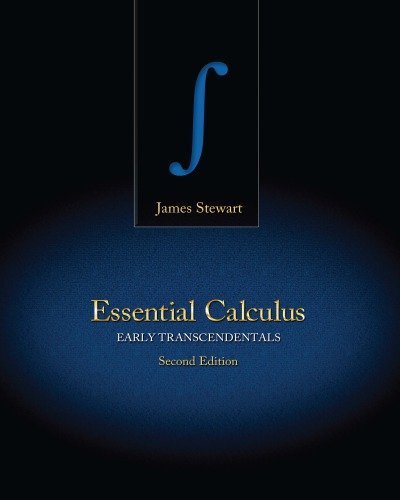
Essential Calculus: Early Transcendentals 2nd Edition by James Stewart, ISBN-13: 978-1133112280
Original price was: $50.00.$14.99Current price is: $14.99.
Safe & secure checkout
Description
Description
Essential Calculus: Early Transcendentals 2nd Edition by James Stewart, ISBN-13: 978-1133112280
[PDF eBook eTextbook] – Available Instantly
- Publisher: Cengage Learning; 2nd edition (January 25, 2012)
- Language: English
- 960 pages
- ISBN-10: 1133112285
- ISBN-13: 978-1133112280
This book is for instructors who think that most calculus textbooks are too long. In writing the book, James Stewart asked himself: What is essential for a three-semester calculus course for scientists and engineers?
ESSENTIAL CALCULUS: EARLY TRANSCENDENTALS, Second Edition, offers a concise approach to teaching calculus that focuses on major concepts, and supports those concepts with precise definitions, patient explanations, and carefully graded problems. The book is only 900 pages–two-thirds the size of Stewart’s other calculus texts, and yet it contains almost all of the same topics. The author achieved this relative brevity primarily by condensing the exposition and by putting some of the features on the book’s website, www.StewartCalculus.com. Despite the more compact size, the book has a modern flavor, covering technology and incorporating material to promote conceptual understanding, though not as prominently as in Stewart’s other books. ESSENTIAL CALCULUS: EARLY TRANSCENDENTALS features the same attention to detail, eye for innovation, and meticulous accuracy that have made Stewart’s textbooks the best-selling calculus texts in the world.
Table of Contents:
Contents
Preface
To the Student
Diagnostic Tests
Ch 1: Functions and Limits
1.1 Functions and Their Representations
1.1 Exercises
1.2 A Catalog of Essential Functions
1.2 Exercises
1.3 The Limit of a Function
1.3 Exercises
1.4 Calculating Limits
1.4 Exercises
1.5 Continuity
1.5 Exercises
1.6 Limits Involving Infinity
1.6 Exercises
Chapter 1: Review
Ch 2: Derivatives
2.1 Derivatives and Rates of Change
2.1 Exercises
2.2 The Derivative as a Function
2.2 Exercises
2.3 Basic Differentiation Formulas
2.3 Exercises
2.4 The Product and Quotient Rules
2.4 Exercises
2.5 The Chain Rule
2.5 Exercises
2.6 Implicit Differentiation
2.6 Exercises
2.7 Related Rates
2.7 Exercises
2.8 Linear Approximations and Differentials
2.8 Exercises
Chapter 2: Review
Ch 3: Inverse Functions: Exponential, Logarithmic, and Inverse Trigonometric Functions
3.1 Exponential Functions
3.1 Exercises
3.2 Inverse Functions and Logarithms
3.2 Exercises
3.3 Derivatives of Logarithmic and Exponential Functions
3.3 Exercises
3.4 Exponential Growth and Decay
3.4 Exercises
3.5 Inverse Trigonometric Functions
3.5 Exercises
3.6 Hyperbolic Functions
3.6 Exercises
3.7 Indeterminate Forms and L’Hospital’s Rule
3.7 Exercises
Chapter 3: Review
Ch 4: Applications of Differentiation
4.1 Maximum and Minimum Values
4.1 Exercises
4.2 The Mean Value Theorem
4.2 Exercises
4.3 Derivatives and the Shapes of Graphs
4.3 Exercises
4.4 Curve Sketching
4.4 Exercises
4.5 Optimization Problems
4.5 Exercises
4.6 Newton’s Method
4.6 Exercises
4.7 Antiderivatives
4.7 Exercises
Chapter 4: Review
Ch 5: Integrals
5.1 Areas and Distances
5.1 Exercises
5.2 The Definite Integral
5.2 Exercises
5.3 Evaluating Definite Integrals
5.3 Exercises
5.4 The Fundamental Theorem of Calculus
5.4 Exercises
5.5 The Substitution Rule
5.5 Exercises
Chapter 5: Review
Ch 6: Techniques of Integration
6.1 Integration by Parts
6.1 Exercises
6.2 Trigonometric Integrals and Substitutions
6.2 Exercises
6.3 Partial Fractions
6.3 Exercises
6.4 Integration with Tables and Computer Algebra Systems
6.4 Exercises
6.5 Approximate Integration
6.5 Exercises
6.6 Improper Integrals
6.6 Exercises
Chapter 6: Review
Ch 7: Applications of Integration
7.1 Areas between Curves
7.1 Exercises
7.2 Volumes
7.2 Exercises
7.3 Volumes by Cylindrical Shells
7.3 Exercises
7.4 Arc Length
7.4 Exercises
7.5 Area of a Surface of Revolution
7.5 Exercises
7.6 Applications to Physics and Engineering
7.6 Exercises
7.7 Differential Equations
7.7 Exercises
Chapter 7: Review
Ch 8: Series
8.1 Sequences
8.1 Exercises
8.2 Series
8.2 Exercises
8.3 The Integral and Comparison Tests
8.3 Exercises
8.4 Other Convergence Tests
8.4 Exercises
8.5 Power Series
8.5 Exercises
8.6 Representing Functions as Power Series
8.6 Exercises
8.7 Taylor and Maclaurin Series
8.7 Exercises
8.8 Applications of Taylor Polynomials
8.8 Exercises
Chapter 8: Review
Ch 9: Parametric Equations and Polar Coordinates
9.1 Parametric Curves
9.1 Exercises
9.2 Calculus with Parametric Curves
9.2 Exercises
9.3 Polar Coordinates
9.3 Exercises
9.4 Areas and Lengths in Polar Coordinates
9.4 Exercises
9.5 Conic Sections in Polar Coordinates
9.5 Exercises
Chapter 9: Review
Ch 10: Vectors and the Geometry of Space
10.1 Three-Dimensional Coordinate Systems
10.1 Exercises
10.2 Vectors
10.2 Exercises
10.3 The Dot Product
10.3 Exercises
10.4 The Cross Product
10.4 Exercises
10.5 Equations of Lines and Planes
10.5 Exercises
10.6 Cylinders and Quadric Surfaces
10.6 Exercises
10.7 Vector Functions and Space Curves
10.7 Exercises
10.8 Arc Length and Curvature
10.8 Exercises
10.9 Motion in Space: Velocity and Acceleration
10.9 Exercises
Chapter 10: Review
Ch 11: Partial Derivatives
11.1 Functions of Several Variables
11.1 Exercises
11.2 Limits and Continuity
11.2 Exercises
11.3 Partial Derivatives
11.3 Exercises
11.4 Tangent Planes and Linear Approximations
11.4 Exercises
11.5 The Chain Rule
11.5 Exercises
11.6 Directional Derivatives and the Gradient Vector
11.6 Exercises
11.7 Maximum and Minimum Values
11.7 Exercises
11.8 Lagrange Multipliers
11.8 Exercises
Chapter 11: Review
Ch 12: Multiple Integrals
12.1 Double Integrals over Rectangles
12.1 Exercises
12.2 Double Integrals over General Regions
12.2 Exercises
12.3 Double Integrals in Polar Coordinates
12.3 Exercises
12.4 Applications of Double Integrals
12.4 Exercises
12.5 Triple Integrals
12.5 Exercises
12.6 Triple Integrals in Cylindrical Coordinates
12.6 Exercises
12.7 Triple Integrals in Spherical Coordinates
12.7 Exercises
12.8 Change of Variables in Multiple Integrals
12.8 Exercises
Chapter 12: Review
Ch 13: Vector Calculus
13.1 Vector Fields
13.1 Exercises
13.2 Line Integrals
13.2 Exercises
13.3 The Fundamental Theorem for Line Integrals
13.3 Exercises
13.4 Green’s Theorem
13.4 Exercises
13.5 Curl and Divergence
13.5 Exercises
13.6 Parametric Surfaces and Their Areas
13.6 Exercises
13.7 Surface Integrals
13.7 Exercises
13.8 Stokes’ Theorem
13.8 Exercises
13.9 The Divergence Theorem
13.9 Exercises
Chapter 13: Review
Appendixes
Appendix A: Trigonometry
Appendix B: Sigma Notation
Appendix C: The Logarithm Defined as an Integral
Appendix D: Proofs
Appendix E: Answers to Odd-Numbered Exercises
Index
James Stewart received the M.S. degree from Stanford University and the Ph.D. from the University of Toronto. After two years as a postdoctoral fellow at the University of London, he became Professor of Mathematics at McMaster University. His research has been in harmonic analysis and functional analysis. Stewart’s books include a series of high school textbooks as well as a best-selling series of calculus textbooks. He is also co-author, with Lothar Redlin and Saleem Watson, of a series of college algebra and precalculus textbooks. Translations of his books include those in Spanish, Portuguese, French, Italian, Korean, Chinese, Greek, and Indonesian.
A talented violinst, Stewart was concertmaster of the McMaster Symphony Orchestra for many years and played professionally in the Hamilton Philharmonic Orchestra. Having explored connections between music and mathematics, Stewart has given more than 20 talks worldwide on Mathematics and Music and is planning to write a book that attempts to explain why mathematicians tend to be musical.
Stewart was named a Fellow of the Fields Institute in 2002 and was awarded an honorary D.Sc. in 2003 by McMaster University. The library of the Fields Institute is named after him. The James Stewart Mathematics Centre was opened in October, 2003, at McMaster University.
What makes us different?
• Instant Download
• Always Competitive Pricing
• 100% Privacy
• FREE Sample Available
• 24-7 LIVE Customer Support

Reviews
There are no reviews yet.