

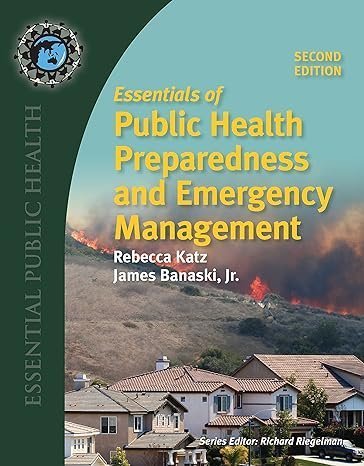
Essentials of Public Health Preparedness and Emergency Management 2nd Edition by Rebecca Katz, ISBN-13: 978-1284121476
Original price was: $50.00.$14.99Current price is: $14.99.
Safe & secure checkout
Description
Description
Essentials of Public Health Preparedness and Emergency Management 2nd Edition by Rebecca Katz, ISBN-13: 978-1284121476
[PDF eBook eTextbook] – Available Instantly
- Publisher: Jones & Bartlett Learning; 2nd edition (March 15, 2018)
- Language: English
- 210 pages
- ISBN-10: 128412147X
- ISBN-13: 978-1284121476
The public health community plays a vital role in identifying, responding to, containing, and recovering from emergencies. Essentials of Public Health Preparedness and Emergency Management takes an all hazards approach to public health preparedness and emergency management by providing broad perspectives on local, national, and global threats. The Second Edition adds authoritative coverage of the field of Emergency Management with the addition of a new co-author, James Banaski, Jr., a hands-on emergency management professional. The Second Edition also includes case studies on Ebola and Zika which demonstrate approaches to addressing the threat of emerging infectious diseases. Additional case studies focus on bioterrorism, environmental disasters, and the need for a coordinated approach involving the full range of first responders, public health and clinical health professionals, and a range of other emergency response professionals.
Key Features:
– Assumes no previous exposure to the concepts making it readable for those who are new to Public Health, yet provides enough depth for readers who may have advanced knowledge.
– Offers new chapters on The Preparedness Cycle, Practical Applications of Public Health Emergency Management, and Developing a Public Health Emergency Operations Center
– Supports mastery of the Public Health Preparedness and Response competencies developed by the Association of School and Programs of Public Health
Table of Contents:
Cover Page
Title Page
Copyright Page
Contents
Prologue
Preface
New to This Edition
Contributors
Acknowledgments
About the Authors
About the Contributors
Abbreviations
Chapter 1 Introduction to Public Health Preparedness
Learning Objectives
Introduction
Definitions
Promote General Welfare and Provide for the Common Defense
National Security
Homeland Security
Homeland Defense
Public Health Preparedness
Emergency Management
Public Health Preparedness and Federalism
Developing the Public Health Preparedness Workforce: Charge and Careers
Jobs in Public Health Preparedness
Key Words
Discussion Questions
References
Chapter 2 Threats from Biological, Chemical, Nuclear, and Radiological Weapons
Learning Objectives
Introduction
Chemical Threats
Toxins
History
Nuclear and Radiological Threats
Nuclear Weapons
Radiological Threats
Biological Threats
Biological Agents
Classification of Biological Weapons
The Biological Threat
Key Words
Discussion Questions
References
Chapter 3 Threats from Naturally Occurring Disease and Natural Disaster
Learning Objectives
Introduction
Evolution of Disease and Security Links
Defining the Link Between Disease and Security
Global Interconnectedness and the Threat of Emerging Infectious Diseases
Monkeypox
Severe Acute Respiratory Syndrome
HIV/AIDS
Ebola in West Africa
Zika
Antimicrobial Resistance
Response
Key Words
Discussion Questions
References
Chapter 4 9/11 and Its Aftermath
Learning Objectives
Introduction
Constitutional Framework and History of Federal Assistance for Preparedness and Disaster Response
Immediate Response to 9/11
Post 9/11
Offices and Organizations—The Federal Preparedness Infrastructure
Department of Homeland Security
Department of Health and Human Services
U.S. Department of Agriculture
Department of Justice, Federal Bureau of Investigation
Department of Defense
Other Relevant Federal Agencies
Introduction to the Intelligence Community
The National Response Framework—Public Health and Medical Response
National Incident Management System
National Response Framework
Emergency Support Function #8
Who Does What
Discussion
Key Words
Discussion Questions
References
Chapter 5 Legislation, Regulations, and Policy Guidance
Learning Objectives
Introduction
Public Health Emergency Preparedness Legislation in the United States (Starting in 2000)
Public Health Improvement Act of 2000 (Public Law 106-505)
Uniting and Strengthening America by Providing Appropriate Tools Required to Intercept and Obstruct Terrorism Act of 2001 (Public Law 107-56)
Public Health Security and Bioterrorism Preparedness and Response Act of 2002 (Public Law 107-188)
Smallpox Emergency Personnel Protection Act of 2003 (Public Law 108-20)
The Project Bioshield Act of 2004 (Public Law 108-276)
Public Readiness and Emergency Preparedness Act of 2005 (Division C of the Department of Defense Emergency Supplemental Appropriations, Public Law 109-148)
Pandemic and All-Hazards Preparedness Act of 2006 (Public Law 109-417)
Pandemic and All-Hazards Preparedness Reauthorization Act of 2013 (Public Law 113-5)
Implementing Recommendations of the 9/11 Commission Act of 2007 (Public Law 110-53)
The National Defense Authorization Act for Fiscal Year 2017 (Public Law 114-328)
Case Study: Passage of the Pandemic and All-Hazards Preparedness Act of 2006
Presidential Directives
Biodefense for the 21st Century: National Security Presidential Directive 33/Homeland Security Presidential Directive 10 (April 2004)
Medical Countermeasures Against Weapons of Mass Destruction: Homeland Security Presidential Directive 18 (January 2017)
Public Health and Medical Preparedness: Homeland Security Presidential Directive 21 (October 2007)
Establishing Federal Capability for the Timely Provision of Medical Countermeasures Following a Biological Attack: Executive Order 13527 (December 2009)
National Strategy for Countering Biological Threats: Presidential Policy Directive 2 (November 2009)
National Preparedness: Presidential Policy Directive 8 (March 2011)
Advancing the Global Health Security Agenda to Achieve a World Safe and Secure from Infectious Disease Threats, Executive Order (November 4, 2016)
Model Legislation
International Law and Regulations
Early Agreements
Chemical Weapons Convention
Nuclear Non-Proliferation Treaty
U.N. Security Council Resolution 1540
Australia Group
Biological Weapons Convention
International Health Regulations 2005
Pandemic Influenza Preparedness Framework
Global Health Security Agenda
The Functionality of International Agreements
Key Words
Discussion Questions
References
Chapter 6 Biosecurity
Learning Objectives
Introduction
The Dual Use Dilemma
Mousepox and Other Research of Concern
Case Study: The H5N1 Transmission Papers—Reinvigorating the Dual Use Dilemma
Select Agents
Synthetic Biology
Global Health Security Agenda Biosafety and Biosecurity Action Package and the Global Partnership Program
Key Words
Discussion Questions
References
Chapter 7 The Research Agenda
Learning Objectives
Introduction
Basic Scientific Research
Infrastructure for Research
High-Containment Laboratories—The Debate
Galveston and Boston
Case Study: Epidemics and Biobanking
Medical Countermeasures
Stockpiling and Distribution of Medical Countermeasures
Cities Readiness Initiative
Case Study: Research Note on Data Integration for Effective Response to Public Health Emergencies
Key Words
Discussion Questions
References
Chapter 8 Natural Disasters and Humanitarian Response
Learning Objectives
Natural Disasters
International Disaster Response
Disaster Risk Reduction
U.N. System
Case Study: Flooding in Pakistan
World Health Organization
Sphere Project
Key Words
Discussion Questions
References
Chapter 9 Surveillance and Attribution Investigations
Learning Objectives
Introduction
Policy Directives
U.S. Government Biosurveillance Programs
Integration Efforts
BioSense
National Biosurveillance Integration System
Biowatch
Global Surveillance
Global Systems
When Epidemiology and Law Enforcement Come Together
Differentiating Between Natural and Intentional Events
Attribution Assessments
Domestic Investigations of Suspected Biological Weapons Use
Case Study: Amerithrax
International Investigations of Suspected Biological Weapons Use
Case Study: Investigating Chemical Weapons Use in Syria
Conclusions
Key Words
Discussion Questions
References
Chapter 10 The Preparedness Cycle
Learning Objectives
Introduction
The Preparedness Cycle
The Planning Process
Conclusions
Key Words
Discussion Questions
References
Chapter 11 Practical Applications of Public Health Emergency Management
Learning Objectives
Introduction
The Incident Command System
Incident Command System Structure
Threat and Hazard Identification and Risk Assessment
Conclusions
Key Words
Discussion Questions
References
Chapter 12 Developing a Public Health Emergency Operations Center
Learning Objectives
Introduction
Emergency Operations Center Development
Framework for a Public Health Emergency Operations Centre
Public Health Emergency Operations Center Network
Public Health Emergency Preparedness Cooperative Agreement
Conclusions
Key Words
Discussion Questions
References
Chapter 13 Links to Exercises and Capacity Building
Learning Objectives
Introduction
Training Development Process
Exercise Development Process
Conclusions
Key Words
Discussion Questions
References
Chapter 14 Case Studies in Public Health Response Operations
Learning Objective
Introduction
Case Study: Public Health Emergency Management in Guinea—Before and After the 2014 Ebola Outbreak
Case Study: Risk Communications in a Time of Zika—Conducting Community Assessments during Public Health Emergencies
Discussion Questions
References
Glossary
List of Figures
List of Boxes
List of Tables
Index
Dr. Rebecca Katz is a Professor at Georgetown University, where she directs the the Center for Global Health Science and Security, and holds joint appointments in Georgetown University Medical Center and the School of Foreign Service. She teaches courses on global health diplomacy, global health security, and emerging infectious diseases.
She has been working in the field of global health security, diplomacy and pandemic preparedness for over 20 years, in both academia and for the U.S. Department of State.
Dr. Katz received her undergraduate degree from Swarthmore College, an M.P.H. from Yale University, and a Ph.D. from Princeton University.
What makes us different?
• Instant Download
• Always Competitive Pricing
• 100% Privacy
• FREE Sample Available
• 24-7 LIVE Customer Support
Reviews
There are no reviews yet.