

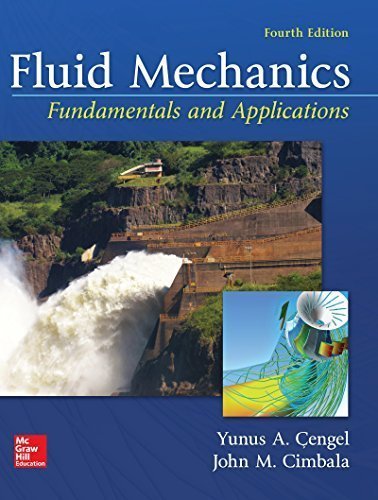
Fluid Mechanics: Fundamentals and Applications 4th Edition by Yunus Cengel, ISBN-13: 978-1259696534
Original price was: $50.00.$14.99Current price is: $14.99.
Safe & secure checkout
Description
Description
Fluid Mechanics: Fundamentals and Applications 4th Edition by Yunus Cengel, ISBN-13: 978-1259696534
[PDF eBook eTextbook] – Available Instantly
- Publisher: McGraw Hill; 4th edition (February 27, 2017)
- Language: English
- 1056 pages
- ISBN-10: 1259696537
- ISBN-13: 978-1259696534
Cengel and Cimbala’s Fluid Mechanics Fundamentals and Applications, communicates directly with tomorrow’s engineers in a simple yet precise manner, while covering the basic principles and equations of fluid mechanics in the context of numerous and diverse real-world engineering examples. The text helps students develop an intuitive understanding of fluid mechanics by emphasizing the physics, using figures, numerous photographs and visual aids to reinforce the physics. The highly visual approach enhances the learning of fluid mechanics by students. This text distinguishes itself from others by the way the material is presented – in a progressive order from simple to more difficult, building each chapter upon foundations laid down in previous chapters. In this way, even the traditionally challenging aspects of fluid mechanics can be learned effectively.
Table of Contents:
Cover
Title
Copyright
Brief Contents
Contents
Preface
CHAPTER ONE INTRODUCTION AND BASIC CONCEPTS
1–1 Introduction
What Is a Fluid?
Application Areas of Fluid Mechanics
1–2 A Brief History of Fluid Mechanics
1–3 The No-Slip Condition
1–4 Classification of Fluid Flows
Viscous versus Inviscid Regions of Flow
Internal versus External Flow
Compressible versus Incompressible Flow
Laminar versus Turbulent Flow
Natural (or Unforced) versus Forced Flow
Steady versus Unsteady Flow
One-, Two-, and Three-Dimensional Flows
Uniform versus Nonuniform Flow
1–5 System and Control Volume
1–6 Importance of Dimensions and Units
Some SI and English Units
Dimensional Homogeneity
Unity Conversion Ratios
1–7 Modeling in Engineering
1–8 Problem-Solving Technique
Step 1: Problem Statement
Step 2: Schematic
Step 3: Assumptions and Approximations
Step 4: Physical Laws
Step 5: Properties
Step 6: Calculations
Step 7: Reasoning, Verification, and Discussion
1–9 Engineering Software Packages
Equation Solvers
CFD Software
1–10 Accuracy, Precision, and Significant Digits
Application Spotlight: What Nuclear Blasts and Raindrops Have in Common
Summary
References and Suggested Reading
Problems
CHAPTER TWO PROPERTIES OF FLUIDS
2–1 Introduction
Continuum
2–2 Density and Specific Gravity
Density of Ideal Gases
2–3 Vapor Pressure and Cavitation
2–4 Energy and Specific Heats
2–5 Compressibility and Speed of Sound
Coefficient of Compressibility
Coefficient of Volume Expansion
Speed of Sound and Mach Number
2–6 Viscosity
2–7 Surface Tension and Capillary Effect
Capillary Effect
Summary
Application Spotlight: Cavitation
References and Suggested Reading
Problems
CHAPTER THREE PRESSURE AND FLUID STATICS
3–1 Pressure
Pressure at a Point
Variation of Pressure with Depth
3–2 Pressure Measurement Devices
The Barometer
The Manometer
Other Pressure Measurement Devices
3–3 Introduction to Fluid Statics
3–4 Hydrostatic Forces on Submerged Plane Surfaces
Special Case: Submerged Rectangular Plate
3–5 Hydrostatic Forces on Submerged Curved Surfaces
3–6 Buoyancy and Stability
Stability of Immersed and Floating Bodies
3–7 Fluids in Rigid-Body Motion
Special Case 1: Fluids at Rest
Special Case 2: Free Fall of a Fluid Body
Acceleration on a Straight Path
Rotation in a Cylindrical Container
Summary
References and Suggested Reading
Problems
CHAPTER FOUR FLUID KINEMATICS
4–1 Lagrangian and Eulerian Descriptions
Acceleration Field
Material Derivative
4–2 Flow Patterns and Flow Visualization
Streamlines and Streamtubes
Pathlines
Streaklines
Timelines
Refractive Flow Visualization Techniques
Surface Flow Visualization Techniques
4–3 Plots of Fluid Flow Data
Profile Plots
Vector Plots
Contour Plots
4–4 Other Kinematic Descriptions
Types of Motion or Deformation of Fluid Elements
4–5 Vorticity and Rotationality
Comparison of Two Circular Flows
4–6 The Reynolds Transport Theorem
Alternate Derivation of the Reynolds Transport Theorem
Relationship between Material Derivative and RTT
Summary
Application Spotlight: Fluidic Actuators
Application Spotlight: Smelling Food; the Human Airway
References and Suggested Reading
Problems
CHAPTER FIVE BERNOULLI AND ENERGY EQUATIONS
5–1 Introduction
Conservation of Mass
The Linear Momentum Equation
Conservation of Energy
5–2 Conservation of Mass
Mass and Volume Flow Rates
Conservation of Mass Principle
Moving or Deforming Control Volumes
Mass Balance for Steady-Flow Processes
Special Case: Incompressible Flow
5–3 Mechanical Energy and Efficiency
5–4 The Bernoulli Equation
Acceleration of a Fluid Particle
Derivation of the Bernoulli Equation
Force Balance across Streamlines
Unsteady, Compressible Flow
Static, Dynamic, and Stagnation Pressures
Limitations on the Use of the Bernoulli Equation
Hydraulic Grade Line (HGL) and Energy Grade Line (EGL)
Applications of the Bernoulli Equation
5–5 General Energy Equation
Energy Transfer by Heat, Q
Energy Transfer by Work, W
5–6 Energy Analysis of Steady Flows
Special Case: Incompressible Flow with No Mechanical Work Devices and Negligible Friction
Kinetic Energy Correction Factor, α
Summary
References and Suggested Reading
Problems
CHAPTER SIX MOMENTUM ANALYSIS OF FLOW SYSTEMS
6–1 Newton’s Laws
6–2 Choosing a Control Volume
6–3 Forces Acting on a Control Volume
6–4 The Linear Momentum Equation
Special Cases
Momentum-Flux Correction Factor, β
Steady Flow
Flow with No External Forces
6–5 Review of Rotational Motion and Angular Momentum
6–6 The Angular Momentum Equation
Special Cases
Flow with No External Moments
Radial-Flow Devices
Application Spotlight: Manta Ray Swimming
Summary
References and Suggested Reading
Problems
CHAPTER SEVEN DIMENSIONAL ANALYSIS AND MODELING
7–1 Dimensions and Units
7–2 Dimensional Homogeneity
Nondimensionalization of Equations
7–3 Dimensional Analysis and Similarity
7–4 The Method of Repeating Variables and the Buckingham Pi Theorem
Historical Spotlight: Persons Honored by Nondimensional Parameters
7–5 Experimental Testing, Modeling, and Incomplete Similarity
Setup of an Experiment and Correlation of Experimental Data
Incomplete Similarity
Wind Tunnel Testing
Flows with Free Surfaces
Application Spotlight: How a Fly Flies
Summary
References and Suggested Reading
Problems
CHAPTER EIGHT INTERNAL FLOW
8–1 Introduction
8–2 Laminar and Turbulent Flows
Reynolds Number
8–3 The Entrance Region
Entry Lengths
8–4 Laminar Flow in Pipes
Pressure Drop and Head Loss
Effect of Gravity on Velocity and Flow Rate in Laminar Flow
Laminar Flow in Noncircular Pipes
8–5 Turbulent Flow in Pipes
Turbulent Shear Stress
Turbulent Velocity Profile
The Moody Chart and Its Associated Equations
Types of Fluid Flow Problems
8–6 Minor Losses
8–7 Piping Networks and Pump Selection
Series and Parallel Pipes
Piping Systems with Pumps and Turbines
8–8 Flow Rate and Velocity Measurement
Pitot and Pitot-Static Probes
Obstruction Flowmeters: Orifice, Venturi, and Nozzle Meters
Positive Displacement Flowmeters
Turbine Flowmeters
Variable-Area Flowmeters (Rotameters)
Ultrasonic Flowmeters
Electromagnetic Flowmeters
Vortex Flowmeters
Thermal (Hot-Wire and Hot-Film) Anemometers
Laser Doppler Velocimetry
Particle Image Velocimetry
Introduction to Biofluid Mechanics
Application Spotlight: PIV Applied to Cardiac Flow
Application Spotlight: Multicolor Particle Shadow Velocimetry/Accelerometry
Summary
References and Suggested Reading
Problems
CHAPTER NINE DIFFERENTIAL ANALYSIS OF FLUID FLOW
9–1 Introduction
9–2 Conservation of Mass—The Continuity Equation
Derivation Using the Divergence Theorem
Derivation Using an Infinitesimal Control Volume
Alternative Form of the Continuity Equation
Continuity Equation in Cylindrical Coordinates
Special Cases of the Continuity Equation
9–3 The Stream Function
The Stream Function in Cartesian Coordinates
The Stream Function in Cylindrical Coordinates
The Compressible Stream Function
9–4 The Differential Linear Momentum Equation—Cauchy’s Equation
Derivation Using the Divergence Theorem
Derivation Using an Infinitesimal Control Volume
Alternative Form of Cauchy’s Equation
Derivation Using Newton’s Second Law
9–5 The Navier–Stokes Equation
Introduction
Newtonian versus Non-Newtonian Fluids
Derivation of the Navier–Stokes Equation for Incompressible, Isothermal Flow
Continuity and Navier–Stokes Equations in Cartesian Coordinates
Continuity and Navier–Stokes Equations in Cylindrical Coordinates
9–6 Differential Analysis of Fluid Flow Problems
Calculation of the Pressure Field for a Known Velocity Field
Exact Solutions of the Continuity and Navier–Stokes Equations
Differential Analysis of Biofluid Mechanics Flows
Summary
References and Suggested Reading
Application Spotlight: The No-Slip Boundary Condition
Problems
CHAPTER TEN APPROXIMATE SOLUTIONS OF THE NAVIER–STOKES EQUATION
10–1 Introduction
10–2 Nondimensionalized Equations of Motion
10–3 The Creeping Flow Approximation
Drag on a Sphere in Creeping Flow
10–4 Approximation for Inviscid Regions of Flow
Derivation of the Bernoulli Equation in Inviscid Regions of Flow
10–5 The Irrotational Flow Approximation
Continuity Equation
Momentum Equation
Derivation of the Bernoulli Equation in Irrotational Regions of Flow
Two-Dimensional Irrotational Regions of Flow
Superposition in Irrotational Regions of Flow
Elementary Planar Irrotational Flows
Irrotational Flows Formed by Superposition
10–6 The Boundary Layer Approximation
The Boundary Layer Equations
The Boundary Layer Procedure
Displacement Thickness
Momentum Thickness
Turbulent Flat Plate Boundary Layer
Boundary Layers with Pressure Gradients
The Momentum Integral Technique for Boundary Layers
Summary
References and Suggested Reading
Application Spotlight: Droplet Formation
Problems
CHAPTER ELEVEN EXTERNAL FLOW: DRAG AND LIFT
11–1 Introduction
11–2 Drag and Lift
11–3 Friction and Pressure Drag
Reducing Drag by Streamlining
Flow Separation
11–4 Drag Coefficients of Common Geometries
Biological Systems and Drag
Drag Coefficients of Vehicles
Superposition
11–5 Parallel Flow over Flat Plates
Friction Coefficient
11–6 Flow over Cylinders and Spheres
Effect of Surface Roughness
11–7 Lift
Finite-Span Wings and Induced Drag
Lift Generated by Spinning
Flying in Nature!
Summary
Application Spotlight: Drag Reduction
References and Suggested Reading
Problems
CHAPTER TWELVE COMPRESSIBLE FLOW
12–1 Stagnation Properties
12–2 One-Dimensional Isentropic Flow
Variation of Fluid Velocity with Flow Area
Property Relations for Isentropic Flow of Ideal Gases
12–3 Isentropic Flow through Nozzles
Converging Nozzles
Converging–Diverging Nozzles
12–4 Shock Waves and Expansion Waves
Normal Shocks
Oblique Shocks
Prandtl–Meyer Expansion Waves
12–5 Duct Flow with Heat Transfer and Negligible Friction (Rayleigh Flow)
Property Relations for Rayleigh Flow
Choked Rayleigh Flow
12–6 Adiabatic Duct Flow with Friction (Fanno Flow)
Property Relations for Fanno Flow
Choked Fanno Flow
Application Spotlight: Shock-Wave/Boundary-Layer Interactions
Summary
References and Suggested Reading
Problems
CHAPTER THIRTEEN OPEN-CHANNEL FLOW
13–1 Classification of Open-Channel Flows
Uniform and Varied Flows
Laminar and Turbulent Flows in Channels
13–2 Froude Number and Wave Speed
Speed of Surface Waves
13–3 Specific Energy
13–4 Conservation of Mass and Energy Equations
13–5 Uniform Flow in Channels
Critical Uniform Flow
Superposition Method for Nonuniform Perimeters
13–6 Best Hydraulic Cross Sections
Rectangular Channels
Trapezoidal Channels
13–7 Gradually Varied Flow
Liquid Surface Profiles in Open Channels, y(x)
Some Representative Surface Profiles
Numerical Solution of Surface Profile
13–8 Rapidly Varied Flow and the Hydraulic Jump
13–9 Flow Control and Measurement
Underflow Gates
Overflow Gates
Application Spotlight: Bridge Scour
Summary
References and Suggested Reading
Problems
CHAPTER FOURTEEN TURBOMACHINERY
14–1 Classifications and Terminology
14–2 Pumps
Pump Performance Curves and Matching a Pump to a Piping System
Pump Cavitation and Net Positive Suction Head
Pumps in Series and Parallel
Positive-Displacement Pumps
Dynamic Pumps
Centrifugal Pumps
Axial Pumps
14–3 Pump Scaling Laws
Dimensional Analysis
Pump Specific Speed
Affinity Laws
14–4 Turbines
Positive-Displacement Turbines
Dynamic Turbines
Impulse Turbines
Reaction Turbines
Gas and Steam Turbines
Wind Turbines
14–5 Turbine Scaling Laws
Dimensionless Turbine Parameters
Turbine Specific Speed
Application Spotlight: Rotary Fuel Atomizers
Summary
References and Suggested Reading
Problems
CHAPTER FIFTEEN INTRODUCTION TO COMPUTATIONAL FLUID DYNAMICS
15–1 Introduction and Fundamentals
Motivation
Equations of Motion
Solution Procedure
Additional Equations of Motion
Grid Generation and Grid Independence
Boundary Conditions
Practice Makes Perfect
15–2 Laminar CFD Calculations
Pipe Flow Entrance Region at Re = 500
Flow around a Circular Cylinder at Re = 150
15–3 Turbulent CFD Calculations
Flow around a Circular Cylinder at Re = 10,000
Flow around a Circular Cylinder at Re = 107
Design of the Stator for a Vane-Axial Flow Fan
15–4 CFD with Heat Transfer
Temperature Rise through a Cross-Flow Heat Exchanger
Cooling of an Array of Integrated Circuit Chips
15–5 Compressible Flow CFD Calculations
Compressible Flow through a Converging–Diverging Nozzle
Oblique Shocks over a Wedge
CFD Methods for Two-Phase Flows
15–6 Open-Channel Flow CFD Calculations
Flow over a Bump on the Bottom of a Channel
Flow through a Sluice Gate (Hydraulic Jump)
Summary
Application Spotlight: A Virtual Stomach
References and Suggested Reading
Problems
APPENDIX 1 PROPERTY TABLES AND CHARTS (SI UNITS)
TABLE A–1 Molar Mass, Gas Constant, and Ideal-Gas Specific Heats of Some Substances
TABLE A–2 Boiling and Freezing Point Properties
TABLE A–3 Properties of Saturated Water
TABLE A–4 Properties of Saturated Refrigerant-134a
TABLE A–5 Properties of Saturated Ammonia
TABLE A–6 Properties of Saturated Propane
TABLE A–7 Properties of Liquids
TABLE A–8 Properties of Liquid Metals
TABLE A–9 Properties of Air at 1 atm Pressure
TABLE A–10 Properties of Gases at 1 atm Pressure
TABLE A–11 Properties of the Atmosphere at High Altitude
FIGURE A–12 The Moody Chart for the Friction Factor for Fully Developed Flow in Circular Pipes
TABLE A–13 One-Dimensional Isentropic Compressible Flow Functions for an Ideal Gas with k = 1.4
TABLE A–14 One-Dimensional Normal Shock Functions for an Ideal Gas with k = 1.4
TABLE A–15 Rayleigh Flow Functions for an Ideal Gas with k = 1.4
TABLE A–16 Fanno Flow Functions for an Ideal Gas with k = 1.4
APPENDIX 2 PROPERTY TABLES AND CHARTS (ENGLISH UNITS)
TABLE A–1E Molar Mass, Gas Constant, and Ideal-Gas Specific Heats of Some Substances
TABLE A–2E Boiling and Freezing Point Properties
TABLE A–3E Properties of Saturated Water
TABLE A–4E Properties of Saturated Refrigerant-134a
TABLE A–5E Properties of Saturated Ammonia
TABLE A–6E Properties of Saturated Propane
TABLE A–7E Properties of Liquids
TABLE A–8E Properties of Liquid Metals
TABLE A–9E Properties of Air at 1 atm Pressure
TABLE A–10E Properties of Gases at 1 atm Pressure
TABLE A–11E Properties of the Atmosphere at High Altitude
Glossary
Index
Conversion Factors
Nomenclature
Yunus A. Çengel is Professor Emeritus of Mechanical Engineering at the University of Nevada, Reno. He received his B.S. in mechanical engineering from Istanbul Technical University and his M.S. and Ph.D. in mechanical engineering from North Carolina State University. His areas of interest are renewable energy, energy efficiency, energy policies, heat transfer enhancement, and engineering education. He served as the director of the Industrial Assessment Center (IAC) at the University of Nevada, Reno, from 1996 to 2000. He has led teams of engineering students to numerous manufacturing facilities in Northern Nevada and California to perform industrial assessments, and has prepared energy conservation, waste minimization, and productivity enhancement reports for them. He has also served as an advisor for various government organizations and corporations.
Dr. Çengel is the recipient of several outstanding teacher awards, and he has received the ASEE Meriam/Wiley Distinguished Author Award for excellence in authorship in 1992 and again in 2000. Dr. Çengel is a registered Professional Engineer in the State of Nevada, and is a member of the American Society of Mechanical Engineers (ASME) and the American Society for Engineering Education (ASEE).
John M. Cimbala is Professor of Mechanical Engineering at The Pennsylvania State University (Penn State), University Park, PA. He received his B.S. in Aerospace Engineering from Penn State and his M.S. in Aeronautics from the California Institute of Technology (CalTech). He received his Ph.D. in Aeronautics from CalTech in 1984. His research areas include experimental and computational fluid mechanics and heat transfer, turbulence, turbulence modeling, turbomachinery, indoor air quality, and air pollution control. More information can be found at www.mne.psu.edu/cimbala.
Professor Cimbala is the recipient of several outstanding teaching awards and views his book writing as an extension of his love of teaching. He is a member and Fellow of the American Society of Mechanical Engineers (ASME). He is also a member of the American Society for Engineering Education (ASEE), and the American Physical Society (APS).
What makes us different?
• Instant Download
• Always Competitive Pricing
• 100% Privacy
• FREE Sample Available
• 24-7 LIVE Customer Support




Reviews
There are no reviews yet.