

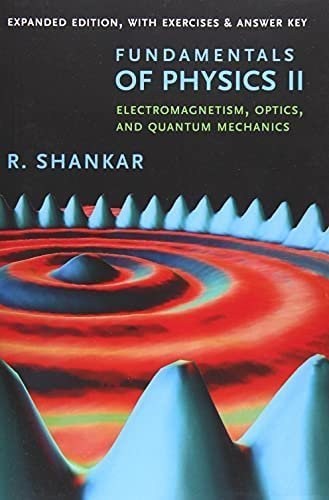
Fundamentals of Physics II: Electromagnetism, Optics, and Quantum Mechanics by R. Shankar, ISBN-13: 978-0300243789
Original price was: $50.00.$14.99Current price is: $14.99.
Safe & secure checkout
Description
Description
Fundamentals of Physics II: Electromagnetism, Optics, and Quantum Mechanics by R. Shankar, ISBN-13: 978-0300243789
[PDF eBook eTextbook]
- Publisher: Yale University Press; Expanded edition (May 19, 2020)
- Language: English
- 680 pages
- ISBN-10: 0300243782
- ISBN-13: 978-0300243789
A beloved introductory physics textbook, now including exercises and an answer key, accessibly explains electromagnetism, optics, and quantum mechanics.
R. Shankar is a well‑known physicist and contagiously enthusiastic educator, whose popular online introductory-physics video lectures have been viewed over a million times. In this second book based on his online courses, Shankar explains electromagnetism, optics, and quantum mechanics, developing the basics and reinforcing the fundamentals. With the help of problem sets and answer keys, students learn about the most interesting findings of today’s research while gaining a firm foundation in the principles and methods of physics.
Table of Contents:
Preface
1. Electrostatics I
1.1. Review of F = ma
1.2. Enter electricity
1.3. Coulomb’s law
1.4. Properties of charge
1.4.1. Superposition principle
1.5. Verifying Coulomb’s law
1.6. The ratio of gravitational to electric forces
1.7. Coulomb’s law for continuous charge density
2. The Electric Field
2.1. Review of key ideas
2.2. Digression on nuclear forces
2.3. The electric field E
2.4. Visualizing the field
2.5. Field of a dipole
2.5.1. Far field of dipole: general case
2.6. Response to a field
2.6.1. Dipole in a uniform field
3. Gauss’s Law I
3.1. Field of an infinite line charge
3.2. Field of an infinite sheet of charge
3.3. Spherical charge distribution: Gauss’s law
3.4. Digression on the area vector dA
3.4.1. Composition of areas
3.4.2. An application of the area vector
3.5. Gauss’s law through pictures
3.5.1. Continuous charge density
4. Gauss’s Law II: Applications
4.1. Applications of Gauss’s law
4.2. Field inside a shell
4.3. Field of an infinite charged wire, redux
4.4. Field of an infinite plane, redux
4.5. Conductors
4.5.1. Field inside a perfect conductor is zero
4.5.2. The net charge on a conductor will reside at the surface
4.5.3. A conductor with a hole inside
4.5.4. Field on the surface of a conductor
5. The Coulomb Potential
5.1. Conservative forces and potential energy
5.2. Is the electrostatic field conservative?
5.3. Path independence through pictures
5.4. Potential and field of a dipole
6. Conductors and Capacitors
6.1. Cases where computing V from E is easier
6.2. Visualizing V
6.3. Equipotentials
6.4. Method of images
6.4.1. Proof of uniqueness (optional section)
6.4.2. Additional properties of the potential V(r)
6.5. Capacitors
6.6. Energy stored in a capacitor
6.7. Energy of a charge distribution
7. Circuits and Currents
7.1. Energy in the electric field
7.2. Circuits and conductivity
7.3. Circuits
7.4. The battery and the EMF
7.5. The RC circuit with a battery
7.6. Miscellaneous circuits
8. Magnetism I
8.1. Experiments pointing to magnetism
8.2. Examples of the Lorentz force, the cyclotron
8.3. Lorentz force on current-carrying wires
8.4. The magnetic dipole
8.5. The DC motor
9. Magnetism II: Biot-Savart Law
9.1. Practice with Biot-Savart: field of a loop
9.2. Microscopic description of a bar magnet
9.3. Magnetic field of an infinite wire
9.4. Ampère’s law
9.5. Maxwell’s equations (static case)
10. Ampère II, Faraday, and Lenz
10.1. Field of an infinite wire, redux
10.2. Field of a solenoid
10.3. Faraday and Lenz
10.4. Optional digression on Faraday’s law
11. More Faraday
11.1. Betatron
11.2. Generators
11.3. Inductance
11.4. Mutual inductance
11.5. Self-inductance
11.6. Energy in the magnetic field
12. AC Circuits
12.1. Review of inductors
12.2. The LC circuit
12.2.1. Driven LC circuit
12.3. The LCR circuit
12.3.1. Review of complex numbers
12.3.2. Solving the LCR equation
12.3.3. Visualizing Z
12.4. Complex form of Ohm’s law
13. LCR Circuits and Displacement Current
13.1. Analysis of LCR results
13.1.1. Transients and the complementary solution
13.2. Power of the complex numbers
13.3. Displacement current
14. Electromagnetic Waves
14.1. The wave equation
14.2. Restricted Maxwell equations in vacuum
14.2.1. Maxwell equations involving infinitesimal cubes
14.2.2. Maxwell equations involving infinitesimal loops
14.3. The wave!
14.4. Sinusoidal solution to the wave equation
14.5. Energy in the electromagnetic wave
14.6. Origin of electromagnetic waves
14.7. Maxwell equations—the general case (optional)
14.7.1. Maxwell equations involving infinitesimal cubes
14.7.2. Maxwell equations involving infinitesimal loops
14.7.3. Consequences for the restricted E and B
14.8. From microscopic to macroscopic (optional)
14.8.1. Maxwell equations involving cubes
14.8.2. Maxwell equations involving loops
15. Electromagnetism and Relativity
15.1. Magnetism from Coulomb’s law and relativity
15.2. Relativistic invariance of electrodynamics
15.3. Review of Lorentz transformations
15.3.1. Implications for Newtonian mechanics
15.4. Scalar and vector fields
15.5. The derivative operator
15.6. Lorentz scalars and vectors
15.7. The four-current J
15.7.1. Charge conservation and the four-current J
15.8. The four-potential A
15.8.1. Gauge invariance
15.9. Wave equation for the four-vector A
15.9.1. Why work with V and A?
15.10. The electromagnetic tensor
15.10.1. Tensors
15.10.2. The electromagnetic field tensor
16. Optics I: Geometric Optics Revisited
16.1. Geometric or ray optics
16.2. Brief history of c
16.3. Some highlights of geometric optics
16.4. The law of reflection from Fermat’s principle
16.5. Snell’s law from Fermat’s principle
16.6. Reflection off a curved surface by Fermat
16.7. Elliptical mirrors and Fermat’s principle
16.8. Parabolic mirrors
17. Optics II: More Mirrors and Lenses
17.1. Spherical approximations to parabolic mirrors
17.2. Image formation: geometric optics
17.2.1. A midlife crisis
17.3. Image formation by Fermat’s principle
17.4. Tricky cases
17.4.1. Fermat’s principle for virtual focal points
17.4.2. Ray optics for virtual images
17.5. Lenses à la Fermat
17.6. Principle of least action
17.7. The eye
18. Wave Theory of Light
18.1. Interference of waves
18.2. Adding waves using real numbers
18.3. Adding waves with complex numbers
18.4. Analysis of interference
18.5. Diffraction grating
18.6. Single-slit diffraction
18.7. Understanding reflection and crystal diffraction
18.8. Light incident on an oil slick
18.8.1. Normal incidence
18.8.2. Oblique incidence
19. Quantum Mechanics: The Main Experiment
19.1. Double-slit experiment with light
19.2. Trouble with Maxwell
19.3. Digression on photons
19.3.1. Photoelectric effect
19.3.2. Compton effect
19.4. Matter waves
19.5. Photons versus electrons
19.6. The Heisenberg uncertainty principle
19.6.1. There are no states of well-defined position and momentum
19.6.2. Heisenberg microscope
19.7. Let there be light
19.8. The wave function ψ
19.9. Collapse of the wave function
19.10. Summary
20. The Wave Function and Its Interpretation
20.1. Probability in classical and quantum mechanics
20.2. Getting to know ψ
20.3. Statistical concepts: mean and uncertainty
21. Quantization and Measurement
21.1. More on momentum states
21.2. Single-valuedness and quantization of momentum
21.2.1. Quantization
21.2.2. The integral of ψp(x)
21.3. Measurement postulate: momentum
21.3.1. An example solvable by inspection
21.3.2. Using a normalized ψ
21.4. Finding A(p) by computation
21.5. More on Fourier’s theorems
21.6. Measurement postulate: general
21.7. More than one variable
22. States of Definite Energy
22.1. Free particle on a ring
22.1.1. Analysis of energy levels: degeneracy
22.2. Thinking inside the box
22.2.1. Particle in a well
22.2.2. The box: an exact solution
22.3. Energy measurement in the box
23. Scattering and Dynamics
23.1. Quantum scattering
23.1.1. Scattering for E > V0
23.1.2. Scattering for E < V0
23.2. Tunneling
23.3. Quantum dynamics
23.3.1. A solution of the time-dependent Schrödinger equation
23.3.2. Derivation of the particular solution ψE(x, t)
23.4. Special properties of the product solution
23.5. General solution for time evolution
23.5.1. Time evolution: a more complicated example
24. Summary and Outlook
24.1. Postulates: first pass
24.2. Refining the postulates
24.2.1. Toward a compact set of postulates
24.2.2. Eigenvalue problem
24.2.3. The Dirac delta function and the operator X
24.3. Postulates: final
24.4. Many particles, bosons, and fermions
24.4.1. Identical versus indistinguishable
24.4.2. Implications for atomic structure
24.5. Energy-time uncertainty principle
24.6. What next?
Constants
Index
R. Shankar is Josiah Willard Gibbs Professor of Physics, Yale University. He is winner of the American Physical Society’s Lilienfeld Prize and author of five textbooks, including Principles of Quantum Mechanics, Basic Training in Mathematics, and Quantum Field Theory and Condensed Matter Physics.
What makes us different?
• Instant Download
• Always Competitive Pricing
• 100% Privacy
• FREE Sample Available
• 24-7 LIVE Customer Support


Reviews
There are no reviews yet.