

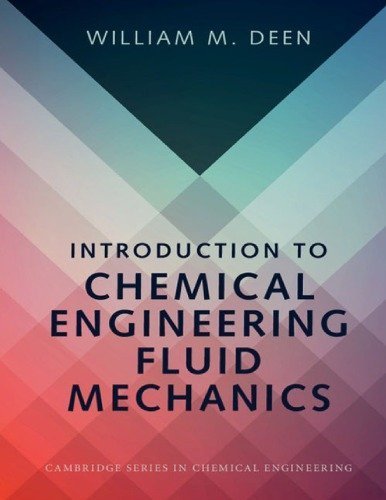
Introduction to Chemical Engineering Fluid Mechanics 1st Edition by William M. Deen, ISBN-13: 978-1107123779
Original price was: $50.00.$14.99Current price is: $14.99.
Safe & secure checkout
Description
Description
Introduction to Chemical Engineering Fluid Mechanics 1st Edition by William M. Deen, ISBN-13: 978-1107123779
[PDF eBook eTextbook]
- Publisher: Cambridge University Press; 1st edition (August 15, 2016)
- Language: English
- 411 pages
- ISBN-10: 1107123771
- ISBN-13: 978-1107123779
Presents the fundamentals of chemical engineering fluid mechanics with an emphasis on valid and practical approximations in modeling.
Designed for introductory undergraduate courses in fluid mechanics for chemical engineers, this stand-alone textbook illustrates the fundamental concepts and analytical strategies in a rigorous and systematic, yet mathematically accessible manner. Using both traditional and novel applications, it examines key topics such as viscous stresses, surface tension, and the microscopic analysis of incompressible flows which enables students to understand what is important physically in a novel situation and how to use such insights in modeling. The many modern worked examples and end-of-chapter problems provide calculation practice, build confidence in analyzing physical systems, and help develop engineering judgment. The book also features a self-contained summary of the mathematics needed to understand vectors and tensors, and explains solution methods for partial differential equations. Including a full solutions manual for instructors available at www.cambridge.org/deen, this balanced textbook is the ideal resource for a one-semester course.
Table of Contents:
Preface
List of symbols
Part I Use of experimental data
1 Properties, dimensions, and scales
1.1 Introduction
1.2 Fluid properties
Viscosity
Density and kinematic viscosity
Units and values
Non-Newtonian liquids
Surface tension
Continuum approximation
1.3 Scales and dimensionless groups
Scales
Dimensions
Stress scales
Dimensionless groups
Example 1.3-1 Deep-water waves
Example 1.3-2 Inkjet printing
1.4 Dimensional analysis
Pi theorem
Example 1.4-1 Speed of water waves
Example 1.4-2 Shear stress in pipe flow
Example 1.4-3 Energy of an atomic blast
Dynamic similarity
1.5 Conclusion
References
Problems
1.1 Falling body
1.2 Pendulum
1.3 Salad dressing
1.4 Heat transfer coefficient
1.5 Oscillating drops
1.6 Dip coating
1.7 Breakup of liquid jets
1.8 Valve scale-up
1.9 Ship scale-up
1.10 Power input in a stirred tank
1.11 Underwater swimming
2 Pipe flow
2.1 Introduction
2.2 Shear stress
Fundamental quantities
Friction factor
2.3 Pressure drop and dynamic pressure
Friction factor and pressure drop
Circuit analogy
Example 2.3-1 Pressure drop for water in process pipes
Example 2.3-2 Pressure drop in an oil pipeline
Example 2.3-3 Flow rate in an oil pipeline
Example 2.3-4 Capillary viscometer
2.4 Noncircular cross-sections
Turbulent flow
Laminar flow
Example 2.4-1 Pressure drop for air in a triangular duct
Example 2.4-2 Material efficiency of square and circular
ducts
2.5 Wall roughness
Example 2.5-1 Effect of roughness on water flow in a
process pipe
Example 2.5-2 Practical smoothness
2.6 Conclusion
References
Problems
2.1 Cavitation
2.2 Bottling honey
2.3 Filling a boiler
2.4 Syringe pump
2.5 Flue gases
2.6 Hydraulic fracturing
2.7 Drag reduction
2.8 Economic pipe diameter
2.9 Microfluidic device
2.10 Murray’s law
2.11 Open-channel flow
3 Drag, particles, and porous media
3.1 Introduction
3.2 Drag
Origins
Drag coefficient
Spheres
Disks
Cylinders
Flat plates
Example 3.2-1 Drag on a cylinder in water
Example 3.2-2 Comparative drag on a cylinder and a flat
plate
3.3 Terminal velocity
Buoyancy and gravity
Terminal velocities for solid spheres
Example 3.3-1 Sand grain falling in air
Example 3.3-2 Microfluidic cell separation
Terminal velocities for fluid spheres
Approach to terminal velocity
Example 3.3-3 Approach to terminal velocity for large
spheres
3.4 Porous media
Darcy permeability
Microstructural models
Example 3.4-1 Air flow through a packed bed of spheres
Example 3.4-2 Comparative properties of granular and
fibrous media
3.5 Packed beds and fluidized beds
Packed beds
Fluidized beds
Example 3.5-1 Fluidization at low Reynolds number
3.6 Conclusion
References
Problems
3.1 Chain-link fence
3.2 Rowing power
3.3 Dispersion of pollen
3.4 Downhill ski racing
3.5 Homogenized milk
3.6 Approach to terminal velocity for small fluid spheres
3.7 Inhaled particles
3.8 Flocculation
3.9 Hydrogel disks
3.10 Bypassing a packed bed
3.11 Fluidization at high Reynolds number
Part II Fundamentals of fluid dynamics
4 Fluid statics: pressure, gravity, and surface tension
4.1 Introduction
4.2 Pressure in static fluids
Properties of pressure
Static pressure equation
Pressure distributions
Example 4.2-1 Manometer
Example 4.2-2 Layered fluids
Additional note: Pascal’s law
4.3 Pressure forces
Stress and force vectors
Boundaries
Example 4.3-1 Rectangular tank
Example 4.3-2 Inclined planar surface
Projected areas
Immersed objects at constant pressure
Buoyancy
Example 4.3-3 Buoyancy of a sphere
4.4 Surface tension
Tensile forces and contact lines
Example 4.4-1 Young–Laplace equation
Example 4.4-2 Capillary rise
Interfaces with variable curvature
4.5 Conclusion
References
Problems
4.1 Manometry for liquid pipe flow
4.2 Hydraulic lift
4.3 Static pressure variations in air
4.4 Force on Hoover Dam
4.5 Floating cup
4.6 Sedimentation in a sucrose gradient
4.7 Half-submerged cylinder
4.8 Buoyancy of a cone
4.9 Formation of small bubbles
4.10 Capillary adhesion
4.11 Capillary flotation
4.12 Plateau–Rayleigh instability
5 Fluid kinematics
5.1 Introduction
5.2 Continuity
Example 5.2-1 Unknown velocity component
Example 5.2-2 Expansion of the Universe
Example 5.2-3 Filtration in a hollow fiber
5.3 Rates of change for moving observers
Example 5.3-1 Temperature changes sensed by a weather
balloon
5.4 Rate of strain
Example 5.4-1 Rate of strain in simple shear flow
Example 5.4-2 Rate of strain in pure dilatation
5.5 Vorticity
Definition
Irrotational flow
5.6 Stream function
Definitions
Streamlines and streaklines
Example 5.6-1 Streamlines from the stream function
Trajectories
Example 5.6-2 Streamlines from trajectories
5.7 Conclusion
References
Problems
5.1 Flow past a bubble
5.2 Channel with wavy walls
5.3 Condensation on a vertical wall
5.4 Flow past a solid sphere
5.5 Wedge flow
5.6 Flow between porous and solid disks
5.7 Trajectories of sedimenting particles
6 Stress and momentum
6.1 Introduction
6.2 Stress vector and stress tensor
Stress notation
Stress at an arbitrary surface
6.3 Force at a point
6.4 Conservation of momentum
Additional note: stress equilibrium
6.5 Viscous stress
Rate-of-strain tensor
Example 6.5-1 Rate of strain in simple shear flow
Newtonian fluids
Non-Newtonian fluids
Additional note: stress symmetry
6.6 Governing equations
Newtonian fluids with constant properties
Example 6.6-1 Pressure in planar stagnation flow
Fluids with varying viscosity
Velocities at phase boundaries
Stresses at phase boundaries
Example 6.6-2 Shear-stress boundary condition with variable
surface tension
Force calculations
Example 6.6-3 General expression for the drag on a sphere
6.7 Conclusion
References
Problems
6.1 Stress vector and tensor
6.2 Effect of surface orientation on the stress vector
6.3 Force balance for plane Couette flow
6.4 Force balance for plane Poiseuille flow
6.5 Normal viscous stress at a solid surface
6.6 Drag on a cylinder at high Reynolds number
6.7 Pressure for creeping flow past a solid sphere
6.8 Pressure between porous and solid disks
Part III Microscopic analysis
7 Unidirectional flow
7.1 Introduction
7.2 Fully developed flow
Example 7.2-1 Velocity and pressure for plane Poiseuille
flow
Example 7.2-2 Velocity and pressure for Poiseuille flow
Example 7.2-3 Friction factor for laminar tube flow
7.3 Moving surfaces
Example 7.3-1 Plane Couette flow
Example 7.3-2 Rotating rod
Example 7.3-3 Plate suddenly set in motion
7.4 Free surfaces
Example 7.4-1 Falling film on a vertical wall
Example 7.4-2 Surface of a stirred liquid
7.5 Non-Newtonian fluids
Example 7.5-1 Poiseuille flow of a power-law fluid
Example 7.5-2 Plane Couette flow of generalized Newtonian
fluids
7.6 Symmetry conditions
Cylindrical symmetry
Reflective symmetry
7.7 Conclusion
References
Problems
7.1 Couette viscometer
7.2 Annular conduit
7.3 Triangular conduit
7.4 Elliptical conduit
7.5 Slip in tube flow
7.6 Darcy permeability of a fibrous material
7.7 Surface of a liquid in rigid-body rotation
7.8 Layered liquids on an inclined surface
7.9 Liquid film outside a vertical tube
7.10 Film on an upward-moving surface
7.11 Slot coating
7.12 Flow in a cavity
7.13 Falling-cylinder viscometer
7.14 Bubble rising in a tube
7.15 Paint film
7.16 Temperature-dependent viscosity
7.17 Blood rheology
8 Approximations for viscous flows
8.1 Introduction
8.2 Lubrication approximation
Example 8.2-1 Tapered channel
Example 8.2-2 Permeable tube
Example 8.2-3 Slider bearing
8.3 Creeping flow
Stokes’ equation
Example 8.3-1 Flow between porous and solid disks
Example 8.3-2 Flow past a sphere
Example 8.3-3 Stokes’ law
Porous media
8.4 Pseudosteady flow
Example 8.4-1 Parallel-plate channel with a decaying
pressure drop
Example 8.4-2 Squeeze flow
8.5 Anticipating approximations
Order-of-magnitude estimation
Example 8.5-1 Order-of-magnitude analysis for a tapered
channel
Example 8.5-2 Order-of-magnitude analysis for Stokes flow
past a sphere
Lubrication approximation
Creeping-flow approximation
Pseudosteady approximation
Example 8.5-3 Order-of-magnitude analysis for squeeze
flow
Example 8.5-4 Force on a slider bearing
8.6 Conclusion
References
Problems
8.1 Imperfect parallel-plate channel
8.2 Permeable closed-end tube
8.3 Permeation-driven flow in a microchannel
8.4 Candy manufacturing
8.5 Blade coating
8.6 Torque on a rotating sphere
8.7 Velocity and pressure for flow past a bubble
8.8 Terminal velocity of a small bubble
8.9 Rotating and stationary disks
8.10 Cone-and-plate viscometer
8.11 Growing mercury drop
8.12 Drag on a cylinder at low Reynolds number
8.13 Darcy flow in a tumor
8.14 Washburn’s law
8.15 Injection molding
8.16 Capillary pump
9 Laminar flow with inertia
9.1 Introduction
9.2 Inviscid and irrotational flow
Inviscid flow
Vorticity transport
Irrotational flow
Example 9.2-1 Velocity for potential flow past a cylinder
Example 9.2-2 Pressure and drag for inviscid and irrotational
flow past a cylinder
Example 9.2-3 Water waves
9.3 Boundary layers: differential analysis
Boundary-layer approximation
Joining the regions
Example 9.3-1 Blasius
Internal boundary layers
Example 9.3-2 Planar jet
9.4 Boundary layers: integral analysis
Integral momentum equation
Example 9.4-1 Integral solution for a flat plate
Boundary-layer separation
Example 9.4-2 Integral solution for a cylinder
9.5 Conclusion
References
Problems
9.1 Potential flow past a sphere
9.2 Lift on a half-cylinder
9.3 Axisymmetric stagnation flow
9.4 Opposed circular jets
9.5 Added mass for a sphere
9.6 Spin coating
9.7 Bubble growing in a liquid
9.8 Entrance length
9.9 Axisymmetric jet
9.10 Boundary layers in power-law fluids
9.11 Normal velocity component for a flat plate
9.12 Rotating disk
9.13 Flat plate with suction
9.14 Terminal velocity of a large bubble
9.15 Planar stagnation flow
9.16 Flow past a right-angle wedge
10 Turbulent flow
10.1 Introduction
10.2 Characteristics and scales
Basic features
Wall variables
Kolmogorov scales
Example 10.2-1 Turbulence scales for air flow in a pipe
10.3 Reynolds averaging
Time-smoothed variables
Continuity equation
Navier–Stokes equation
Closure problem
Reynolds stress
10.4 Closure schemes
Eddy diffusivities
Other approaches
10.5 Unidirectional flow
Example 10.5-1 Velocity profile near a wall
Complete velocity profile for tube flow
Example 10.5-2 Prandtl–Kármán equation
10.6 Boundary layers
Example 10.6-1 Flat plate
Example 10.6-2 Axisymmetric jet
Limitations of mixing-length concept
10.7 Conclusion
References
Problems
10.1 Turbulence scales for water flow in a pipe
10.2 Cell damage in turbulent flow
10.3 Jet velocity from a photograph
10.4 Reynolds-stress data
10.5 Eddy diffusivity from near-wall velocity data
10.6 Mixing length in tube flow
10.7 Power-law velocity profile and Blasius friction factor
10.8 Improved velocity profile for tube flow
10.9 Friction factor and hydraulic diameter
10.10 Effects of tube roughness
10.11 Planar jet
10.12 Eddy diffusivity in a circular jet
Part IV Macroscopic analysis
11 Macroscopic balances for mass, momentum, and energy
11.1 Introduction
11.2 Conservation of mass
General control volume
Discrete openings
Example 11.2-1 Fluid displacement from a cavity
Example 11.2-2 Draining of a tank through a horizontal pipe
Integration of the continuity equation
11.3 Conservation of momentum
General control volume
Discrete openings
Example 11.3-1 Force on a return bend
Example 11.3-2 Acceleration of a force-free rocket
11.4 Mechanical energy balances
General control volume
Discrete openings
Example 11.4-1 Viscous loss in pipe flow
Example 11.4-2 Venturi flow meter
Example 11.4-3 Hydroelectric power
Additional note: mechanical energy derivations
11.5 Systems with free surfaces
Example 11.5-1 Capillary jet
Example 11.5-2 Hydraulic jump
Example 11.5-3 Liquid jet striking an inclined plate
11.6 Conclusion
References
Problems
11.1 Torricelli’s law
11.2 Water clock
11.3 Forces on nozzles
11.4 Drag on a flat plate calculated from the wake velocity
11.5 Drag on a cylinder calculated from the wake velocity
11.6 Jet ejector
11.7 Wave tank
11.8 Force in a syringe pump
11.9 Plate suspended by a water jet
11.10 Viscous losses in laminar pipe flow
11.11 Hydroelectric power
11.12 Pitot tube
11.13 Siphon
11.14 Sump pump
11.15 Drainage pipe
12 Pipe flow: entrance effects, fittings, and compressibility
12.1 Introduction
12.2 Entrance effects
Entrance length
Excess pressure drop in entrance regions
Example 12.2-1 Entrance correction for a process pipe
Example 12.2-2 Entrance correction for a capillary
viscometer
12.3 Fittings, valves, and pumps
Loss coefficients
Pump characteristics
Example 12.3-1 Force on a return bend (revisited)
Example 12.3-2 Borda–Carnot equation
Example 12.3-3 Pressure increase at a diverging branch
Example 12.3-4 Draining of one tank into another
Additional note: pseudosteady approximation for tank filling
or emptying
12.4 Compressible flow in long pipes
Engineering Bernoulli equation for variable density
Isothermal pipe flow
Example 12.4-1 Natural-gas pipeline
12.5 Compressible flow near the speed of sound
Adiabatic pipe flow
Choked flow
Example 12.5-1 Absence of choking in a natural-gas
pipeline
Example 12.5-2 Choked air flow
Varying cross-section: nozzles and diffusers
Example 12.5-3 Converging nozzle
12.6 Conclusion
References
Problems
12.1 Entrance effects with air flow
12.2 Entrance-region model
12.3 Nozzle with diffuser
12.4 Water siphon
12.5 Pumping from a lower to a higher reservoir
12.6 Water transfer from a higher to a lower reservoir
12.7 Home plumbing
12.8 Membrane hydraulic permeability
12.9 Design of distribution manifolds
12.10 Tubular reactors in parallel
12.11 Pumping between tanks
12.12 Pumps in series or parallel
12.13 Conical diffuser
12.14 Balloon inflation
12.15 Discharge of a compressed-air tank
12.16 Automobile tire inflation
12.17 Comparison of isothermal and adiabatic pipe flow
12.18 Gas-cylinder hazard
12.19 Speed of sound
12.20 Transonic flow
Appendix. Vectors, tensors, and coordinate systems
A.1 Introduction
A.2 Notation and fundamentals
Representation of vectors and tensors
Basic operations
Coordinate independence
A.3 Vector and tensor products
Vector dot product
Vector cross product
Dyadic product
Tensor products
Identity tensor
Example A.3-1 Repeated dot products of a vector with an
antisymmetric tensor
Example A.3-2 Scalar triple products
A.4 Differential and integral identities
Gradient
Divergence
Curl
Laplacian
Differential identities
Example A.4-1 Proof of a differential identity
Example A.4-2 Proof of a differential identity
Example A.4-3 Proof of a differential identity
Example A.4-4 Proof of a differential identity
Integral transformations
Unit normal and unit tangent vectors
Example A.4-5 Integration of a unit normal over a surface
A.5 Orthogonal curvilinear coordinates
Base vectors
Position vectors and scale factors
Volumes and surface areas
Gradient
Scale-factor identities
Divergence
Curl
Laplacian
Cartesian coordinates
Cylindrical coordinates
Spherical coordinates
References
Author index
Subject index
William M. Deen is the Carbon P. Dubbs Professor Emeritus in the Department of Chemical Engineering at Massachusetts Institute of Technology (MIT). He is an author of some 200 research publications in bioengineering, colloid science, membrane science, quantitative physiology, and toxicology, most involving aspects of diffusion or fluid flow. During his 40 years of teaching at MIT, he has focused on undergraduate and graduate fluid mechanics, heat transfer, and mass transfer. He is the author of Analysis of Transport Phenomena (2012), which is used internationally in graduate-level transport courses. Among his awards are the 2012 Bose Award for Excellence in Teaching from the MIT School of Engineering and the 2012 Warren K. Lewis Award for Contributions to Chemical Engineering Education from the American Institute of Chemical Engineers.
What makes us different?
• Instant Download
• Always Competitive Pricing
• 100% Privacy
• FREE Sample Available
• 24-7 LIVE Customer Support




Reviews
There are no reviews yet.