

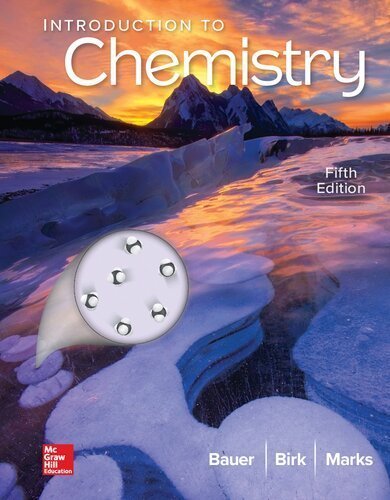
Introduction to Chemistry 5th Edition by Rich Bauer, ISBN-13: 978-1259911149
Original price was: $50.00.$14.99Current price is: $14.99.
Safe & secure checkout
Description
Description
Introduction to Chemistry 5th Edition by Rich Bauer, ISBN-13: 978-1259911149
[PDF eBook eTextbook] – Available Instantly
- Publisher: McGraw Hill; 5th edition (January 3, 2018)
- Language: English
- 832 pages
- ISBN-10: 1259911144
- ISBN-13: 978-1259911149
Introduction to Chemistry, Fifth edition takes a conceptual approach to introductory chemistry. Chapters open with a scenario involving real-life students to connect abstract chemical concepts to students’ lives. Math is introduced on a need-to-know basis. This conceptual approach first teaches the chemistry and then shows students how to use the math with the chemistry. We recognize how important it is for students to apply chemistry to their world and have added or expanded applications – especially medical- and environment-related applications – throughout the text, marginal notes, worked examples, and end-of-chapter problems.
• Consider This features offer conceptual-in-nature questions at the end of worked examples. These questions prompt students to extend their understanding beyond the focus of the worked examples.
• Key Concepts replace end-of-chapter summaries. Presented in outline form, they guide student discovery of the most important ideas discussed in each chapter.
• Concept Review multiple-choice questions have been added to end-of-chapter questions and problems. Because most students in an introductory chemistry course will take multiple-choice exams, these questions provide them with an outstanding practice opportunity. The conceptual nature of these questions helps students develop deeper understanding and critical thinking skills. After each question, a follow-up question provides additional practice with the analysis of multiple-choice responses.
• Four new elements have been named in the Revised Periodic Table: nihonium (Nh, element 113), moscovium (Mc, 115), tennessine (Ts, 117), and oganesson (Og, 118).
• The Art Program is considered the best in the market. To help students connect verbal descriptions to molecular-level representations, the program uses symbols and zoomed-in art to show critical phenomena at a molecular level.
• The problem-solving approach is supported by worked Example Boxes. Problem solving in chemistry is much more than algorithmic number crunching. It involves applying principles to solve problems. Conceptual problems require students to apply their understanding of concepts instead of just an algorithm. This text emphasizes underlying concepts when discussing numerical problems within in-chapter worked examples as well as end-of-chapter problems.
The best approach to incorporating math involves development of associated math on an as-needed basis, with an emphasis on concepts that the problems are trying to illustrate. This text integrates need-to-know mathematical ideas that are important to chemists into conceptual discussions.
• Math Toolboxes have been reworked and expanded, and now include accompanying end-of-chapter problems.
• Toolbox Icons in the text margins point students to the appropriate review material.
• The math reviews provided in the end-of-chapter Math Toolboxes are referenced within appropriate sections of the text.
Table of Contents:
Cover
Title Page
Copyright Information
Dedication
About the Authors
Brief Contents
Contents
Preface
Features of this Text
Detailed List of Changes
Connect
Instructor and Student Resources
Acknowledgments
Chapter 1: Matter and Energy
1.1 Matter and Its Classification
1.2 Physical and Chemical Changes and Properties of Matter
1.3 Energy and Energy Changes
1.4 Scientific Inquiry
Math Toolbox 1.1: Scientific Notation
Math Toolbox 1.2: Significant Figures
Math Toolbox 1.3: Units and Conversions
Chapter Review
Questions and Problems
Chapter 2: Atoms, Ions, and the Periodic Table
2.1 Dalton’s Atomic Theory
2.2 Structure of the Atom
2.3 Ions
2.4 Atomic Mass
2.5 The Periodic Table
Chapter Review
Questions and Problems
Chapter 3: Chemical Compounds
3.1 Ionic and Molecular Compounds
3.2 Monatomic and Polyatomic Ions
3.3 Formulas for Ionic Compounds
3.4 Naming Ionic Compounds
3.5 Naming and Writing Formulas for Molecular Compounds
3.6 Acids and Bases
3.7 Predicting Properties and Naming Compounds
Chapter Review
Questions and Problems
Chapter 4: Chemical Composition
4.1 Percent Composition
4.2 Mole Quantities
4.3 Determining Empirical and Molecular Formulas
4.4 Chemical Composition of Solutions
Math Toolbox 4.1: Mole Conversions
Chapter Review
Questions and Problems
Chapter 5: Chemical Reactions and Equations
5.1 What Is a Chemical Reaction?
5.2 How Do We Know a Chemical Reaction Occurs?
5.3 Writing Chemical Equations
5.4 Predicting Chemical Reactions
5.5 Representing Reactions in Aqueous Solution
Chapter Review
Questions and Problems
Chapter 6: Quantities in Chemical Reactions
6.1 The Meaning of a Balanced Equation
6.2 Mole-Mole Conversions
6.3 Mass-Mass Conversions
6.4 Limiting Reactants
6.5 Percent Yield
6.6 Energy Changes
6.7 Heat Changes in Chemical Reactions
Chapter Review
Questions and Problems
Chapter 7: Electron Structure of the Atom
7.1 Electromagnetic Radiation and Energy
7.2 The Bohr Model of the Hydrogen Atom
7.3 The Modern Model of the Atom
7.4 Periodicity of Electron Configurations
7.5 Valence Electrons for the Main-Group Elements
7.6 Electron Configurations for Ions
7.7 Periodic Properties of Atoms
Chapter Review
Questions and Problems
Chapter 8: Chemical Bonding
8.1 Types of Bonds
8.2 Ionic Bonding
8.3 Covalent Bonding
8.4 Bonding in Carbon Compounds
8.5 Shapes of Molecules
Chapter Review
Questions and Problems
Chapter 9: The Gaseous State
9.1 The Behavior of Gases
9.2 Factors That Affect the Properties of Gases
9.3 The Ideal Gas Law
9.4 Kinetic-Molecular Theory of Gases
9.5 Gases and Chemical Reactions
Math Toolbox 9.1: Graphing
Math Toolbox 9.2: Solving Simple Algebraic Equations
Chapter Review
Questions and Problems
Chapter 10: The Liquid and Solid States
10.1 Changes of State
10.2 Intermolecular Forces
10.3 Properties of Liquids
10.4 Properties of Solids
Chapter Review
Questions and Problems
Chapter 11: Solutions
11.1 The Composition of Solutions
11.2 The Solution Process
11.3 Factors That Affect Solubility
11.4 Measuring Concentrations of Solutions
11.5 Quantities for Reactions That Occur in Aqueous Solution
11.6 Colligative Properties
Chapter Review
Questions and Problems
Chapter 12: Reaction Rates and Chemical Equilibrium
12.1 Reaction Rates
12.2 Collision Theory
12.3 Conditions That Affect Reaction Rates
12.4 Chemical Equilibrium
12.5 The Equilibrium Constant
12.6 Le Chatelier’s Principle
Chapter Review
Questions and Problems
Chapter 13: Acids and Bases
13.1 What Are Acids and Bases?
13.2 Strong and Weak Acids and Bases
13.3 Relative Strengths of Weak Acids
13.4 Acidic, Basic, and Neutral Solutions
13.5 The pH Scale
13.6 Buffered Solutions
Math Toolbox 13.1: Log and Inverse Log Functions
Chapter Review
Questions and Problems
Chapter 14: Oxidation-Reduction Reactions
14.1 What Is an Oxidation-Reduction Reaction?
14.2 Oxidation Numbers
14.3 Batteries
14.4 Balancing Simple Oxidation-Reduction Equations
14.5 Balancing Complex Oxidation-Reduction Equations
14.6 Electrochemistry
14.7 Corrosion Prevention
Chapter Review
Questions and Problems
Chapter 15: Nuclear Chemistry
15.1 Radioactivity
15.2 Nuclear Reactions
15.3 Rates of Radioactive Decay
15.4 Medical Applications of Isotopes
15.5 Biological Effects of Radiation
15.6 Nuclear Energy
Chapter Review
Questions and Problems
Chapter 16: Organic Chemistry
16.1 Representations of Organic Molecules
16.2 Hydrocarbons
16.3 Acyclic Hydrocarbons
16.4 Cyclic Hydrocarbons
16.5 Alcohols and Ethers
16.6 Aldehydes and Ketones
16.7 Carboxylic Acids and Esters
16.8 Amines
16.9 Organic Nomenclature
Chapter Review
Questions and Problems
Chapter 17: Biochemistry
17.1 Proteins
17.2 Nucleic Acids
17.3 Carbohydrates
17.4 Lipids
Chapter Review
Questions and Problems
Appendices
A Useful Reference Tables and Figures
B Math Toolboxes
C Answers to Consider This Questions and Practice Problems
D Answers to Selected Questions and Problems
Glossary
Index
What makes us different?
• Instant Download
• Always Competitive Pricing
• 100% Privacy
• FREE Sample Available
• 24-7 LIVE Customer Support


Reviews
There are no reviews yet.