

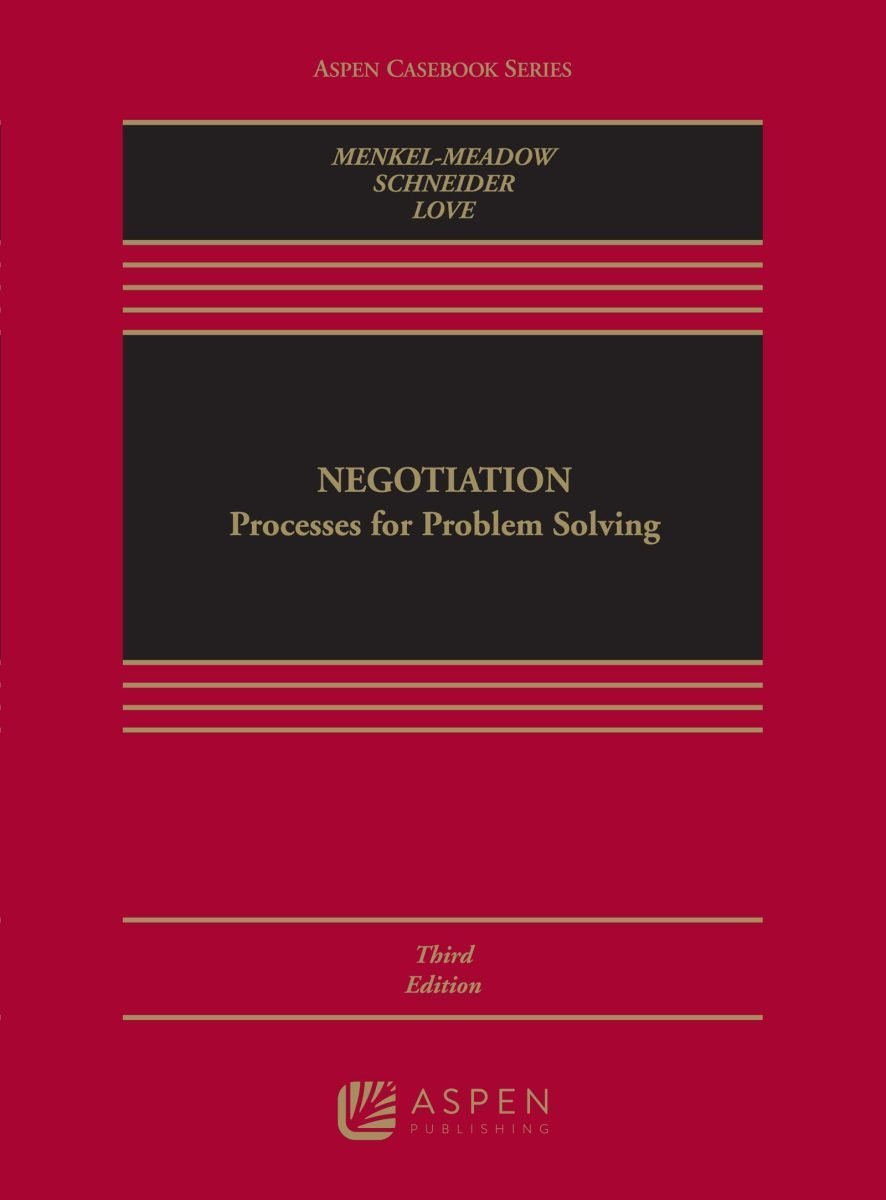
Negotiation: Processes for Problem Solving 3rd Edition by Carrie J Menkel-Meadow, ISBN-13: 978-1543801699
Original price was: $100.00.$19.99Current price is: $19.99.
Safe & secure checkout
Description
Description
Negotiation: Processes for Problem Solving 3rd Edition by Carrie J Menkel-Meadow, ISBN-13: 978-1543801699
[PDF eBook eTextbook]
- Publisher: Aspen Publishing; 3rd ed. edition (September 15, 2020)
- Language: English
- 624 pages
- ISBN-10: 1543801692
- ISBN-13: 978-1543801699
A distinguished team of leaders in the field of dispute resolution offers a thorough treatment of negotiation skills, ethics, and problem-solving techniques. Comprehensive and current, Negotiation: Processes for Problem Solving covers the theory, skills, ethical issues, and legal and policy analyses relevant to all key areas of negotiation practice. Carefully selected cases are supported by key readings, from critical articles and empirical studies to statutes and regulations. Negotiation: Processes for Problem Solving looks at the latest interdisciplinary approaches to negotiation, including new empirical studies examining on-line negotiation, social and cognitive psychology, gender, race, culture and negotiation, and multiple party negotiation. An introduction to facilitated negotiation (mediation and meeting facilitation) is also included. New research is distilled for use by law students and practicing lawyers. New and complex examples from international negotiation problems come from both private and public environments. The book also explores new forms of complex negotiation in international, multi-party and diverse settings and considers negotiators as problem-solving lawyers. The text is perfectly suited to free standing negotiation courses in American and foreign law schools. Problem boxes, set off in the book, make for easy classroom exercises and teaching.
New to the Third Edition:
- Online and other media forms of negotiation
- New articles from both research and practice books
- Shorter excerpts for distilled treatment of issues
- Comprehensive treatment of negotiation preparation, including client interviewing and counseling
- Analysis of choice of negotiation approaches to match particular contexts
Professors and students will benefit from:
- A thorough treatment of negotiation skills, ethics, and problem-solving techniques
- Theory and different frameworks for analyzing negotiation contexts
- Legal and policy analyses relevant to all key areas of negotiation practice
- Carefully selected cases and problem sets supported by key readings, from critical articles and empirical studies to statutes and regulations
- Latest interdisciplinary approaches to negotiation
- Negotiation research distilled for law students and practicing lawyers
- Deep discussion of negotiators as problem-solving lawyers
- Complex examples from international negotiation problems in both private and public environments
- New forms and facilitation of complex negotiation in international, multi-party, and diverse settings
Table of Contents:
Cover Page
Front Matter
Editorial Advisors
Title Page
Copyright Page
About Aspen Publishing
Dedication
Summary of Contents
Contents
Preface to Third Edition
Preface to Second Edition
Preface to First Edition
Acknowledgments
Part I. Concepts and Models of Negotiation
Chapter 1. Conflict Theory: Concepts of Conflict and Negotiation
A. Conflict Theory
Carrie Menkel-Meadow, Roots and Inspirations: A Brief History of the Foundations of Dispute Resolution
Carrie Menkel-Meadow, Conflict Theory
Problem 1-1
Thomas C. Schelling, The Strategy of Conflict
Mary Parker Follett, Constructive Conflict
Deborah Tannen, The Argument Culture: Moving from Debate to Dialogue
Carrie Menkel-Meadow, The Trouble with the Adversary System in a Postmodern, Multicultural World
Problem 1-2
Problem 1-3
B. Negotiation Theory
1. Concepts of Negotiation
Jonathan R. Cohen, Adversaries? Partners? How About Counterparts? On Metaphors in the Practice and Teaching of Negotiation and Dispute Resolution
Problem 1-4
Problem 1-5
Linda L. Putnam, Challenging the Assumptions of Traditional Approaches to Negotiation
Problem 1-6
Frank E.A. Sander & Jeffrey Z. Rubin, The Janus Quality of Negotiation: Dealmaking and Dispute Settlement
Michael L. Moffitt, Disputes as Opportunities to Create Value
Problem 1-7
2. Descriptions of the Negotiation Process
Gerald Williams, Legal Negotiation and Settlement
Philip H. Gulliver, Disputes and Negotiations: A Cross-Cultural Perspective
Problem 1-8
Russell Korobkin, A Positive Theory of Legal Negotiation
3. Learning How to Negotiate
Scott R. Peppet & Michael L. Moffitt, Learning How to Negotiate
Further Reading
Chapter 2. Working with Your Client: Preparing for Negotiation by Learning from and Listening to Your Client
A. Attorney-Client Issues
Robert H. Mnookin, Scott R. Peppet & Andrew S. Tulumello, Beyond Winning: Negotiating to Create Value in Deals and Disputes
Problem 2-1
Problem 2-2
Problem 2-3
Scott Peppet, Six Principles for Using Negotiating Agents to Maximum Advantage
Problem 2-4
Problem 2-5
B. Learning
Katherine R. Kruse, Beyond Cardboard Clients in Legal Ethics
Problem 2-6
Warren Lehman, The Pursuit of a Client’s Interest
David A. Lax & James K. Sebenius, Interests: The Measure of Negotiation
C. Listening
John L. Barkai, How to Develop the Skill of Active Listening
Douglas Stone, Bruce Patton & Sheila Heen, Difficult Conversations: How to Discuss What Matters Most
Problem 2-7
Guy Itzchakov & Avraham N. Kluger, Changing the Other Party’s Attitude with High Quality Listening
Problem 2-8
Further Reading
Chapter 3. Working with Your Client: Interviewing, Counseling, Communicating
A. Interviewing
Stefan H. Kreiger & Richard K. Neumann, Jr., Essential Lawyering Skills: Interviewing, Counseling, Negotiation, and Persuasive Fact Analysis
Eric E. Vogt et al., The Art of Powerful Questions: Catalyzing Insight, Innovation, and Action
Problem 3-1
Problem 3-2
B. Counseling
Stefan H. Kreiger & Richard K. Neumann, Jr., Essential Lawyering Skills: Interviewing, Counseling, Negotiation, and Persuasive Fact Analysis
Marjorie C. Aaron, Client Science: Advice for Lawyers on Counseling Clients Through Bad News and Other Legal Realities
Jean R. Sternlight & Jennifer Robbennolt, Good Lawyers Should Be Good Psychologists: Insights for Interviewing and Counseling Clients
Problem 3-3
Problem 3-4
C. Communication Modes
Andrea Kupfer Schneider & Sean A. McCarthy, Choosing Modes of Communication
Noam Ebner, Negotiating Via Email
Problem 3-5
Problem 3-6
Further Reading
Chapter 4. Preparation and Persuasion
A. Goals—Aspirations
Andrea Kupfer Schneider, Measuring Success
Problem 4-1
Jennifer Gerarda Brown, The Role of Hope in Negotiation
Problem 4-2
B. Limits—BATNA and Reservation Point
Roger Fisher, William Ury & Bruce Patton, Getting to YES: Negotiating Agreement Without Giving In
Russell Korobkin, A Positive Theory of Legal Negotiation
Problem 4-3
Jeffrey Senger, Decisionmaking Under Uncertainty
Problem 4-4
C. Criteria and Fairness
Problem 4-5
Problem 4-6
Roger Fisher, William Ury & Bruce Patton, Getting to YES: Negotiating Agreement Without Giving In
Problem 4-7
Russell Korobkin & Chris Guthrie, Psychological Barriers to Litigation Settlement: An Experimental Approach
Chris Guthrie, Principles of Influence in Negotiation
Problem 4-8
D. Talking Persuasively
Problem 4-9
Robert B. Cialdini, Influence: The Psychology of Persuasion
Douglas Stone, Bruce Patton & Sheila Heen, Difficult Conversations: How to Discuss What Matters Most
Problem 4-10
Further Reading
Chapter 5. Integrative Negotiation: Expanding the Pie and Solving the Problem
A. Theory of Integrative Negotiation
Problem 5-1
Roger Fisher, William Ury & Bruce Patton, Getting to YES: Negotiating Agreement Without Giving In
Problem 5-2
Carrie Menkel-Meadow, Toward Another View of Legal Negotiation: The Structure of Problem Solving
Problem 5-3
B. Strategy of Integrative Negotiation
David A. Lax & James K. Sebenius, The Manager as Negotiator: Bargaining for Cooperation and Competitive Gain
Problem 5-4
C. Skill Building for Creative Problem Solving
Jennifer Gerarda Brown, Creativity and Problem-Solving
Problem 5-5
Carrie Menkel-Meadow, Aha? Is Creativity Possible in Legal Problem Solving and Teachable in Legal Education?
Problem 5-6
Problem 5-7
Problem 5-8
Roger Fisher, Elizabeth Kopelman & Andrea Kupfer Schneider, Beyond Machiavelli: Tools for Coping with Conflict
Michael L. Moffitt, Disputes as Opportunities to Create Value
Further Reading
Chapter 6. Distributive Bargaining and Conflict Orientations
Howard Raiffa, The Art and Science of Negotiation
A. Adversarial Approach
1. The Theory of Adversarial Approaches
Gary Goodpaster, A Primer on Competitive Bargaining
Carrie Menkel-Meadow, Toward Another View of Legal Negotiation: The Structure of Problem Solving
2. The Strategy of Adversarial Approaches
Michael Meltsner & Philip G. Schrag, Negotiation
Robert H. Mnookin, Scott R. Peppet & Andrew S. Tulumello, Beyond Winning: Negotiating to Create Value in Deals and Disputes
Problem 6-1
Problem 6-2
3. Concerns with Adversarial Approaches
Carrie Menkel-Meadow, Toward Another View of Legal Negotiation: The Structure of Problem Solving
Problem 6-3
Andrea Kupfer Schneider, Shattering Negotiation Myths: Empirical Evidence on the Effectiveness of Negotiation Style
B. Accommodating
1. Theory and Strategies of Accommodating
Roger Fisher, William Ury & Bruce Patton, Getting to YES: Negotiating Agreement Without Giving In
Gerald R. Williams, Legal Negotiation and Settlement
Problem 6-4
2. Concerns with an Accommodating Approach
Chester L. Karrass, The Negotiating Game
Problem 6-5
Problem 6-6
C. Conflict Orientation
Kenneth Thomas, Conflict and Conflict Management
Andrea Kupfer Schneider & David Kupfer, Smart & Savvy: Negotiation Strategies in Academia
Further Reading
Chapter 7. Choosing a Negotiation Approach
Carrie Menkel-Meadow, The Morality of Compromise
Problem 7-1
A. The Prisoner’s Dilemma
Douglas R. Hofstadter, Metamagical Themas: Questing for the Essence of Mind and Pattern
Problem 7-2
Problem 7-3
Robert Axelrod, The Evolution of Cooperation
Problem 7-4
Michael L. Moffitt, Disputes as Opportunities to Create Value
Douglas R. Hofstadter, Metamagical Themas: Questing for the Essence of Mind and Pattern
Ronald J. Gilson, Value Creation by Business Lawyers: Legal Skills and Asset Pricing
Problem 7-5
Natalie Angier, Why We’re So Nice: We’re Wired to Cooperate
Problem 7-6
B. Negotiator’s Dilemma
David A. Lax & James K. Sebenius, The Manager as Negotiator: Bargaining for Cooperation and Competitive Gain
Problem 7-7
C. Choosing Among Negotiation Approaches
Carrie Menkel-Meadow, The Art and Science of Problem Solving Negotiation
Problem 7-8
Andrea Kupfer Schneider, Shattering Negotiation Myths: Empirical Evidence on the Effectiveness of Negotiation Style
Peter S. Adler, Protean Negotiation
Further Reading
Part II. Skills for Negotiation
Chapter 8. Relating to Your Counterpart: Information Exchange, Trust, Apology, Reputation, and Power
A. Information Exchange
Carrie Menkel-Meadow, Know When to Show Your Hand
Peter Reilly, Was Machiavelli Right? Lying in Negotiation and the Art of Defensive Self-Help
Problem 8-1
B. Trust
Roy J. Lewicki, Trust and Repair
Moty Cristal, Negotiating in a Low-to-No Trust Environment
C. Apology
Jennifer Gerarda Brown & Jennifer K. Robbennolt, Apology in Negotiation
D. Reputation
Catherine H. Tinsley, Jack Cambria & Andrea Kupfer Schneider, Reputation in Negotiation
Problem 8-2
E. Power
Peter T. Coleman, Power and Conflict
Problem 8-3
Robert S. Adler & Elliot M. Silverstein, When David Meets Goliath: Dealing with Power Differentials in Negotiations
Problem 8-4
Further Reading
Chapter 9. Working with Your Counterpart: Understanding and Emotions
A. Understanding Yourself
Melissa Nelken, Negotiation and Psychoanalysis: If I’d Wanted to Learn About Feelings, I Wouldn’t Have Gone to Law School
Roger Fisher & Wayne H. Davis, Six Basic Interpersonal Skills for a Negotiator’s Repertoire
Problem 9-1
Problem 9-2
B. Understanding Your Counterpart
Robert H. Mnookin, Scott R. Peppet & Andrew S. Tulumello, Beyond Winning: Negotiating to Create Value in Deals and Disputes
Problem 9-3
Roger Fisher, Elizabeth Kopelman & Andrea Kupfer Schneider, Beyond Machiavelli: Tools for Coping with Conflict
Problem 9-4
Rick Ross, The Ladder of Inference
James H. Stark & Douglas N. Frenkel, Changing Minds: The Work of Mediators and Empirical Studies of Persuasion
Andrea Kupfer Schneider, Effective Responses to Offensive Comments
Problem 9-5
C. Emotions and Mood
Daniel L. Shapiro, Emotions in Negotiation: Peril or Promise?
Melissa L. Nelken, Andrea Kupfer Schneider & Jamil Mahaud, If I Wanted to Teach About Feelings, I Wouldn’t Have Become a Law Professor
Peter Reilly, Teaching Law Students How to Feel: Using Negotiations Training to Increase Emotional Intelligence
Problem 9-6
Clark Freshman, Adele Hayes & Greg Feldman, The Lawyer-Negotiator as Mood Scientist: What We Know and Don’t Know About How Mood Relates to Successful Negotiation
Problem 9-7
D. Social Intuition
Andrea Kupfer Schneider & Noam Ebner, Social Intuition
Problem 9-8
Further Reading
Chapter 10. Recognizing and Responding to Challenges in Negotiations
A. Psychological Factors Affecting Negotiation
1. Heuristics and Biases
Russell Korobkin & Chris Guthrie, Heuristics and Biases at the Bargaining Table
2. Status Quo Barriers
Daniel Kahneman & Amos Tversky, Conflict Resolution: A Cognitive Perspective
Problem 10-1
Problem 10-2
Richard Birke, Reconciling Loss Aversion and Guilty Pleas
Andrea Kupfer Schneider and Cynthia Alkon, Bargaining in the Dark: The Need for Transparency and Data in Plea Bargaining
Problem 10-3
3. Informational Barriers
Robert H. Mnookin, Why Negotiations Fail: An Exploration of Barriers to Conflict Resolution
Max H. Bazerman & Margaret A. Neale, Negotiating Rationally
Problem 10-4
Daniel Kahneman & Amos Tversky, Conflict Resolution: A Cognitive Perspective
4. Gamesmanship Barriers
Max H. Bazerman & Margaret A. Neale, Negotiating Rationally
Lee Ross, Reactive Devaluation in Negotiation and Conflict Resolution
Problem 10-5
B. Strategies for Recognizing and Responding to Negotiation Barriers and Dilemmas
Andrea Kupfer Schneider, Effective Responses to Offensive Comments
Problem 10-6
William Ury, Getting Past No: Negotiating with Difficult People
Problem 10-7
Problem 10-8
Further Reading
Chapter 11. Dealing with Differences: Culture, Gender, Race, and Others
A. Culture
Jeffrey Z. Rubin & Frank E.A. Sander, Culture, Negotiation, and the Eye of the Beholder
Problem 11-1
Jeswald W. Salacuse, Ten Ways That Culture Affects Negotiating Style: Some Survey Results
Problem 11-2
Problem 11-3
B. Gender
Carol Gilligan, In a Different Voice: Psychological Theory and Women’s Development
Carrie Menkel-Meadow, Feminist Discourse, Moral Values and the Law—A Conversation
Problem 11-4
Problem 11-5
Andrea Kupfer Schneider, Negotiating While Female
Problem 11-6
C. Race
Ian Ayres, Further Evidence of Discrimination in New Car Negotiations and Estimates of Its Cause
Michael Z. Green, Negotiating While Black
Phyllis Beck Kritek, Negotiating at an Uneven Table: A Practical Approach to Working with Difference and Diversity
Problem 11-7
Further Reading
Part III. Law and Ethics in Negotiation
Chapter 12. Ethics in Negotiation
A. How Lawyers (Should) Behave in Negotiations
Carrie Menkel-Meadow, What’s Fair in Negotiation? What Is Ethics in Negotiation?
B. Ethical Rules and Legal Obligations
1. The Law of Misrepresentation and Fraud
Restatement (Second) of Torts §525
Restatement (Second) of Contracts §§161, 164
a. Misrepresentation
Stare v. Tate
Problem 12-1
b. Omissions
G. Richard Shell, Bargaining for Advantage: Negotiation Strategies for Reasonable People
Problem 12-2
c. Material Facts
Vulcan Metals Co. v. Simmons Manufacturing Co.
Problem 12-3
Beavers v. Lamplighters Realty
Kabatchnick v. Hanover-Elm Building Corp.
Problem 12-4
d. Recovery
Problem 12-5
2. Ethical Rules
Carrie Menkel-Meadow, Ethics, Morality and Professional Responsibility in Negotiation
Problem 12-6
G. Richard Shell, Bargaining for Advantage: Negotiation Strategies for Reasonable People
James J. White, Machiavelli and the Bar: Ethical Limitations on Lying in Negotiation
Problem 12-7
Patrick J. Schiltz, On Being a Happy, Healthy, and Ethical Member of an Unhappy, Unhealthy, and Unethical Profession
Problem 12-8
Problem 12-9
Art Hinshaw, Peter Reilly & Andrea Kupfer Schneider, Attorneys and Negotiation Ethics: A Material Misunderstanding?
Further Reading
Chapter 13. The Law of Negotiation
A. Negotiated Settlements as Contracts
Problem 13-1
B. Legal Authority to Negotiate: Lawyer-Client/Agent-Principal
Restatement (Third) of Agency §§1.01, 2.02
Model Rule of Professional Conduct 1.2
Covington v. Continental General Tire, Inc.
Problem 13-2
C. Duty to Bargain
D. Rules with Incentives to Bargain: Fees and Costs of Negotiating
Federal Rule of Civil Procedure 68
Problem 13-3
Evans v. Jeff D.
Problem 13-4
E. Multiple-Party Settlements
1. Lawyers’ Duties with Multiple Clients
Model Rule of Professional Conduct 1.8(g)
2. Class Actions
Amchem Products, Inc. v. Windsor
Problem 13-5
3. Joint and Several Liability for and Contributions to Settlements: Mary Carter Agreements
Problem 13-6
F. Confidentiality, Secrecy, and Transparency of Negotiations
Federal Rule of Evidence 408
David Luban, Settlements and the Erosion of the Public Realm
Carrie Menkel-Meadow, Public Access to Private Settlements: Conflicting Legal Policies
Problem 13-7
G. Judicial Review of Negotiated Settlements
Spaulding v. Zimmerman
Problem 13-8
H. Taxation of Negotiated Settlements and Attorneys’ Fees
Problem 13-9
Further Reading
Part IV. Complex Negotiation Processes
Chapter 14. Multiparty Negotiation
A. Multiparty Dispute Processes: How Are They Different?
1. Negotiating with More Than Two Parties: Coalitions and Groups
Carrie Menkel-Meadow, Introduction, Multi-Party Dispute Resolution, Democracy and Decision Making
Robert H. Mnookin, Strategic Barriers to Dispute Resolution: A Comparison of Bilateral and Multilateral Negotiations
Leigh L. Thompson, The Mind and Heart of the Negotiator
Problem 14-1
James K. Sebenius, Mapping Backward: Negotiating in the Right Sequence?
Problem 14-2
Cass R. Sunstein, Deliberative Trouble? Why Groups Go to Extremes
Problem 14-3
2. Organizing and Legitimizing Group Negotiations: New Processes and Deliberative Democracy
Carrie Menkel-Meadow, The Lawyer’s Role(s) in Deliberative Democracy
Carrie Menkel-Meadow, Introduction: From Legal Disputes to Conflict Resolution and Human Problem Solving
Problem 14-4
Philip J. Harter, Negotiating Regulations: A Cure for Malaise
3. Legal Issues in Use of Consensus Building and Group Negotiations
Dwight Golann & Eric E. Van Loon, Legal Issues in Consensus Building
Jeffrey R. Seul, Settling Significant Cases
Problem 14-6
Problem 14-7
B. Structures, Procedures, and Skills for Multiparty Processes and Dispute System Design
Lawrence Susskind, An Alternative to Robert’s Rules of Order for Groups, Organizations, and Ad Hoc Assemblies That Want to Operate by Consensus
Problem 14-8
Robert Dingwall & Carrie Menkel-Meadow, Negotiating Against a Script
Further Reading
Chapter 15. International Negotiation
A. Causes of International Conflict
Samuel P. Huntington, The Clash of Civilizations?
Problem 15-1
B. International Negotiation
Robert D. Putnam, Diplomacy and Domestic Politics: The Logic of Two-Level Games
Andrea Kupfer Schneider, Book Review, Getting to NAFTA: A Review of Interpreting NAFTA by Frederick W. Mayer
Problem 15-2
Robert H. Mnookin, When Not to Negotiate: A Negotiation Imperialist Reflects on Appropriate Limits
Carrie Menkel-Meadow, Compromise, Negotiation and Morality
Problem 15-3
Carrie Menkel-Meadow, Deconstructing Henry: Negotiation Lessons from Kissinger’s Career
C. Facilitated Negotiation: International Mediation
Roger Fisher, Elizabeth Kopelman & Andrea Kupfer Schneider, Beyond Machiavelli: Tools for Coping with Conflict
Problem 15-4
I. William Zartman, The Timing of Peace Initiatives: Hurting Stalemates and Ripe Moments
John Paul Lederach, Cultivating Peace: A Practitioner’s View of Deadly Conflict and Negotiation
Problem 15-5
Daniel Curran, James K. Sebenius & Michael Watkins, Two Paths to Peace: Contrasting George Mitchell in Northern Ireland with Richard Holbrooke in Bosnia-Herzegovina
Problem 15-6
Further Reading
Chapter 16. Facilitated Negotiation: Mediation
A. Introduction to Mediation
1. What Is Mediation?
2. The Advantages of Mediation
a. Settlement: Avoiding the Expense, Delay, and Risk of Adjudication
b. Participation and Self-Determination: Giving Parties Voice and Choice
c. Better Outcomes: Generating Creative Problem Solving
d. Relationship, Community, and Harmony: Building Bridges Between People
Problem 16-1
3. A History and Overview of Mediation in the United States
a. Roots
b. Labor
c. Community
d. Family
e. Civil Cases
f. Cybermediation
g. Other Arenas
4. Two Perspectives on Mediation
Carrie Menkel-Meadow, Introduction
Lon L. Fuller, Mediation—Its Forms and Functions
Problem 16-2
B. Approaches to Mediation
1. Narrow or Broad Problem Definition, Evaluative or Facilitative
Leonard L. Riskin, Mediator Orientations, Strategies and Techniques
Problem 16-3
2. Problem-Solving, Understanding-Based, or Transformative
Gary Friedman & Jack Himmelstein, The Understanding-Based Model of Mediation
Robert A. Baruch Bush & Joseph P. Folger, The Promise of Mediation
Problem 16-4
3. Trashing, Bashing, or Hashing
James J. Alfini, Trashing, Bashing, and Hashing It Out: Is This the End of “Good Mediation”?
Problem 16-5
4. Dispute Settlement or Transaction and Relationship Formation
Scott R. Peppet, Contract Formation in Imperfect Markets: Should We Use Mediators in Deals?
Problem 16-6
C. Examples of Mediations
Frank J. Scardilli, Sisters of the Precious Blood v. Bristol-Myers Co.: A Shareholder-Management Dispute
Problem 16-7
Eric Galton, Mediation of Medical Negligence Claims
Problem 16-8
Lela P. Love, Glen Cove: Mediation Achieves What Litigation Cannot
Problem 16-9
Further Reading
Table of Online Resources
Table of Rules and Statutes
Table of Cases
Collected References
Index
Andrea Kupfer Schneider is a Professor of Law and Director of the Kukin Program for Conflict Resolution at Cardozo School of Law. Professor Schneider was the previous director of the nationally ranked dispute resolution (DR) program at Marquette University Law School in Wisconsin, where she taught DR, Negotiation, Ethics and International Conflict Resolution for over two decades. In addition to overseeing the DR program, Professor Schneider was the inaugural director of the university’s Institute for Women’s Leadership.
What makes us different?
• Instant Download
• Always Competitive Pricing
• 100% Privacy
• FREE Sample Available
• 24-7 LIVE Customer Support




Reviews
There are no reviews yet.