

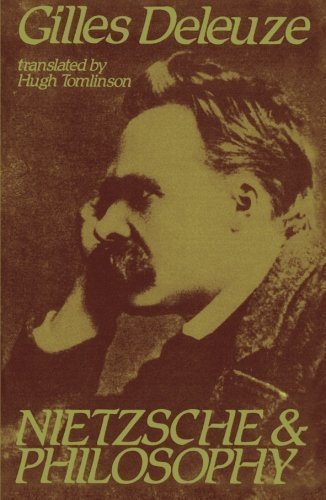
Nietzsche and Philosophy by Gilles Deleuze, ISBN-13: 978-0231056694
Original price was: $50.00.$14.99Current price is: $14.99.
Safe & secure checkout
Description
Description
Nietzsche and Philosophy by Gilles Deleuze, ISBN-13: 978-0231056694
[PDF eBook eTextbook]
- Publisher: Columbia University Press; Columbia Classics edition (April 15, 1983)
- Language: English
- 221 pages
- ISBN-10: 0231056699
- ISBN-13: 978-0231056694
Praised for its rare combination of scholarly rigor and imaginative interpretation, Nietzsche and Philosophy has long been recognized as one of the most important analyses of Nietzsche. It is also one of the best introductions to Deleuze’s thought, establishing many of his central philosophical positions.
In Nietzsche and Philosophy, Deleuze identifies and explores three crucial concepts in Nietzschean thought-multiplicity, becoming, and affirmation-and clarifies Nietzsche’s views regarding the will to power, eternal return, nihilism, and difference. For Deleuze, Nietzsche challenged conventional philosophical ideas and provided a means of escape from Hegel’s dialectical thinking, which had come to dominate French philosophy. He also offered a path toward a politics of difference. In this new edition, Michael Hardt’s foreword examines the profound influence of Deleuze’s provocative interpretations on the study of Nietzsche, which opened a whole new avenue in postwar thought.
Table of Contents:
Preface to the English Translation
Translator’s Note
Abbreviations of Nietzsche’s Works
1.The Tragic
1. The Concept of Genealogy
2. Sense
3. The Philosophy of the Will
4. Against the Dialectic
5. The Problem of Tragedy
6. Nietzsche’s Evolution
7. Dionysus and Christ
8. The Essence of the Tragic
9. The Problem of Existence
10. Existence and Innocence
11. The Dicethrow
12. Consequences for the Eternal Return
13. Nietzsche’s Symbolism
14. Nietzsche and Mallarme
15. Tragic Thought
16. The Touchstone
2.Active and Reactive
1. The Body
2. The Distinction of Forces
3. Quantity and Quality
4. Nietzsche and Science
5. First Aspect of the Eternal Return: as cosmoligical and
physical doctrine
6. What is the Will to Power?
7. Nietzsche’s Terminology
8. Origin and Inverted Image 55
9. The Problem of the Measure of Forces 58
10. Hierarchy 59
11. Will to Power and Feeling of Power 61
12. The Becoming-Reactive of Forces 64
13. Ambivalence of Sense and of Values 65
14. Second Aspect of the Eternal Return: as ethical and
selective thought 68
15. The Problem of the Eternal Return 71
3.Critique 73
1. Transformation of the Sciences of Man 73
2. The Form of the Question in Nietzsche 75
3. Nietzsche’s Method 78
4. Against his Predecessors 79
5. Against Pessimism and against Schopenhauer 82
6. Principles for the Philosophy of the Will 84
7. Plan of The Genealogy of Morals 87
8. Nietzsche and Kant from the Point of View of Principles 89
9. Realisation of Critique 91
10. Nietzsche and Kant from the Point of View of Consequences 93
11. The Concept of Truth 94
12. Knowledge, Morality and Religion 97
13. Thought and Life 100
14. Art 102
15. New Image of Thought 103
4.From Ressentiment to the Bad Conscience 111
1. Reaction and Ressentiment 111
2. Principle of Ressentiment 112
3. Typology of Ressentiment 114
4. Characteristics of Ressentiment 116
5. Is he Good? Is he Evil? 119
6. The Paralogism 122
7. Development of Ressentiment: the Judaic priest 124
8. Bad Conscience and Interiority 127
9. The Problem of Pain 129
10. Development of Bad Conscience: The Christian priest 131
11. Culture Considered from the Prehistoric Point of View 133
12. Culture Considered from the Post-Historic Point of View 135
13. Culture Considered from the Historical Point of View 138
14. Bad Conscience, Responsibility, Guilt 141
15. The Ascetic Ideal and the Essence of Religion 143
16. Triumph of Reactive Forces 145
5.The Overman: Against the Dialectic 147
1. Nihilism 147
2. Analysis of Pity 148
3. God is Dead 152
4. Against Hegelianism 156
5. The Avatars of the Dialectic 159
6. Nietzsche and the Dialectic 162
7. Theory of the Higher Man 164
8. Is Man Essentially “Reactive”? 166
9. Nihilism and Transmutation: the focal point 171
10. Affirmation and Negation 175
11. The Sense of Affirmation 180
12. The Double Affirmation: Ariadne 186
13. Dionysus and Zarathustra 189
Conclusion 195
Notes 199
Gilles Deleuze (1925–1995) was professor of philosophy at the University of Paris, Vincennes–St. Denis. He coauthored Anti-Oedipus and A Thousand Plateaus with Félix Guattari. These works, as well as Cinema 1, Cinema 2, The Fold, Proust and Signs, and others, are published in English by Univ. Of Minnesota Press.
What makes us different?
• Instant Download
• Always Competitive Pricing
• 100% Privacy
• FREE Sample Available
• 24-7 LIVE Customer Support



Reviews
There are no reviews yet.