

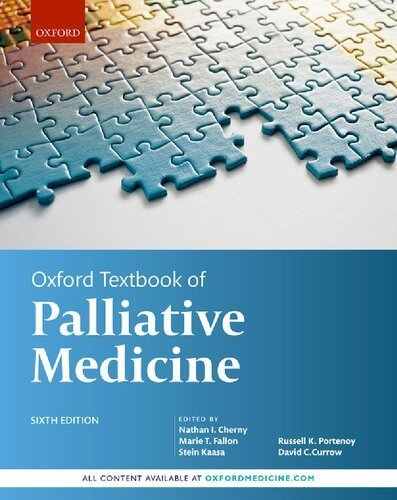
Oxford Textbook of Palliative Medicine 6th Edition by Nathan I. Cherny, ISBN-13: 978-0198821328
Original price was: $100.00.$19.99Current price is: $19.99.
Safe & secure checkout
Description
Description
Oxford Textbook of Palliative Medicine 6th Edition by Nathan I. Cherny, ISBN-13: 978-0198821328
[PDF eBook eTextbook]
- Publisher: Oxford University Press; 6th edition (November 23, 2021)
- Language: English
- 1408 pages
- ISBN-10: 0198821328
- ISBN-13: 978-0198821328
This sixth edition of the Oxford Textbook of Palliative Medicine takes us now into the third decade for this definitive award-winning textbook. It has been rigorously updated to offer a truly global perspective, highlighting the best current evidence-based practices, and collective wisdom from more than 200 experts around the world.
This leading textbook covers all the new and emerging topics, updated and restructured to reflect major developments in the increasingly widespread acceptance of palliative medicine as a fundamental public health need. The sixth edition includes new sections devoted to family and caregiver issues, cardio-respiratory symptoms and disorders, and genitourinary symptoms and disorders. In addition, the multi-disciplinary nature of palliative care is emphasized throughout the textbook, covering areas from ethical and communication issues, the treatment of symptoms, and the management of pain.
The Oxford Textbook of Palliative Medicine is a truly comprehensive text. No hospital, hospice, palliative care service, or medical library should be without this essential source of information.
This sixth edition of the Oxford Textbook of Palliative Medicine is dedicated to the memory of Professor Kenneth Fearon husband of Professor Marie Fallon and a surgeon who became a world leader in the research and management of anorexia and cachexia. He modeled a work-life balance that is so critical in our field, with devotion to both his patients and his family.
Table of Contents:
Title Page
Copyright Page
Dedication
Contents
Abbreviations
Contributors
Section 1 The worldwide status of palliative care
1.1 International progress in the development of palliative medicine
1.2 Essential medicines for palliative care
1.3 Human rights issues
1.4 Policy in palliative care
Section 2 The challenge of palliative medicine
2.1 Building definitional consensus in palliative care
2.2 Core concepts in palliative care
2.3 The epidemiology of death and symptoms: planning for population-based palliative care
2.4 Barriers to the delivery of palliative care
2.5 Ethnic and cultural aspects of palliative and end of life care
2.6 Health economics for palliative care
Section 3 Service delivery issues in palliative care
3.1 Specialist palliative care along the trajectory of illness: issues in the early integration of palliative care
3.2 Palliative care delivery models
3.3 Palliative medicine in the intensive care unit
3.4 Palliative care in the emergency department
3.5 Palliative care in the nursing home
Section 4 Healthcare professionals in palliative care
4.1 The core team and the extended team
4.2 Burnout, compassion fatigue, and moral distress in palliative care
4.3 Nursing education in palliative care
4.4 Social work in palliative care
4.5 The role of the chaplain in palliative care
4.6 Occupational therapy in palliative care
4.7 The role of the creative arts in palliative care
4.8 The role of the dietitian in palliative care
4.9 Physiotherapy in palliative care
4.10 Speech and language therapy in palliative care
4.11 Clinical psychology in palliative care
4.12 The contribution of the clinical pharmacist in palliative care
4.13 Medical rehabilitation and the palliative care patient
Section 5 Communication and palliative medicine
5.1 Communication with the patient and family
5.2 Practical considerations including difficult conversations
5.3 Advance care planning
Section 6 Family and caregiver issues
6.1 Family dynamics in the context of serious illness
6.2 Caregiver burden and distress
Section 7 Pain
7.1 Definition and assessment of chronic pain in advanced disease
7.2 Pathophysiology of pain in cancer and other terminal illnesses
7.3 Acute cancer pain syndromes
7.4 Chronic cancer pain syndromes
7.5 Principles of drug therapy
7.6 Opioid therapy: optimizing analgesic outcomes
7.7 Opioid therapy: managing risks of abuse, addiction, and diversion
7.8 Non-opioid analgesics
7.9 Adjuvant analgesics: principles of use
7.10 Interventional approaches for chronic pain
7.11 Neurostimulation in pain management
7.12 Behavioural and psychosocial interventions for pain management
7.13 Integrative medicine therapies in pain management
7.14 Management issues in bone pain
7.15 Management issues in neuropathic pain
7.16 Management issues in visceral pain
7.17 Management issues in chronic pain following cancer therapy
7.18 Paediatric pain control
Section 8 Gastrointestinal symptoms and disorders
8.1 Dysphagia, dyspepsia, and hiccups
8.2 Nausea and vomiting
8.3 Constipation and diarrhoea
8.4 Jaundice, ascites, and encephalopathy
8.5 Aetiology, classification, assessment, and treatment of the anorexia-cachexia syndrome
8.6 Parenteral nutrition
Section 9 Cardiorespiratory symptoms and disorders
9.1 Breathlessness and other respiratory symptoms in palliative care
9.2 Cough and other pulmonary symptoms
Section 10 Skin and oral symptoms and disorders
10.1 Skin problems in palliative care
10.2 Palliative wound and ostomy care
10.3 Lymphoedema and oedema of advanced disease
10.4 Oral care
Section 11 Genitourinary symptoms and disorders
11.1 Dysuria, frequency, and bladder spasm
11.2 Obstructive urinary disorders
Section 12 Constitutional symptoms and related disorders
12.1 Fatigue
12.2 Sexuality in palliative care: discussing patient sexuality and intimacy in palliative care
12.3 Sleep disorders
12.4 Assessment and management of thrombotic complications
12.5 Assessment and management of bleeding complications in the medically ill
Section 13 Psychiatric and psychological symptoms and disorders
13.1 Coping and resilience in palliative medicine
13.2 Depression, demoralization, and suicidality
13.3 Fear, anxiety, and adjustment disorder in palliative care
13.4 Delirium
13.5 Bereavement
Section 14 Palliative care in cancer
14.1 The oncologist’s role in delivering palliative care
14.2 Disease-modifying therapies in advanced cancer: medical treatment
14.3 Radiotherapy in symptom management
14.4 The role of general surgery in the palliative care of patients with cancer
14.5 Orthopaedic surgery in the palliation of cancer
14.6 Integrative oncology in palliative medicine
14.7 Interventional radiology in the palliation of cancer
14.8 Neurological problems in advanced cancer
14.9 Endocrine and metabolic complications of advanced cancer
14.10 Malignant bowel obstruction
14.11 Palliative care issues in head and neck cancers
14.12 Palliative care issues in populations with haematological malignancies
14.13 Anaemia, cytopenias, and thrombosis in palliative medicine
Section 15 Issues in populations with non-cancer illnesses
15.1 HIV/AIDS
15.2 Advanced diseases of the lung
15.3 Advanced heart disease
15.4 Dementia
15.5 Neurological disorders other than dementia
15.6 Palliative care and end-stage liver disease
15.7 End-stage kidney disease
15.8 Palliative care in catastrophic disasters and humanitarian crises
Section 16 Issues of the very young and the very old
16.1 Involving children and families when someone important is dying or has died
16.2 Care of children with advanced illness
16.3 Palliative medicine and care of the elderly
Section 17 Spiritual issues in palliative medicine
17.1 Spiritual issues in palliative medicine
17.2 Integration of spiritual care into palliative care service delivery models
Section 18 The terminal phase
18.1 Predicting survival in patients with advanced disease
18.2 Physiology of dying
18.3 Management of the actively dying patient
Section 19 Ethical issues
19.1 Practical bioethics in the care of patients with advanced illness
19.2 Requests for futile or inappropriate interventions near the end of life
19.3 Autonomy and shared decision-making in a multicultural world
19.4 Truth telling and consent
19.5 Ethics in paediatric palliative care
19.6 Ethical issues in physician aid-in-dying
19.7 Withholding and withdrawing life-sustaining treatment (including artificial nutrition and hydration)
19.8 Medical and ethical considerations in palliative sedation at the end of life
Section 20 Assessment tools and informatics
20.1 Palliative care needs assessment tools
20.2 Informatics and literature search
20.3 Validated assessment tools for psychological, spiritual, and family issues
Section 21 Teaching and training in palliative medicine
21.1 Physicians
21.2 Nurses
21.3 Teaching and training in palliative social work, chaplaincy, and pharmacy
Section 22 Research in palliative medicine
22.1 Research in palliative care
22.2 The principles of evidence-based medicine
22.3 Understanding clinical trials in palliative care research
22.4 Qualitative research
22.5 Research into psychosocial issues
22.6 Ethical issues in palliative care research
22.7 Quality of life and patient-reported outcome measures
22.8 Health services research in palliative and end of life care
22.9 Clinical audit, quality improvement, and safety in palliative medicine
Index
Nathan I. Cherny, Norman Levan Chair of Humanistic Medicine, Chief Cancer Pain and Palliative Medicine Service, Department of Oncology, Shaare Zedek Medical Center, Jerusalem, Israel,Marie T. Fallon, St Columba’s Hospice Chair of Palliative Medicine, University of Edinburgh, UK,Stein Kaasa, Oslo University Hospital, Department of Oncology; and University of Oslo, Institute of Clinical Medicine, Oslo, Norway,Russell K. Portenoy, Professor of Neurology and Family and Social Medicine, Albert Einstein College of Medicine; Executive Director, MJHS Institute for Innovation in Palliative Care; and Chief Medical Officer, MJHS Hospice and Palliative Care, New York, NY, USA,David C. Currow, University of Technology, Sydney Faculty of Health, IMPACCT (Improving Palliative, Aged and Chronic Care through Clinical Research and Translation), Sydney, NSW, Australia
Nathan I. Cherny is Norman Levan Chair of Humanistic Medicine at Shaare Zedek Medical Center and Associate Professor of Medicine at Ben Gurion University, Israel. In 2015 he was awarded the ESMO (European Society of Medical Oncology) Award for his contributions to the development of oncology in Europe, and in 2016 was the recipient of the EAPC/EJPC (European Association of Palliative Care/ European Journal of Palliative Care) Palliative Care Policy Development Award. Nathan has diverse research interests including opioid responsiveness of neuropathic pain, opioid rotation, opioid side effects and their management, cancer pain syndromes, suffering, palliative sedation, communication issues in oncology and palliative care, bioethics, and public health. He teaches in the Hebrew University Medical School and runs courses in communication and palliative medicine. Nathan has edited five books and has published over 120 peer reviewed papers and has made numerous invited lectures worldwide.
Marie T. Fallon is the St Columba’s Hospice Chair of Palliative Medicine at the University of Edinburgh, Honorary Consultant in Palliative Care at the Western General Hospital in Edinburgh and leads the Edinburgh Palliative and Supportive Care group (EpaS). Marie serves as Chief Investigator for EpaS on a large portfolio of clinical studies spanning investigator-led randomized controlled trials examining improved management of cancer-induced bone pain, neuropathic pain, and institutionalisation of pain assessment. Marie is also the lead in an international programme of RCTs in cannabinoids in cancer-related pain and has led the development of studies using fMRI in Edinburgh, UK.
Stein Kaasa is Professor of Palliative Medicine at the Institute of Cancer Research and Molecular Medicine at the Norwegian University of Science and Technology (NTNU), Norway. Stein specialises in medical oncology, radiotherapy, and palliative medicine. In 1993, he was appointed as the first professor in palliative medicine in Scandinavia and he was one of the founders of the palliative care unit in Trondheim and founder of the European Palliative Care Research Centre (PRC). He has been president of EAPC, the coordinator for a large EU-funded project, and is at present involved in several research collaborative and international partnerships on research and policy development. Stein has been an important advocate for evidence-based practice and has worked extensively to get palliative care research on the global agenda. Stein is also Director of the PRC and Chair of the European Association for Palliative Care Research Network and has published more than 450 articles and book chapters.
Russell K. Portenoy is Executive Director and Chief Medical Officer of the MJHS Institute for Innovation in Palliative Care and is Professor of Neurology and Family and Social Medicine at the Albert Einstein College of Medicine, New York. Prior to joining MJHS, he was founding Chairman of the Department of Pain Medicine and Palliative Care and the Gerald J. Friedman Chair in Pain Medicine and Palliative Care at Mount Sinai Beth Israel Medical Center. Russell is Past President of both the American Academy of Hospice and Palliative Medicine and the American Pain Society. He previously chaired the American Board of Hospice and Palliative Medicine. Russell is recipient of the Lifetime Achievement Award, the National Leadership Award of the American Academy of Hospice and Palliative Medicine, the Wilbert Fordyce Award for Lifetime Excellence in Clinical Investigation, the Distinguished Service Award from the American Pain Society, and the Founder’s Award by the American Academy of Pain Medicine.
David C. Currow is Professor of Palliative Medicine at University of Technology Sydney, the Matthew Flinders Distinguished Professor of Palliative and Supportive Care, Flinders University and Associate Director (Research) at the Wolfson Palliative Care Research Centre, University of Hull, UK. Research includes clinical trials and use of large datasets to understand better the impact of life-limiting illnesses on patients and caregivers. Research into chronic breathlessness is a particular area of interest. He is the principal investigator for the Australian national Palliative Care Clinical Studies Collaborative (PaCCSC) and is a foundation partner in the Australian national Palliative Care Outcomes Collaborative (PCOC), an initiative to improve palliative care clinical outcomes through point-of-care data collection.
What makes us different?
• Instant Download
• Always Competitive Pricing
• 100% Privacy
• FREE Sample Available
• 24-7 LIVE Customer Support


Reviews
There are no reviews yet.