

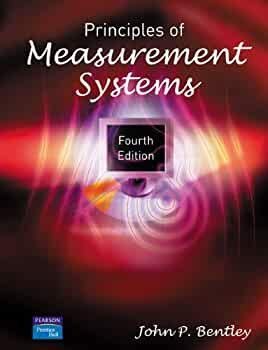
Principles of Measurement Systems 4th Edition by John P. Bentley, ISBN-13: 978-0130430281
Original price was: $50.00.$14.99Current price is: $14.99.
Safe & secure checkout
Description
Description
Principles of Measurement Systems 4th Edition by John P. Bentley, ISBN-13: 978-0130430281
[PDF eBook eTextbook]
- Publisher: Pearson Education; 4th edition (January 1, 2005)
- Language: English
- 528 pages
- ISBN-10: 0130430285
- ISBN-13: 978-0130430281
Measurement is an essential activity in every branch of technology and science and as such forms part of degree, diploma and certificate courses in engineering and applied science.
The fourth edition of this respected and successful text has been extensively extended and updated to include new developments in measurement devices and technology. It provides a coherent and integrated approach to the topic, covering main techniques and devices used, together with relevant theory and applications, for both mechanical and electronic systems.
It is divided into three parts, covering the general principles, followed by the typical elements of measurement systems, and then moving on to current and emerging specialised techniques which have important industrial applications.
Key features:
- New chapter on Intelligent Multivariable Measurement Systems
- Incorporates increased coverage on solid state sensors
- New material on structure, software and applications of microcontrollers
- A completely revised chapter on Data Presentation
- Additional problems have been added at a basic and introductory level
This book is aimed at students taking modules in measurement and instrumentation as part of degree courses in instrumentation/control, mechanical, manufacturing, electrical, electronic, chemical engineering and applied physics, as well as students on HNC/HND and foundation degree courses on measurement and instrumentation. This text is also suitable for professional and technician engineers working in the measurement and control discipline.
Table of Contents:
Preface to the fourth edition xi
Acknowledgements xiii
Part A General Principles 1
1 The General Measurement System 3
1.1 Purpose and performance of measurement systems 3
1.2 Structure of measurement systems 4
1.3 Examples of measurement systems 5
1.4 Block diagram symbols 7
2 Static Characteristics of Measurement System Elements 9
2.1 Systematic characteristics 9
2.2 Generalised model of a system element 15
2.3 Statistical characteristics 17
2.4 Identification of static characteristics – calibration 21
3 The Accuracy of Measurement Systems in the Steady State 35
3.1 Measurement error of a system of ideal elements 35
3.2 The error probability density function of a system of
non-ideal elements 36
3.3 Error reduction techniques 41
4 Dynamic Characteristics of Measurement Systems 51
4.1 Transfer function G(s) for typical system elements 51
4.2 Identification of the dynamics of an element 58
4.3 Dynamic errors in measurement systems 65
4.4 Techniques for dynamic compensation 70
5 Loading Effects and Two-port Networks 77
5.1 Electrical loading 77
5.2 Two-port networks 84
6 Signals and Noise in Measurement Systems 97
6.1 Introduction 97
6.2 Statistical representation of random signals 98
6.3 Effects of noise and interference on measurement circuits 107
6.4 Noise sources and coupling mechanisms 110
6.5 Methods of reducing effects of noise and interference 113
7 Reliability, Choice and Economics of Measurement Systems 125
7.1 Reliability of measurement systems 125
7.2 Choice of measurement systems 140
7.3 Total lifetime operating cost 141
Part B Typical Measurement System Elements 147
8 Sensing Elements 149
8.1 Resistive sensing elements 149
8.2 Capacitive sensing elements 160
8.3 Inductive sensing elements 165
8.4 Electromagnetic sensing elements 170
8.5 Thermoelectric sensing elements 172
8.6 Elastic sensing elements 177
8.7 Piezoelectric sensing elements 182
8.8 Piezoresistive sensing elements 188
8.9 Electrochemical sensing elements 190
8.10 Hall effect sensors 196
9 Signal Conditioning Elements 205
9.1 Deflection bridges 205
9.2 Amplifiers 214
9.3 A.C. carrier systems 224
9.4 Current transmitters 228
9.5 Oscillators and resonators 235
10 Signal Processing Elements and Software 247
10.1 Analogue-to-digital (A/D) conversion 247
10.2 Computer and microcontroller systems 260
10.3 Microcontroller and computer software 264
10.4 Signal processing calculations 270
11 Data Presentation Elements 285
11.1 Review and choice of data presentation elements 285
11.2 Pointer–scale indicators 287
11.3 Digital display principles 289
11.4 Light-emitting diode (LED) displays 292
11.5 Cathode ray tube (CRT) displays 295
11.6 Liquid crystal displays (LCDs) 299
11.7 Electroluminescence (EL) displays 302
11.8 Chart recorders 304
11.9 Paperless recorders 306
11.10 Laser printers 307
Part C Specialised Measurement Systems 311
12 Flow Measurement Systems 313
12.1 Essential principles of fluid mechanics 313
12.2 Measurement of velocity at a point in a fluid 319
12.3 Measurement of volume flow rate 321
12.4 Measurement of mass flow rate 339
12.5 Measurement of flow rate in difficult situations 342
13 Intrinsically Safe Measurement Systems 351
13.1 Pneumatic measurement systems 353
13.2 Intrinsically safe electronic systems 362
14 Heat Transfer Effects in Measurement Systems 367
14.1 Introduction 367
14.2 Dynamic characteristics of thermal sensors 369
14.3 Constant-temperature anemometer system for fluid
velocity measurements 374
14.4 Katharometer systems for gas thermal conductivity
and composition measurement 378
15 Optical Measurement Systems 385
15.1 Introduction: types of system 385
15.2 Sources 387
15.3 Transmission medium 393
15.4 Geometry of coupling of detector to source 398
15.5 Detectors and signal conditioning elements 403
15.6 Measurement systems 409
16 Ultrasonic Measurement Systems 427
16.1 Basic ultrasonic transmission link 427
16.2 Piezoelectric ultrasonic transmitters and receivers 428
16.3 Principles of ultrasonic transmission 436
16.4 Examples of ultrasonic measurement systems 447
17 Gas Chromatography 461
17.1 Principles and basic theory 461
17.2 Typical gas chromatograph 465
17.3 Signal processing and operations sequencing 468
18 Data Acquisition and Communication Systems 475
18.1 Time division multiplexing 476
18.2 Typical data acquisition system 477
18.3 Parallel digital signals 478
18.4 Serial digital signals 479
18.5 Error detection and correction 487
18.6 Frequency shift keying 490
18.7 Communication systems for measurement 493
19 The Intelligent Multivariable Measurement System 503
19.1 The structure of an intelligent multivariable system 503
19.2 Modelling methods for multivariable systems 507
Answers to Numerical Problems 515
Index 521
John P. Bentley is Emeritus Professor of Measurement Systems at the University of Teesside.
What makes us different?
• Instant Download
• Always Competitive Pricing
• 100% Privacy
• FREE Sample Available
• 24-7 LIVE Customer Support



Reviews
There are no reviews yet.