

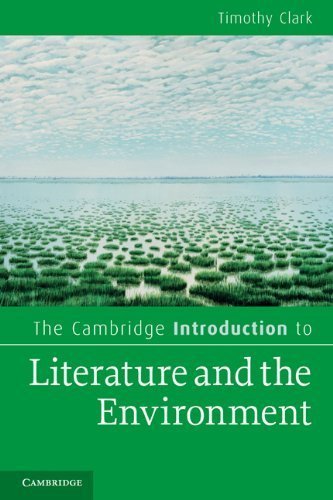
The Cambridge Introduction to Literature and the Environment by Timothy Clark, ISBN-13: 978-0521720908
Original price was: $50.00.$14.99Current price is: $14.99.
Safe & secure checkout
Description
Description
The Cambridge Introduction to Literature and the Environment by Timothy Clark, ISBN-13: 978-0521720908
[PDF eBook eTextbook]
- Publisher: Cambridge University Press; Illustrated edition (February 14, 2011)
- Language: English
- 267 pages
- ISBN-10: 0521720907
- ISBN-13: 978-0521720908
A comprehensive overview of the arguments in environmental criticism.
Environmental criticism is a relatively new discipline that brings the global problem of environmental crisis to the forefront of literary and cultural studies. This introduction defines what eco-criticism is and provides a set of conceptual tools to encourage students to look at the texts they’re reading in a new way.
The degrading environment of the planet is something that touches everyone. This 2011 book offers an introductory overview of literary and cultural criticism that concerns environmental crisis in some form. Both as a way of reading texts and as a theoretical approach to culture more generally, ‘ecocriticism’ is a varied and fast-changing set of practices which challenges inherited thinking and practice in the reading of literature and culture. This introduction defines what ecocriticism is, its methods, arguments and concepts, and will enable students to look at texts in a wholly new way. Boxed sections explain key critical terms and contemporary debates in the field with ‘hands-on’ examples and comparisons. Timothy Clark’s thoughtful approach makes this an ideal first encounter with environmental readings of literature.
Table of Contents:
Coverpage
Halftitle page
Title page
Copyright page
Dedication
Contents
List of illustrations
Preface
Acknowledgements
Introduction: the challenge
Anthropocentrism
The literary and cultural criticism
A crisis of the ‘natural’
The natures of nature
A reading
First quandary: climate change
Romantic and anti-romantic
Chapter 1 Old world romanticism
Romantic ecology
The self-evidence of the natural?
The inherent greenness of the literary?
A reading: the case of John Clare
Deep ecology
Chapter 2 New world romanticism
A reading: retrieving Walden
Wild
Chapter 3 Genre and the question of non-fiction
‘You don’t make it up’
Fiction or non-fiction?
An aesthetic consumerism
A reading: genres and the projection of animal subjectivity
Second quandary: fiction or non-fiction?
Chapter 4 Language beyond the human?
A realist poetics
The Spell of the Sensuous
Third quandary: how human-centred is given language?
Chapter 5 The inherent violence of western thought?
The archetypal eco-fascist?
The forest
Chapter 6 Post-humanism and the ‘end of nature’?
A reading: Frankenstein
Ecology without nature?
The boundaries of the political
Chapter 7 Thinking like a mountain?
The aesthetic
Fifth quandary: what isn’t an environmental issue?
Chapter 8 Environmental justice and the move ‘beyond nature writing’
Social ecology
A reading: A River Runs Through It
Environmental criticism as cultural history?
Sixth quandary: the antinomy of environmental criticism
Chapter 9 Two readings: European ecojustice
Chapter 10 Liberalism and green moralism
The limits of liberal criticism
A reading: William and Dorothy Wordsworth
Seventh quandary: the rights of the yet-to-be-born
Chapter 11 Ecofeminism
An écriture ecofemine?
‘Nature provides us with few givens’
Chapter 12 ‘Post-colonial’ ecojustice
Environmentalism as neocolonialism?
Is there yet a specifically environmental post-colonial criticism?
Colonialism as the ‘Conquest of nature’
A reading: Amitav Ghosh, The Hungry Tide
Eighth quandary: overpopulation
Chapter 13 Questions of scale: the local, the national and the global
Methodological nationalism
Literary ‘reinhabitation’?
Questions of scale
Ecopoetry
Science and the struggle for intellectual authority
Chapter 14 Science and the crisis of authority
The disenchantment thesis
Facts versus values? a reading, Annie Dillard’s ‘Galápagos’
The ‘naturalistic fallacy’
Against the facts–values split
Ecology, ‘ecology’ and literature
Hubert Zapf, Literature as Cultural Ecology
Chapter 15 Science studies
Studying science as a kind of behaviour
The Selfish Gene
Donna Haraway
Ninth quandary: constructivism and doing justice to non-human agency
Chapter 16 Evolutionary theories of literature
The Standard Social Science Model
Literature and human nature
Chapter 17 Interdisciplinarity and science: two essays on human evolution
Tenth quandary: the challenge of scientific illiteracy
The animal mirror
Chapter 18 Ethics and the non-human animal
‘Kiss goodbye to the idea that humans are qualitatively different from other animals’
Human–animal
Twelfth quandary: reading the animal as ‘construct’
Chapter 19 Anthropomorphism
An art of animal interpretation
A reading: The Wind in the Pylons
Chapter 20 The future of ecocriticism?
Final brief quandary: what place environmental criticism in the modern ‘University of Excellence’?
Notes
Further reading
Index
Timothy Clark is Professor of English at Durham University.
What makes us different?
• Instant Download
• Always Competitive Pricing
• 100% Privacy
• FREE Sample Available
• 24-7 LIVE Customer Support


Reviews
There are no reviews yet.