

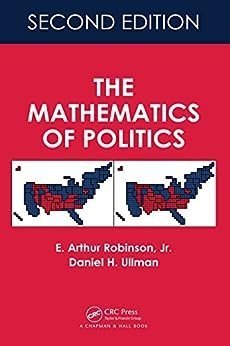
The Mathematics of Politics 2nd Edition by E. Arthur Robinson, ISBN-13: 978-1498798860
Original price was: $50.00.$14.99Current price is: $14.99.
Safe & secure checkout
Description
Description
The Mathematics of Politics 2nd Edition by E. Arthur Robinson, ISBN-13: 978-1498798860
[PDF eBook eTextbook]
- Publisher: CRC Press; 2nd edition (November 16, 2016)
- Language: English
- 478 pages
- ISBN-10: 1498798861
- ISBN-13: 978-1498798860
It is because mathematics is often misunderstood, it is commonly believed it has nothing to say about politics. The high school experience with mathematics, for so many the lasting impression of the subject, suggests that mathematics is the study of numbers, operations, formulas, and manipulations of symbols. Those believing this is the extent of mathematics might conclude mathematics has no relevance to politics. This book counters this impression. The second edition of this popular book focuses on mathematical reasoning about politics. In the search for ideal ways to make certain kinds of decisions, a lot of wasted effort can be averted if mathematics can determine that finding such an ideal is actually impossible in the first place. In the first three parts of this book, we address the following three political questions:
(1) Is there a good way to choose winners of elections?
(2) Is there a good way to apportion congressional seats?
(3) Is there a good way to make decisions in situations of conflict and uncertainty?
In the fourth and final part of this book, we examine the Electoral College system that is used in the United States to select a president. There we bring together ideas that are introduced in each of the three earlier parts of the book.
Table of Contents:
Half Title
Title Page
Copyright Page
Contents
Preface for the Reader
Preface for the Instructor
I: Voting
Introduction to Part I
1 Two Candidates
1.0 Scenario
1.1 Two-Candidate Methods
1.2 Supermajority and Status Quo
1.3 Weighted Voting and Other Methods
1.4 Criteria
1.5 May’s Theorem
1.6 Exercises and Problems
2 Social Choice Functions
2.0 Scenario
2.1 Ballots
2.2 Social Choice Functions
2.3 Alternatives to Plurality
2.4 Some Methods on the Edge
2.5 Exercises and Problems
3 Criteria for Social Choice
3.0 Scenario
3.1 Weakness and Strength
3.2 Some Familiar Criteria
3.3 Some New Criteria
3.4 Exercises and Problems
4 Which Methods Are Good?
4.0 Scenario
4.1 Methods and Criteria
4.2 Proofs and Counterexamples
4.3 Summarizing the Results
4.4 Exercises and Problems
5 Arrow’s Theorem
5.0 Scenario
5.1 The Condorcet Paradox
5.2 Statement of the Result
5.3 Decisiveness
5.4 Proving the Theorem
5.5 Exercises and Problems
6 Variations on the Theme
6.0 Scenario
6.1 Inputs and Outputs
6.2 Vote-for-One Ballots
6.3 Approval Ballots
6.4 Mixed Approval/Preference Ballots
6.5 Cumulative Voting
6.6 Condorcet Methods
6.7 Social Ranking Functions
6.8 Preference Ballots with Ties
6.9 Exercises and Problems
Notes on Part I
II: Apportionment
Introduction to Part II
7 Hamilton’s Method
7.0 Scenario
7.1 The Apportionment Problem
7.2 Some Basic Notions
7.3 A Sensible Approach
7.4 The Paradoxes
7.5 Exercises and Problems
8 Divisor Methods
8.0 Scenario
8.1 Jefferson’s Method
8.2 Critical Divisors
8.3 Assessing Jefferson’s Method
8.4 Other Divisor Methods
8.5 Rounding Functions
8.6 Exercises and Problems
9 Criteria and Impossibility
9.0 Scenario
9.1 Basic Criteria
9.2 Quota Rules and the Alabama Paradox
9.3 Population Monotonicity
9.4 Relative Population Monotonicity
9.5 The New States Paradox
9.6 Impossibility
9.7 Exercises and Problems
10 The Method of Balinski and Young
10.0 Scenario
10.1 Tracking Critical Divisors
10.2 Satisfying the Quota Rule
10.3 Exercises and Problems
11 Deciding among Divisor Methods
11.0 Scenario
11.1 Why Webster Is Best
11.2 Why Dean Is Best
11.3 Why Hill Is Best
11.4 Exercises and Problems
12 History of Apportionment in the United States
12.0 Scenario
12.1 The Fight for Representation
12.2 Summary
12.3 Exercises and Problems
Notes on Part II
III: Conflict
Introduction to Part III
13 Strategies and Outcomes
13.0 Scenario
13.1 Zero-Sum Games
13.2 The Naive and Prudent Strategies
13.3 Best Response and Saddle Points
13.4 Dominance
13.5 Exercises and Problems
14 Chance and Expectation
14.0 Scenario
14.1 Probability Theory
14.2 All Outcomes Are Not Created Equal
14.3 Random Variables and Expected Value
14.4 Mixed Strategies and Their Payoffs
14.5 Independent Processes
14.6 Expected Payoffs for Mixed Strategies
14.7 Exercises and Problems
15 Solving Zero-Sum Games
15.0 Scenario
15.1 The Best Response
15.2 Prudent Mixed Strategies
15.3 An Application to Counterterrorism
15.4 The 2-by-2 Case
15.5 Exercises and Problems
16 Conflict and Cooperation
16.0 Scenario
16.1 Bimatrix Games
16.2 Guarantees, Saddle Points, and All That Jazz
16.3 Common Interests
16.4 Some Famous Games
16.5 Exercises and Problems
17 Nash Equilibria
17.0 Scenario
17.1 Mixed Strategies
17.2 The 2-by-2 Case
17.3 The Proof of Nash’s Theorem
17.4 Exercises and Problems
18 The Prisoner’s Dilemma
18.0 Scenario
18.1 Criteria and Impossibility
18.2 Omnipresence of the Prisoner’s Dilemma
18.3 Repeated Play
18.4 Irresolvability
18.5 Exercises and Problems
Notes on Part III
IV: The Electoral College
Introduction to Part IV
19 Weighted Voting
19.0 Scenario
19.1 Weighted Voting Methods
19.2 Non-Weighted Voting Methods
19.3 Voting Power
19.4 Power of the States
19.5 Exercises and Problems
20 Whose Advantage?
20.0 Scenario
20.1 Violations of Criteria
20.2 People Power
20.3 Interpretation
20.4 Exercises and Problems
Notes on Part IV
Solutions to Odd-Numbered Exercises and Problems
Bibliography
Index
E. Arthur Robinson, Jr. is a Professor of Mathematics a Professor of mathematics at the George Washington University, where he has been since 1987. Like his coauthor, he was once the department chair. His current research is primarily in the area of dynamical systems theory and discrete geometry. Besides teaching the Mathematics and Politics course, he is teaching a course on Math and Art for the students of the Corcoran School the Arts and Design.
Daniel H. Ullman is a Professor of Mathematics at the George Washington University, where he has been since 1985. He holds a Ph.D. from Berkeley and an A.B. from Harvard. He served as chair of the department of mathematics at GW from 2001 to 2006, as the American Mathematical Society Congressional Fellow from 2006 to 2007, and as Associate Dean for Undergraduate Studies in the arts and sciences at GW from 2011 to 2015. He has been an Associate Editor of the American Mathematical Monthly since 1997. He enjoys playing piano, soccer, and Scrabble.
What makes us different?
• Instant Download
• Always Competitive Pricing
• 100% Privacy
• FREE Sample Available
• 24-7 LIVE Customer Support
Reviews
There are no reviews yet.