

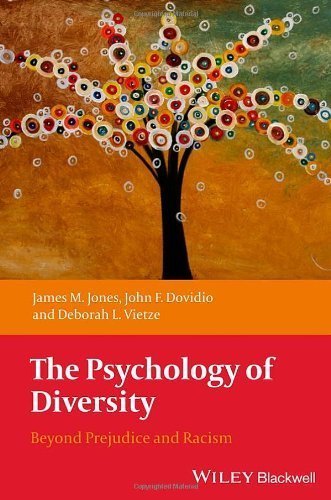
The Psychology of Diversity: Beyond Prejudice and Racism by James M. Jones, ISBN-13: 978-1405162142
Original price was: $50.00.$14.99Current price is: $14.99.
Safe & secure checkout
Description
Description
The Psychology of Diversity: Beyond Prejudice and Racism by James M. Jones, ISBN-13: 978-1405162142
[PDF eBook eTextbook]
- Publisher: Wiley-Blackwell; 1st edition (September 10, 2013)
- Language: English
- 432 pages
- ISBN-10: 9781405162142
- ISBN-13: 978-1405162142
The Psychology of Diversity presents a captivating social-psychological study of diversity, the obstacles confronting it, and the benefits it provides.
The text considers how historical, political, economic, and societal factors shape the way people think about and respond to diversity. The approach is multi-level, with coverage of diverse topics including everything from the neuroscience of prejudice to the politics of diversity.
While the book devotes considerable attention to the problems of prejudice and discrimination toward diverse groups, chapters also describe proven techniques for improving intergroup relations in a variety of ways. It illuminates how well-intentioned efforts to control bias can backfire personally, interpersonally, and socially. Although challenges to diversity are significant, emphasis is placed on why and how an understanding of diversity can offer unique insights and opportunities, and prepare people better for a global society.
- Goes beyond prejudice and discrimination to discuss the personal and social implications of diversity for both majority and minority group members
- Considers how historical, political, economic, and societal factors shape the way people think about and respond to diversity
- Explains why discrimination leads to bias at all levels in society – interpersonal, institutional, cultural, and social
- Describes proven techniques for improving intergroup relations
- Examines the brain’s impact on bias in clear terms for students with little or no background in neuroscience
- Includes helpful study tools throughout the text as well as an online instructor’s manual
Unlike older and traditional texts on prejudice and intergroup relations, The Psychology of Diversity offers a sharply different approach one much better suited to the complexities and subtleties of present-day intergroup phenomena. It is also authoritative as one would expect from a text written by leading social psychological experts in the field.
Table of Contents:
Front Matter
Praise for The Psychology of Diversity
About the Authors
Brief Contents
Contents
Preface
What Is This Book About and Who Is It For?
What Is the Purpose of this Book?
What Is Special About this Book?
Dedication
Acknowledgments
Part One Framing Diversity
Chapter 1 Psychology of Diversity: Challenges and Benefits
Introduction
The Goals of this Book
What is Diversity About?
A Taxonomy of Diversity
When Diversity Does Not Add Up To Equality
Perspectives on Diversity
Behavioral Science and Diversity
Diversity within Diversity
The Diversity Divide: Benefits versus Challenges
What Are the Benefits of Diversity?
Adaptability, flexibility, and creativity
Better citizenship
Full use of human capital
It is morally correct and consistent with the value of equality
What Are the Challenges of Diversity?
The practice of diversity can be exclusionary
Which differences matter?
Diversity undermines meritocracy
Focusing on differences may promote conflict
Organization of this Book
Summary
Questions for Thinking and Knowing
Key Terms
References
Chapter 2 Central Concepts in the Psychology of Diversity
Introduction
Understanding Diversity
What is the Psychology of Diversity?
What’s in a Social Group Label?
Social Biases: Stereotypes, Prejudice, and Discrimination
What Are They Like? Stereotypes
Figure 2.1. The Content of Stereotypes Is Determined by the Perceived Competence and Warmth of the Group. HC, High Competence; HW, High Warmth; LC, Low Competence; LW, Low Warmth. From “The BIAS Map: Behaviors from Intergroup Affect and Stereotypes,” by A. J. C. Cuddy, S. T. Fiske, & P. Glick, 2007, Journal of Personality and Social Psychology, 92, pp. 631–648.
How Do I Feel About Them? Prejudice
Figure 2.2. Components of Prejudice: Cognitive, Affective, and Behavioral.
How Do I Treat Them? Discrimination and Fairness
Box 2.1. Ricci v. DeStefano
Biases Below and Above the Surface
The Structure of Social Bias
Racism: A Case Example of Social Bias
The Different Layers of Social Bias
Individual bias
Institutional bias
Cultural bias
Research Methods for the Study of Social Bias
The Scientific Enterprise
Figure 2.3. Steps in the Scientific Method: (a) Initial Observation, (b) Theory Development, (c) Derivation of Hypothesis, and (d) Systematic Observation.
Making Sense of the World Scientifically: Theories and Research Methods
Testing Our Ideas: Research Designs
Making Meaning from Research: Measures and Analysis of Data
Summary
Questions for Thinking and Knowing
Key Terms
References
Chapter 3 Historical Perspectives on Diversity in the United States
Introduction
Push–Pull: Dynamics of Diversity
Immigration, Importation, and Citizenship
U.S. Population Growth is Fueled by Immigration
Figure 3.1. Immigrants to the United States as a Percentage of Population Change 1820–2010. From U.S. Census, 2010.
Figure 3.2. Immigrants Being Processed at Ellis Island, 1904. Library of Congress: Digital ID (b&w film copy neg.) cph 3a17784, http://hdl.loc.gov/loc.pnp/cph.3a17784. Reproduction Number: LC-USZ62-15539 (b&w film copy neg.). Repository: Library of Congress Prints and Photographs Division Washington, DC 20540, USA. http://www.loc.gov/pictures/item/97501095/resource/
Who Are Citizens of the United States?
Immigration and Ethnic Diversity
Benevolent Sexism as Legal Argument
Cultural Conditioning of American Indians
Negative Responses to Diversity
Immigration Policy
Table 3.1. Immigration Quota by Country, 1924 Immigration Act
Figure 3.3. Foreign-born Percentage of the U.S. Population From 1850 to 2010. From U.S. Census, 2010.
Civil Rights
Diversity and Civil Rights
Figure 3.4. Brown Sisters Walk to School, Topeka, Kansas, 1953. © Carl Iwasaki/Time Life Pictures/Getty Images.
Expanding Diversity and Inclusion in U.S. Society Through Civil Rights
Figure 3.5. Percentage of Total Immigrants to the United States From Europe, Asia, South and Central America, and the Caribbean, 1820–2000. From Bureau of Census, 2010, http://www.census.gov/prod/2010pubs/acsbr09-15.pdf
Affirmative Action as a Diversity Approach
Box 3.1. The Case of Lynn, Massachusetts
A Nation of Minorities
Figure 3.6. Percentage U.S. Population by Race/Ethnicity 2000–2010. From Bureau of Census, 2010.
Figure 3.7. The United States Becomes a “Nation of Minorities” 2042. From Bureau of Census, 2010.
Challenges of Diversity
Individual Rights, Diversity, and Prejudice Collide
Diversity and Difference
Majority and Minority
Summary
Questions for Thinking and Knowing
Key Terms
References
Part Two Psychological Processes
Chapter 4 Personality and Individual Differences: How Different Types of People Respond to Diversity in Different Ways
Introduction
Origins of Prejudice: Allport’s Lens Model
Figure 4.1. Allport’s Lens Model of Prejudice: Sources of Prejudice. Adapted from The Nature of Prejudice, by G. W. Allport, 1954, Reading, MA: Addison-Wesley.
Personality and Prejudice
The Abnormality of Prejudice: The Psychodynamic Model
Psychodynamic Theory and Prejudice
Prejudice against Difference: The Authoritarian Personality
The Legacy of Authoritarianism: Contemporary Measures
The right-wing authoritarianism scale
Table 4.1. Sample Items from the Right-wing Authoritarianism Scale
Need for closure
Other personality measures
The Normality of Prejudice
Conformity and Norms
Social Dominance
Table 4.2. Sample Items: Social Dominance Orientation
Figure 4.2. Attitudes Toward Immigrants Are Less Favorable When Canadians Perceive They Are in Competition With Them or When Participants Are High in Social Dominance Orientation. Adapted from “The Immigration Dilemma: The Role of Perceived Group Competition, Ethnic Prejudice, and National Identity,” by V. M. Esses, J. F. Dovidio, L. M. Jackson, & T. M. Armstrong, 2001, Journal of Social Issues, 57, pp. 389–412.
Box 4.1. Personality, Social Groups, and the Capacity for Evil
Authoritarianism and SDO: Sometimes a Lethal Combination
Religion and Prejudice
Politics and Prejudice
Individual Differences in Blatant and Subtle Prejudice
Summary
Questions for Thinking and Knowing
Key Terms
References
Chapter 5 Social Cognition and Categorization: Distinguishing “Us” from “Them”
Introduction
We Are Social Animals
How We Think About People: Social Cognition
Acquiring Information: Attributions
The fundamental attribution error
A just world
Threat and attributions
Figure 5.1. The 9/11 Terrorist Attacks on the World Trade Center Has Had a Lasting Psychological Impact on Americans. © Ken Tannenbaum/Shutterstock.com.
Integrating Information: Cognitive Consistency
Illusory correlations
Confirmatory biases
Behavioral consistency and bias
Self-fulfilling prophecies
How We Think About Groups: Social Categorization and Group Membership
Who Is “In” and Who Is “Out”? Social Categorization
Figure 5.2. The Experimenter Is Testing How Rhesus Macaques Respond to Faces of In-group and Out-group Members (a) and Novel Objects Associated With In-group and Out-group Members (b). From “The Evolution of Intergroup Bias: Perceptions and Attitudes in Rhesus Macaques,” by N. Mahajan, M. A. Martinez, N. L. Gutierrez, G. Diesendruck, M. R. Banaji, & L. R. Santos, 2011, Journal of Personality and Social Psychology, 100, pp. 387–405.
Box 5.1. What Did You Say? The Impact of Accents
Thinking Differently About Us and Them
What Can We Do? Reducing Bias and Embracing Diversity
“Me” and “You” Instead of “Us” and “Them”: Decategorization
Figure 5.3. Participants Show Particularly Low Levels of Bias Toward Islamic Fundamentalists Whom They See As Typical of the Group who Disclose Personal Information to Them. Adapted from “The Out-group Must Not Be So Bad After All: The Effects of Disclosure, Typicality, and Salience on Intergroup Bias,” by N. Ensari, & N. Miller, 2002, Journal of Personality and Social Psychology, 83, pp. 313–329 (Figure 1).
Playing on the Same Team: Recategorization
Implications and Applications of Category-based Models for Reducing Bias
Figure 5.4. Recategorization Reduces Bias by Increasing the Attractiveness of Out-group Members, Whereas Decategorization Reduces Bias by Decreasing the Attractiveness of In-group Members. Adapted from “Reduction of Intergroup Bias: The Benefits of Recategorization,” by S. L. Gaertner, J. A. Mann, A. J. Murrell, & J. F. Dovidio, 1989, Journal of Personality and Social Psychology, 57, pp. 239–249.
Summary
Questions for Thinking and Knowing
Key Terms
References
Chapter 6 Social Identity, Roles, and Relations: Motivational Influences in Responses to Diversity
Introduction
Feeling Good about Us: Social Identity
Who Am I? Personal and Social Identity
Figure 6.1. A Measure of Identity Fusion: In (E), the Self and the Group Are Completely Fused. Reprinted from Figure 1 of “Identity Fusion and Self-Sacrifice: Arousal as a Catalyst of Pro-Group Fighting, Dying, and Helping Behavior,” by W. B. Swann Jr, A. Gómez, C. Huici, J. F. Morales, & J. G. Hixon, November 2010, Journal of Personality and Social Psychology, 99, pp. 824–841, doi: 10.1037/a0020014.
Many Me’s: Multiple Identities
My Group Is Better than Yours: Creating Positive Identity
Feeling superior to other groups
Feeling connected to your group
Becoming an extremist
Responding to diversity
Confusing “What Is” with “What Should Be”: Social Roles and System Justification
Blaming the Victim: Attributions to Groups
Judging Who People Are by What Jobs They Do: Social Roles
Figure 6.2. Eagly and Wood’s Social Role Theory. Adapted from “Social Role Theory,” by A. H. Eagly & W. Wood, 2011. In A. W. Kruglanski, E. T. Higgins, & P. A. M. Van Lange (Eds.), Handbook of Theories in Social Psychology (Vol. 2, pp. 458–476). Thousand Oaks, CA: Sage.
Maintaining the Status Quo: System Justification
Box 6.1. Feeling Like a Body: Objectification
Figure 6.3. Advertisers Frequently Objectify Women to Market Even Products That Have Little Directly to do With Sex. Magazine Advertisement for Kahlua. Image Courtesy of The Advertising Archives.
Slipping into the Darkness: Groups in Competition
“You Dirty Rattler”: Conflict between Groups
Threatening What We Have and What We Are: Realistic and Symbolic Conflict
What Can We Do? Changing How Groups Relate
Achieving More Together Than Alone: Superordinate Goals
Putting the Pieces Together: Jigsaw Classroom
You Complete Me (Us): Mutual Intergroup Differentiation
Which Approach Is Best?
Summary
Questions for Thinking and Knowing
Key Terms
References
Chapter 7 Is Bias in the Brain?
Introduction
What’s Under the Hood? The Organization of the Human Brain
How We Know How the Brain Functions
Figure 7.1. In fMRI Images, Different Colors Show Increases or Decreases in Activity in Areas of the Brain When People Are Exposed to People of Different Groups or Perform Different Tasks. © Miguel Medina/AFP/Getty Images.
Brain Structure and Function
Figure 7.2. Three Basic Areas of the Human Brain Are the Hindbrain, Midbrain, and Forebrain.
Brain Structure, Diversity, and Intergroup Relations
Warning! Difference Ahead!
Box 7.1. Shooter Bias
Figure 7.3. White Participants Are Quicker to Recognize Crime-related Objects After Seeing a Black Than a White Face. Reprinted from “Seeing Black: Race, Crime, and Visual Processing,” by J. L. Eberhardt, P. A. Goff, V. J. Purdie, & P. G. Davies, 2004, Journal of Personality and Social Psychology, 87, pp. 876–893.
Who Are You? Race and Face Perception
Figure 7.4. People Draw Radically Different Pictures of a Racially Ambiguous Person (top image) After They Label the Person as Black or White (bottom pictures). Reprinted from “Believing is Seeing: The Effects of Racial Labels and Implicit Beliefs on Face Perception,” by J. L. Eberhardt, N. Dasgupta, & T. I. Banaszynski, 2003, Personality and Social Psychology Bulletin, 29, pp. 360–370.
Brain Function and Intergroup Bias
Explicit and Implicit Bias
Table 7.1. Average Acceptability of Prejudice Toward 105 Target Groups
Figure 7.5. White 6-Year-Olds, 10-Year-Olds, and Adults Show Implicit Biases Against Blacks to the Same Degree, But Explicit Bias Decreases for Older Age Groups. Adapted from “The Development of Implicit Attitudes: Evidence of Race Evaluations from Ages 6, 10, and Adulthood,” by A. S. Baron, & M. R. Banaji, 2006, Psychological Science, 17, pp. 53–58.
Contemporary Prejudice
Symbolic racism
Aversive racism
Figure 7.6. Across Three Different Time Periods (1989, 1999, and 2005) White Participants Do Not Discriminate Against Black Job Applicants Relative to White Job Applicants When the Person Candidate Is Strongly Qualified for the Position. However, They Do Discriminate, and to the Same Degree Across 16 years, When the Candidate Has Only Moderate Credentials and the Decision is More Complicated. Adapted from “New Directions in Aversive Racism Research: Persistence and Pervasiveness,” by J. F. Dovidio & S. L. Gaertner, 2007. In C. W. Esqueda (Ed.), Nebraska Symposium on Motivation: Motivational Aspects of Prejudice and Racism (pp. 43–67). New York: Springer.
Contemporary racism and implicit attitudes
What Can We Do? Addressing Implicit Bias
Acknowledging Implicit Bias
Controlling Implicit Bias Through Unconscious Goals
Summary
Questions for Thinking and Knowing
Key Terms
References
Chapter 8 Coping and Adapting to Stigma and Difference
Introduction
Social Stigma and Cultural Difference
The Social “Stain” of Stigma
How Social and Cultural Difference Divides Us
Racial Socialization and Acculturation
Preparing Children for a Racialized Society: Racial Socialization
Adapting to a Different Culture: Acculturation
Table 8.1. Profiles of Acculturation Orientations
Stresses Caused by Stigma and Difference
Perceiving Discrimination Is Bad for Your Health
Stereotype Threat Is “in the Air”
Figure 8.1. Correlation Between Self-esteem and GPA for Black and White Eighth and Tenth Grade Boys and Girls: Evidence of Disidentification. From “Academics, Self-esteem, and Race: A Look at the Underlying Assumptions of the Disidentification Hypothesis,” by J. W. Osborne, 1995, Personality and Social Psychology Bulletin, 21, pp. 449–455.
Figure 8.2. Generational Differences in Stereotype Threat among West Indian Immigrants. From “Becoming American: Stereotype Threat Effects in Afro-Caribbean Immigrant Groups,” by K. Deaux, N. Bikmen, A. Gilkes, A. Ventuneac, Y. Joseph, Y. A. Payne, & C. M. Steele, 2007, Social Psychology Quarterly, 70, pp. 384–404 (Figure 1 as published).
Figure 8.3. Stereotype Boost for Asian and Stereotype Threat for Latino Students on Math Performance. Adapted from “Stereotype Boost and Stereotype Threat Effects: The Moderating Role of Ethnic Identification,” by B. E. Armenta, 2010, Cultural Diversity and Ethnic Minority Psychology, 16, pp. 94–98 (Figure 1 as published).
Box 8.1. Communicating Across the Racial Divide
Coping with Perceived Discrimination
How Group Membership Influences the Ways We Cope with Discrimination
Rejection identification
Rejection sensitivity to race
The universal context of racism
The Ways We Cope with Discrimination Individually
Psychological disengagement
Attributional ambiguity and explaining outcomes
Worldview verification
Collective Identities
How We Relate to Our Racial Group: Racial Identity
Black identity
Racial identity and collective threat
White identity
How We Relate to Our Ethnic Group: Ethnic Identity
Multigroup Ethnic Identity Measure
Table 8.2. The Multigroup Ethnic Identity Measure
Multiracial identity
Summary
Questions for Thinking and Knowing
Key Terms
References
Chapter 9 Intergroup Interactions Pitfalls and Promises
Introduction
Psychological Challenges of Intergroup Interaction
Preparing for the “First Date”
Where Do We Go From Here? Experiences in Intergroup Interactions
Figure 9.1. Blacks Are Most Cognitively Depleted After Exposure to Ambiguous Bias; Whites Are Most Depleted After Exposure to Blatant Bias. Reprinted from “Cognitive Costs to Exposure to Racial Prejudice,” by J. Salvatore, & J. N. Shelton, 2007, Psychological Science, 18, pp. 810–815.
You (Can) Complete Me
Figure 9.2. Whites Show More Ingratiation Behaviors Than Self-presentational Behaviors in Interracial Interactions, Whereas Blacks Show More Self-presentational Behaviors Than Ingratiation Behaviors. From “To Be Liked Versus Respected: Divergent Goals in Interracial Interaction,” by H. B. Bergsieker, J. N. Shelton, & J. A. Richeson, 2010, Journal of Personality and Social Psychology, 99, pp. 248–264.
Under the Radar? Implicit Bias and Intergroup Interaction
Figure 9.3. Whites Higher in Implicit Prejudice See Hostility (Depicted by Images on the Left) Longer on the Faces of Blacks than of Whites. Reprinted from “Facing Prejudice: Implicit Prejudice and the Perception of Facial Threat,” by K. Hugenberg, & G. V. Bodenhausen, 2003, Psychological Science, 14, pp. 640–643.
Box 9.1. Health Disparities and Implicit Bias in Healthcare
Some Conclusions About Intergroup Interactions
The Promise of Positive Intergroup Interaction
How Does Contact Work?
Friends of My Friends
Just Imagine!
Summary
Questions for Thinking and Knowing
Key Terms
References
Part Three Culture, Power, and Institutions
Chapter 10 Cultural Diversity Preferences, Meaning, and Difference
Introduction
Figure 10.1. Elizabeth Eckford Withstands Taunts and Insults to Attend a White-only Central High School in Little Rock, Arkansas, September 4, 1957. © Bettmann/CORBIS.
What Is Culture?
Figure 10.2. Changes in Self-esteem Among American Indian High-School Students When Exposed to Indian Mascots, Cartoons, and Negative Stereotypes. From “Of Warrior Chiefs and Indian Princesses: The Psychological Consequences of American Indian Mascots,” by S. A. Fryberg, H. R. Markus, D. Oyserman, & J. M. Stone, 2008, Basic and Applied Social Psychology, 30, pp. 208–218 (adapted from Figure 1).
When Do Race Preferences Begin?
Figure 10.3. Experimental Sample of a Male White, Middle Eastern, African, and Asian face. From “Three-month-olds, But Not Newborns, Prefer Own-race Faces,” by D. J. Kelly, P. C. Quinn, A. M. Slater, K. Lee, A. Gibson, M. Smith, L. Ge, & O. Pascalis, 2005, Developmental Science, 8, pp. 31–36 (Figure 1).
Why Do Early Preferences Matter?
How Do Cultures Differ?
What We Value
Table 10.1. Ten Values Expressed Across Cultures
How We See Power
Procedural justice
Voice in decision-making
Closeness
Interethnic relations
How We Relate to Others: Individualism–Collectivism
Table 10.2. Individualistic and Collectivist Cultures
How We Perceive “the Other”: Enemyship
How We Understand Time: Psychological Time
How We Create Meaning: Religion
Box 10.1. Being Muslim in America
Figure 10.4. Imane Boudlal Speaks During a News Conference at the ACLU With Her Lawyer Mark Rosenbaum, Chief Counsel ACLU in Los Angeles on Monday, August 13, 2012. Boudlal, a Former Disneyland Employee Who Says She Was forbidden to Wear a Muslim Head Scarf at Work Plans to Sue the Walt Disney Company for Discrimination. © AP Photo/Nick Ut.
Cultural Diversity
Table 10.3. United States Population by Race/Ethnicity, Sex, and Age, 2010
Figure 10.5. Percent Total U.S. Worker Income Earned by Lowest to Highest Income Groups, 1979–2007. Source: Congressional Budget Office (2011). Retrieved from http://www.cbo.gov/sites/default/files/cbofiles/attachments/10-25-HouseholdIncome.pdf
Table 10.4. Change in Household Wealth by Socioeconomic Status, 1962 to 2009
Now We See It, Now We Don’t: Perspectives on Cultural Diversity
Multicultural
Identity safety
Culture Wars Promote Conflict and Contest
Figure 10.6. White and Black Perceptions of Bias against Whites and Blacks (10, very much; 1, not at all). From “Whites See Racism as a Zero-sum game That They Are Now Losing,” by M. I. Norton & S. R. Sommers, 2011, Perspectives on Psychological Science, 6, pp. 215–218 (Figure 1).
Culture Peace Promotes Representation and Belonging
Diversity benefits all
Social belonging enhances achievement
Preventing Bias and Favoritism
Circles of inclusion for children
What parents can do
You don’t have to be prejudiced!
Breaking the prejudice habit
Summary
Questions for Thinking and Knowing
Key Terms
References
Chapter 11 Social Roles and Power in a Diverse Society
Introduction
Power Matters
Figure 11.1. Skyboxes Denote Special Privilege and Are Often Inaccessible to Persons With Disabilities. © Adam Haylock/iStockPhoto.
Box 11.1. Becoming Aware of Power and Privilege
Who’s Got the Power? Power Dynamics and Diversity
It’s Just Natural: The Power of Social Roles and Social Groups
Who’s at the Top and Why? CEOs, Lawyers, and Janitors
Table 11.1. Occupations and Wage Estimates for Employment in the United States
Multiple Me: Intersectionality and Power
Table 11.2. Implications of Three Questions on Multiple Group Identity for Each Stage of the Research Process
A Social Hierarchy: What’s Diversity Got To Do With It?
Psychological Sources of Power
Figure 11.2. Lack of Economic and Social Power Can Lead to Political Protest as Disenfranchised People Seek Political Power. Egyptian Women Gather in Cairo’s Tahrir Square, the Epicenter of the Popular Revolt That Drove Veteran Strongman Hosni Mubarak From Power on February 12, 2011. © Mohammed Abed/AFP/Getty Images.
Skin Color, Social Role, and Power
Social Dominance: My Group Versus Your Group
Social Class as a Source of Power
Pathways to Fairness: Reducing Bias in Power Dynamics
You Have More Power—What Should I Expect?
Maybe the Status Quo Has Too Much Power
Stereotyping: Can It Help and Not Harm?
Summary
Questions for Thinking and Knowing
Key Terms
References
Chapter 12 The Challenge of Diversity for Institutions
Introduction
Portraits of Institutional Bias
Texaco: Recognizing Diversity Bias and Doing Something About It
An All-Girls Math Class: Educational Bias on Purpose
Figure 12.1. Girls Enjoy Excelling in Math as Well as Boys When Given Opportunities to Do So. © lightpoet/Shutterstock.com.
How Institutional Bias Operates
The Origins of Institutional Bias: A Case Example
Types of Institutional Bias
Box 12.1. At a Slaughter House, Some Things Never Die: Tar Heel, North Carolina
Most Bias is Standard-of-Practice Bias
Can Affirmative Action Address Institutional Bias?
Home Ownership and Mortgage Lending
Table 12.1. Homeownership Rates (%) by Race and Ethnicity of Householder 2009–2011
Race, Ethnicity, Gender, and Age Disparities in Unemployment
Table 12.2. Unemployment Rates (%) Among Age, Gender, Race, Ethnicity Diversity Groups for First Quarter of 2012
The Criminal Justice System and Ethnicity Disparities
Ethnic Disparities in Capital Punishment
Healthcare, Marriage, and Environmental Safety
What Makes Institutional Bias so Challenging?
Figure 12.2. The Theoretical Barriers to Diversity. From “Workplace Diversity and Public Policy: Challenges and Opportunities for Psychology,” by R. E. Fassinger, 2008, American Psychologist, 63, pp. 252–268.
Effects of Institutional Bias Are Far-reaching
Emotions May Run High
Maybe Poverty Leads to Institutional Bias
Preventing Institutional Bias is a Challenge
Valuing Diversity
Diversity Training in Higher Education
Summary
Questions for Thinking and Knowing
Key Terms
References
Chapter 13 The Psychology of Diversity Principles and Prospects
Introduction
Diversity Is Diverse
Diversity When It Is All Good
Diversity Is Normal
Doing Diversity Is Hard
Diversity Demands Change
Diversity Sometimes Stands Opposed to Fairness
Bias Has Deep-seated Psychological Roots and Consequences
Diversity Complicates Interpersonal and Intergroup Interactions
Principles of Diversity: What Have We Learned in This Book?
Bias Against Diversity Is Not Inevitable
Diversity Presents Opportunities to Learn
Interaction Improves Attitudes Toward Other Groups
Diverse Contexts Promote Flexibility, Adaptability, and Creativity
Personal Motivation Can Limit or Prevent Bias
Belief That Biases Can Be Changed Increases People’s Interest in Diversity
People Can Learn To Be Unprejudiced
Approach and Avoidance Motivations Are Keys to Diversity Dynamics
Individual Ideology and Values Determine Diversity Attitudes, Support, and Actions
People Are Resilient in the Face of Discrimination
Respect Promotes Diversity Among Members of Racial and Ethnic Minority Groups
Support for Diversity Is Greatest When it Includes Your Group
Programs to Promote Intergroup Relations Can Succeed
Trust Is Crucial for Dealing with Difference and Change
Organizational Values, Goals, and Practices Determine the Success of Diversity Efforts
Conclusion
Questions for Thinking and Knowing
Key Terms
References
Back Matter
Glossary
Index
James M. Jones is Professor of Psychology and Director of the Center for the Study for Diversity at the University of Delaware.
John F. Dovidio is Professor of Psychology at Yale University.
Deborah L. Vietze is Professor of Psychology at the City University of New York.
What makes us different?
• Instant Download
• Always Competitive Pricing
• 100% Privacy
• FREE Sample Available
• 24-7 LIVE Customer Support




Reviews
There are no reviews yet.