

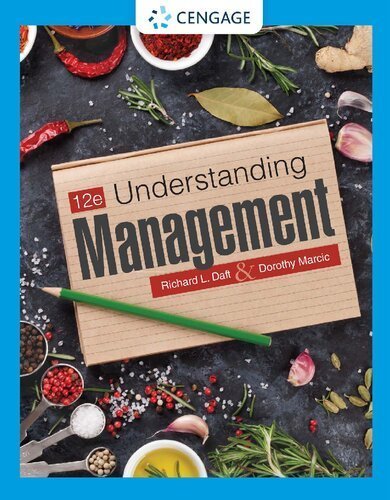
Understanding Management 12th Edition by Richard L. Daft, ISBN-13: 978-0357716892
Original price was: $50.00.$14.99Current price is: $14.99.
Safe & secure checkout
Description
Description
Understanding Management 12th Edition by Richard L. Daft, ISBN-13: 978-0357716892
[PDF eBook eTextbook] – Available Instantly
- Publisher: Cengage Learning; 12th edition (March 31, 2022)
- Language: English
- 616 pages
- ISBN-10: 0357716892
- ISBN-13: 978-0357716892
Examine the issues impacting today’s current, fast-shifting business environment and the necessary management solutions with Daft/Marcic’s market-leading UNDERSTANDING MANAGEMENT, 12E. Even before recent upheavals, managers and organizations were buffeted by competitive, social, technological and economic change. Today’s managers face more demands than ever before in the scramble to cope with the turbulence of recent events, ethical and social turmoil, mobile commerce, economic instability, globalization, cybersecurity threats, increasing government regulation and global supply chains. This edition helps you, as a future manager, find leading-edge solutions to significant problems — whether everyday challenges or once-in-a-lifetime crises. Content extends beyond techniques traditionally taught to encompass a breadth of management skills and new competencies you can use to face today’s issues.
Table of Contents:
Cover Page
Title Page
Copyright Page
Dedication
Preface
About the Authors
Acknowledgments
Part 1. Introduction to Management
Chapter 1. Leading Edge Management
1-1. Management Competencies for Today’s World
1-1a. Leading-Edge Management Competencies
1-1b. The Trend Toward Bosslessness
1-2. The Basic Functions of Management
1-3. Organizational Performance
1-4. Management Skills
1-4a. When Skills Fail
1-5. Challenges Facing New Managers
1-6. What Is a Manager’s Job Really Like?
1-6a. Manager Activities
1-6b. Manager Roles
1-7. Managing in Nonprofit Organizations
1-8. The Historical Struggle: The Things of Production Versus the Humanity of Production
1-9. Classical Perspective
1-9a. Scientific Management
1-9b. Bureaucratic Organizations
1-9c. Administrative Principles
1-9d. Management Science
1-10. Humanistic Perspective
1-10a. Early Advocates
1-10b. Human Relations Movement
1-10c. Human Resources Perspective
1-10d. Behavioral Sciences Approach
1-11. Management Thinking into the Future
1-11a. Managing the New Technology-Driven Workplace
1-11b. Managing the New People-Driven Workplace
1-12. The Historical Struggle: Is Artificial Intelligence the Answer?
Chapter 1 Discussion Questions
Chapter 1 Practice Your Skills: Self-Learning
Chapter 1 Practice Your Skills: Group Learning
Chapter 1 Practice Your Skills: Action Learning
Chapter 1 Practice Your Skills: Ethical Dilemma
Chapter 1 Practice Your Skills: Case for Critical Analysis
Part 2. The Environment of Management
Chapter 2. The Environment and Corporate Culture
2-1. The External Environment
2-1a. Task Environment
2-1b. General Environment
2-2. The Organization–Environment Relationship
2-2a. Environmental Uncertainty
2-2b. Adapting to the Environment
2-3. The Internal Environment: Corporate Culture
2-3a. What Is Culture?
2-3b. Toxic Cultures
2-4. Interpreting/Shaping Culture
2-4a. Symbols
2-4b. Stories
2-4c. Heroes
2-4d. Slogans
2-4e. Ceremonies
2-5. Types of Culture
2-5a. Adaptability Culture
2-5b. Achievement Culture
2-5c. Involvement Culture
2-5d. Consistency Culture
2-6. Shaping Corporate Culture for Innovative Response
2-6a. Managing the High-Performance Culture
2-6b. Cultural Leadership
Chapter 2 Discussion Questions
Chapter 2 Practice Your Skills: Self-Learning
Chapter 2 Practice Your Skills: Group Learning
Chapter 2 Practice Your Skills: Action Learning
Chapter 2 Practice Your Skills: Ethical Dilemma
Chapter 2 Practice Your Skills: Case for Critical Analysis
Chapter 3. Managing in a Global Environment
3-1. A Borderless World
3-1a. Globalization
3-1b. Developing a Global Mind-Set
3-2. The Changing International Landscape
3-2a. China Rising
3-2b. India, the Service Giant
3-3. Multinational Corporations
3-3a. Characteristics of Multinational Corporations
3-3b. Serving the Bottom of the Pyramid
3-4. Getting Started Internationally
3-5. Legal–Political Challenges
3-6. Sociocultural Challenges
3-6a. Social Values
3-6b. Communication Challenges
3-7. International Trade Alliances
3-7a. GATT and the WTO
3-7b. European Union
3-7c. United States–Mexico–Canada Agreement
Chapter 3 Discussion Questions
Chapter 3 Practice Your Skills: Self-Learning
Chapter 3 Practice Your Skills: Group Learning
Chapter 3 Practice Your Skills: Action Learning
Chapter 3 Practice Your Skills: Ethical Dilemma
Chapter 3 Practice Your Skills: Case for Critical Analysis
Chapter 4. Managing Ethics and Social Responsibility
4-1. What Is Managerial Ethics?
4-1a. Ethical Management Today
4-1b. The Business Case for Ethics and Social Responsibility
4-1c. Ethical Dilemmas: What Would You Do?
4-2. Frameworks for Ethical Decision Making
4-2a. Utilitarian Approach
4-2b. Individualism Approach
4-2c. Moral-Rights Approach
4-2d. Justice Approach
4-2e. Practical Approach
4-3. The Individual Manager and Ethical Choices
4-3a. The Stages of Moral Development
4-3b. Giving Versus Taking
4-4. What Is Corporate Social Responsibility?
4-4a. A New Purpose for the Corporation: Stakeholders
4-4b. The Green Movement
4-4c. Sustainability and the Triple Bottom Line
4-4d. Benefit Corporations and B Lab
4-5. Managing Company Ethics and Social Responsibility
4-5a. Values-Oriented Approach
4-5b. Structure-Oriented Approach
4-5c. Whistle-Blowing
Chapter 4 Discussion Questions
Chapter 4 Practice Your Skills: Self-Learning
Chapter 4 Practice Your Skills: Group Learning
Chapter 4 Practice Your Skills: Action Learning
Chapter 4 Practice Your Skills: Ethical Dilemma
Chapter 4 Practice Your Skills: Case for Critical Analysis
Part 3. Planning
Chapter 5. Planning and Goal Setting
5-1. Goal Setting and Planning Overview
5-1a. Levels of Goals and Plans
5-1b. The Organizational Planning Process
5-2. Goal Setting in Organizations
5-2a. Organizational Mission
5-2b. Managing Goal Conflict
5-3. Performance Management
5-3a. Criteria for Effective Goals
5-3b. Management by Objectives
5-4. Benefits and Limitations of Planning
5-5. Planning for a Turbulent Environment
5-5a. Contingency Planning
5-5b. Scenario Building
5-5c. Setting Stretch Goals for Excellence
5-5d. Crisis Planning
5-6. Thinking Strategically
5-7. What Is Strategic Management?
5-7a. Purpose of Strategy
5-7b. SWOT Analysis
5-8. Formulating Corporate-Level Strategy
5-8a. Portfolio Strategy
5-8b. The BCG Matrix
5-8c. Diversification Strategy
5-9. Formulating Business-Level Strategy
5-9a. Porter’s Five Competitive Forces
5-9b. Porter’s Competitive Strategies
Chapter 5 Discussion Questions
Chapter 5 Practice Your Skills: Self-Learning
Chapter 5 Practice Your Skills: Group Learning
Chapter 5 Practice Your Skills: Action Learning
Chapter 5 Practice Your Skills: Ethical Dilemma
Chapter 5 Practice Your Skills: Case for Critical Analysis
Chapter 6. Managerial Decision Making
6-1. Types of Decisions and Problems
6-1a. Programmed and Nonprogrammed Decisions
6-1b. Facing Uncertainty and Ambiguity
6-2. Decision-Making Models
6-2a. The Ideal, Rational Model
6-2b. How Managers Make Decisions
6-2c. The Political Model
6-3. Decision-Making Steps
6-3a. Recognition of Decision Requirement
6-3b. Diagnosis and Analysis of Causes
6-3c. Development of Alternatives
6-3d. Selection of the Desired Alternative
6-3e. Implementation of the Chosen Alternative
6-3f. Evaluation and Feedback
6-4. Personal Decision Framework
6-5. Why Do Managers Make Bad Decisions?
6-6. Innovative Decision Making
6-6a. Start with Brainstorming
6-6b. Use Hard Evidence
6-6c. Engage in Rigorous Debate
6-6d. Avoid Groupthink
6-6e. Know when to Bail
6-6f. Do a Premortem and Postmortem
Chapter 6 Discussion Questions
Chapter 6 Practice Your Skills: Self-Learning
Chapter 6 Practice Your Skills: Group Learning
Chapter 6 Practice Your Skills: Action Learning
Chapter 6 Practice Your Skills: Ethical Dilemma
Chapter 6 Practice Your Skills: Case for Critical Analysis
Chapter 6 Answers to Questions in “Sunny Side Up”
Part 4. Organizing
Chapter 7. Designing Organization Structure
7-1. Organizing the Vertical Structure
7-1a. Division of Labor
7-1b. Chain of Command
7-1c. Span of Management
7-1d. Centralization and Decentralization
7-2. Departmentalization
7-2a. Vertical Functional Approach
7-2b. Divisional Approach
7-2c. Matrix Approach
7-2d. Team Approach
7-2e. Virtual Network Approach
7-3. Organizing for Horizontal Coordination
7-3a. The Need for Coordination
7-3b. Task Forces, Teams, and Project Management
7-3c. Relational Coordination
7-4. Factors Shaping Structure
7-4a. Structure Follows Strategy
7-4b. Structure Fits the Workflow Technology
Chapter 7 Discussion Questions
Chapter 7 Practice Your Skills: Self-Learning
Chapter 7 Practice Your Skills: Group Learning
Chapter 7 Practice Your Skills: Action Learning
Chapter 7 Practice Your Skills: Ethical Dilemma
Chapter 7 Apply Your Skills: Case for Critical Analysis
Chapter 8. Managing Innovation and Change
8-1. Innovation and the Changing Workplace
8-1a. Disruptive Innovation
8-1b. The Ambidextrous Approach
8-2. Changing Things: New Products and Processes
8-2a. Discovery
8-2b. Horizontal Collaboration and Open Innovation
8-2c. Innovation Roles and Structures
8-3. Changing People and Culture
8-3a. Training and Development
8-3b. Organization Development
8-4. Implementing Innovation and Change
8-4a. Implementation Stages
8-4b. Why Do People Resist Change?
8-4c. Create a Sense of Urgency
8-4d. Use Implementation Tactics
Chapter 8 Discussion Questions
Chapter 8 Practice Your Skills: Self-Learning
Chapter 8 Practice Your Skills: Group Learning
Chapter 8. Practice Your Skills: Action Learning
Chapter 8 Practice Your Skills: Ethical Dilemma
Chapter 8 From Group Learning: New Rental Negotiation
Chapter 8 Practice Your Skills: Case for Critical Analysis
Chapter 8 From Group Learning: New Rental Negotiation
Chapter 9. Managing Human Talent and Diversity/Inclusion
9-1. The Strategic Role of HRM Is to Drive Organizational Performance
9-1a. The Strategic Approach
9-1b. Building Human Capital to Drive Performance
9-2. The Impact of Federal Legislation on HRM
9-3. The Changing Social Contract
9-3a. The End of Lifetime Employment
9-3b. Leading-Edge HR Practices
9-4. Finding the Right People
9-4a. Human Resource Planning
9-4b. Recruiting
9-4c. Selecting
9-5. Developing Talent
9-5a. Training and Development
9-5b. Performance Management
9-6. Maintaining an Effective Workforce
9-6a. Rewards
9-6b. Benefits
9-6c. Termination
9-7. Diversity in the Workplace
9-7a. Diversity Challenges in Corporate America
9-7b. Diversity Challenges on a Global Scale
9-8. Managing Diversity
9-8a. Diversity and Inclusion
9-8b. Diversity of Thought
9-8c. Dividends of Workplace Diversity
9-9. Factors Shaping Personal Bias
9-9a. Unconscious Bias
9-9b. Workplace Prejudice, Discrimination, and Stereotypes
9-9c. Challenges Underrepresented Employees Face
9-10. Factors Affecting Women’s Careers
9-10a. The First Rung of the Management Ladder
9-10b. The Female Advantage
9-11. Diversity Initiatives and Programs
9-11a. Enhance Structures and Policies
9-11b. Expand Recruitment Efforts
9-11c. Establish Sponsor Relationships
9-11d. Provide Personal Coaching and Feedback
9-11e. Increase Awareness of Sexual Harassment
9-11f. Encourage Employee Resource Groups
Chapter 9 Discussion Questions
Chapter 9 Practice Your Skills: Self-Learning
Chapter 9 Practice Your Skills: Group Learning
Chapter 9 Action Learning
Chapter 9 Practice Your Skills: Ethical Dilemma
Chapter 9 Practice Your Skills: Case for Critical Analysis
Part 5. Leading
Chapter 10. Understanding Individual Behavior
10-1. Understanding Yourself and Others
10-1a. The Value and Difficulty of Knowing Yourself
10-1b. Enhance Your Self-Awareness
10-2. Job Satisfaction and Trust
10-2a. Job Satisfaction
10-2b. Trust
10-3. Perception and Attributions
10-3a. Perception and Perceptual Distortions
10-3b. Attributions: A Special Case of Perception
10-4. Personality and Behavior
10-4a. Personality Traits
10-4b. Attitudes and Behaviors Influenced by Personality
10-4c. Problem-Solving Styles and the Myers-Briggs Type Indicator™
10-5. Emotions
10-5a. Positive and Negative Emotions
10-5b. Emotional Intelligence
10-6. Managing Yourself
10-6a. Basic Principles for Self-Management
10-6b. A Step-By-Step Guide for Managing Your Time
10-7. Stress and Resilience
10-7a. Challenge Stress and Threat Stress
10-7b. Causes of Work Stress
10-7c. Enhancing Resilience
Chapter 10 Discussion Questions
Chapter 10 Practice Your Skills: Self-Learning
Chapter 10 Practice Your Skills: Group Learning
Chapter 10 Practice Your Skills: Action Learning
Chapter 10 Practice Your Skills: Ethical Dilemma
Chapter 10 Practice Your Skills: Case for Critical Analysis
Reference
Chapter 11. Leadership
11-1. The Nature of Leadership
11-2. From Management to Leadership
11-3. Contemporary Leadership
11-3a. Level 5 Leadership
11-3b. Servant Leadership
11-3c. Authentic Leadership
11-3d. Interactive Leadership
11-4. Leadership Traits
11-5. Behavioral and Contingency Approaches
11-5a. Behavioral: Task versus People
11-5b. Contingency: The Situational Model of Leadership
11-5c. Contingency: Fiedler’s Contingency Theory
11-5d. Contingency: Situational Substitutes for Leadership
11-6. Charismatic and Transformational Leadership
11-6a. Charismatic Leadership
11-6b. Transformational versus Transactional Leadership
11-7. Followership
11-8. Power and Influence
11-8a. Hard Position Power
11-8b. Personal Soft Power
11-8c. Other Sources of Power
11-8d. Interpersonal Influence Tactics
Chapter 11 Discussion Questions
Chapter 11 Practice Your Skills: Self-Learning
Chapter 11 Practice Your Skills: Group Learning
Chapter 11 Practice Your Skills: Action Learning
Chapter 11 Practice Your Skills: Ethical Dilemma
Chapter 11 Practice Your Skills: Case for Critical Analysis
Chapter 12. Motivating Employees
12-1. Individual Needs and Motivation
12-2. Intrinsic and Extrinsic Rewards
12-3. Content Perspectives on Motivation
12-3a. The Hierarchy of Needs
12-3b. ERG Theory
12-3c. A Two-Factor Approach to Motivation
12-3d. Acquired Needs
12-4. Process Perspectives on Motivation
12-4a. Goal Setting
12-4b. Equity Theory
12-4c. Expectancy Theory
12-5. Reinforcement Perspective on Motivation
12-5a. Direct Reinforcement
12-5b. Social Learning Theory
12-6. Job Design for Motivation
12-6a. Job Enrichment
12-6b. Job Characteristics Model
12-7. Leading-Edge Ideas for Motivating
12-7a. Empowering People to Meet Higher Needs
12-7b. Giving Meaning to Work Through Engagement
Chapter 12 Discussion Questions
Chapter 12 Practice Your Skills: Self-Learning
Chapter 12 Practice Your Skills: Group Learning
Chapter 12 Practice Your Skills: Action Learning
Chapter 12 Practice Your Skills: Ethical Dilemma
Chapter 12 Practice Your Skills: Case for Critical Analysis
Chapter 13. Managing Communication
13-1. Communication Is the Manager’s Job
13-1a. What Is Communication?
13-1b. A Model of Communication
13-2. Purpose-Driven Communication
13-2a. Communicating Vision, Mission, and Values
13-2b. Communicating to Persuade and Influence Others
13-3. Communicating Effectively with Others
13-3a. Open Communication Climate
13-3b. Communication Channels
13-3c. Giving Feedback
13-3d. Communicating with Candor
13-3e. Asking Questions
13-3f. Listening
13-3g. Nonverbal Communication
13-4. Workplace Communication
13-4a. Social Media
13-4b. Personal Communication Networks
13-4c. Formal Communication Channels
Chapter 13 Discussion Questions
Chapter 13 Practice Your Skills: Self-Learning
Chapter 13 Practice Your Skills: Group Learning
Chapter 13 Practice Your Skills: Action Learning
Chapter 13 Practice Your Skills: Ethical Dilemma
Chapter 13 Practice Your Skills: Case for Critical Analysis
Chapter 14. Leading Teams
14-1. The Value of Teams
14-1a. What is a Team?
14-1b. Contributions of Teams
14-1c. Types of Teams
14-2. Virtual Teams
14-3. The Personal Dilemma of Teamwork
14-4. Model of Team Effectiveness
14-5. Team Demographics
14-5a. Size
14-5b. Diversity
14-5c. Member Roles
14-6. Team Processes
14-6a. Stages of Team Development
14-6b. Building a Cohesive Team
14-6c. Establishing Team Norms
14-7. Managing Team Conflict
14-7a. Types of Conflict
14-7b. Balancing Conflict and Cooperation
14-7c. Causes of Conflict
14-7d. Styles of Handling Conflict
14-7e. Ways of Expressing Conflict
14-7f. Negotiation
Chapter 14 Discussion Questions
Chapter 14 Practice Your Skills: Self-Learning
Chapter 14 Practice Your Skills: Group Learning
Chapter 14 Practice Your Skills: Action Learning
Chapter 14 Practice Your Skills: Ethical Dilemma
Chapter 14 Practice Your Skills: Case for Critical Analysis
Part 6. Controlling
Chapter 15. Managing Quality and Performance
15-1. The Meaning of Control
15-2. Feedback Control Model
15-2a. Four Steps of Feedback Control
15-2b. The Balanced Scorecard
15-3. The Changing Philosophy of Control
15-3a. Hierarchical Versus Decentralized Approaches
15-3b. The Dilemma of Algorithmic Control
15-4. Total Quality Management
15-4a. TQM Techniques
15-4b. TQM Success Factors
15-5. Budgetary Control
15-5a. Expense Budget
15-5b. Revenue Budget
15-5c. Cash Budget
15-5d. Capital Budget
15-5e. Zero-Based Budget
15-6. Financial Control
15-6a. Financial Statements
15-6b. Financial Analysis: Interpreting the Numbers
Chapter 15 Discussion Questions
Chapter 15 Practice Your Skills: Self-Learning
Chapter 15 Practice Your Skills: Group Learning
Chapter 15 Practice Your Skills: Action Learning
Chapter 15 Practice Your Skills: Ethical Dilemma
Chapter 15 Practice Your Skills: Case for Critical Analysis
Richard L. Daft, Ph.D., is the Brownlee O. Currey, Jr., Professor of Management in the Owen Graduate School of Management at Vanderbilt University where he specializes in the study of leadership and organization theory. Dr. Daft is a Fellow of the Academy of Management and has served on the editorial boards of Academy of Management Journal, Administrative Science Quarterly, and Journal of Management Education. He was the Associate Editor-in-Chief of Organization Science and associate editor of Administrative Science Quarterly.
Dr. Daft has authored or co-authored 13 books, including ORGANIZATION THEORY AND DESIGN and MANAGEMENT. He has also authored dozens of scholarly articles, papers, and chapters and has published in the Administrative Science Quarterly, Academy of Management Journal, Academy of Management Review, Strategic Management Journal, Journal of Management, Accounting Organizations and Society, Management Science, MIS Quarterly, and Organizational Behavior Teaching Review. Dr. Daft has received several government research grants in organization design, organizational innovation and change, strategy implementation, and organizational information processing.
An active teacher and respected consultant, Dr. Daft has served as associate dean and helped manage a start-up enterprise. He has been involved in management development and consulting for numerous organizations, including the American Banking Association, AutoZone, Nortel, Bridgestone, TVA, Pratt & Whitney, Allstate Insurance, State Farm Insurance, the United States Air Force, the U.S. Army, J. C. Bradford & Co., Central Parking System, USAA, Bristol-Myers Squibb, Vanderbilt University Medical Center and many others.
What makes us different?
• Instant Download
• Always Competitive Pricing
• 100% Privacy
• FREE Sample Available
• 24-7 LIVE Customer Support


Reviews
There are no reviews yet.